.png) 3 hours ago
4
3 hours ago
4
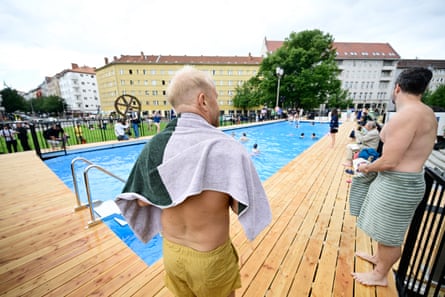
It was meant to be an outing for Black children in Berlin and their families, offering them an exclusive afternoon at an outdoor pool set up by a local theatre.
But the plans, slated for earlier this month, had to be scrapped after they were seized on by rightwing and conservative voices to whip up outrage, leaving organisers fending off racist emails and threats.
Berlin’s Volksbühne theatre said it had extended the invitation in hopes of dismantling some of the barriers that would normally keep these children away from the pool. While other groups had similarly been invited to use pool exclusively without incident, the idea of Black children enjoying a private afternoon at a public pool proved to be controversial among some.
“Berlin is a livable, diverse, colourful and free city. So why do we need safe spaces?” a local Christian Democrat politician, Aileen Weibeler, said on social media, while the far-right Alternative für Deutschland co-leader Alice Weidel described it as “an apartheid” in which “white people are temporarily denied access”.
It was the latest in a long list of incidents linking swimming pools to racism. Across North America and Europe swimming pools have often acted as a flashpoint for wider racial tensions and exclusions.
Earlier this summer, an open-air swimming lake in the eastern German city of Halle made headlines after it refused entry to bathers who did not speak German. In the Netherlands, the Institute for Human Rights recently ruled against a pool after it was found to have singled out a Black child for an identity check.
The list of incidents spans decades. In 2013, the Swiss town of Bremgarten moved to restrict asylum seekers’ access to swimming pools. In Bulgaria, Roma have sounded the alarm about being discriminated against at public pools, while in 2022, a swimming pool in Romania was fined just over €2,000 (£1,716) for barring entry to Romani children.
Some of the association between racism and pools most likely comes down to the intimacy of these spaces, said Jeff Wiltse, the author of Contested Waters: A Social History of Swimming Pools in America. “They’re visually, physically, and socially intimate spaces, and I think that continues to pique people’s social anxieties,” he said.
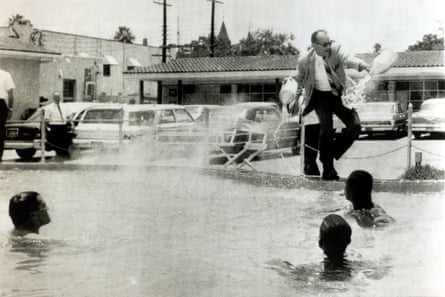
Wiltse has long studied pools in the US, recasting them as sites that reflect the wider tensions in society at any given time, from James Brock in 1964 pouring hydrochloric acid into a whites-only pool where Black men were swimming, to the Texas police officer who in 2015 pinned an unarmed Black teenager to the ground and drew his gun as he sought to break up a pool party.
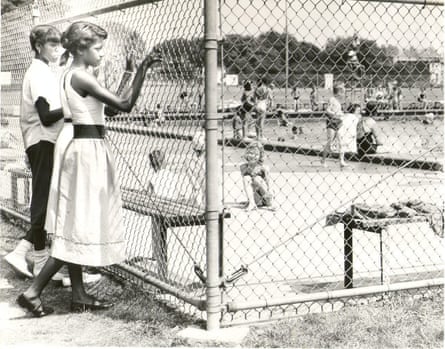
In the US, “throughout much of the 20th century, swimming pools were homogenous spaces”, he said. “There was explicit racial segregation of public pools.”
In the late 1940s, as public swimming pools in the US began to be racially desegregated, private pools began to spring up, particularly in suburbs that were almost exclusively white. Many people came to see swimming pools as “a certain type of social space in which the people there are all socially similar”, said Wiltse, who advocates tackling the issue by increasing public investment in community pools that could bring together people from different ethnic and racial backgrounds.
The racialised history of pools – and its continued legacy today – has helped to give rise to a stark racial divide when it comes to swimming ability, one that has had deadly consequences. In the US, the fatal-drowning rate of Black and African American children is three times higher than that of white children.
The statistics are even worse in England, where recent data found that children from Black, Asian and minority ethnic communities are 3.5 times more likely to drown than their white counterparts. Recent figures from Sport England suggest that 95% of Black adults and 80% of Black children do not swim at all.
In 2022, Katrice Rodrigues set out to change this with the launch of Unity Swimming, a community organisation that runs weekly classes aimed at Black and Asian communities.
“People get angry at that, saying: ‘How can it be inclusive if it’s just for Black and Asian communities?’” said Rodrigues, who is also a keynote speaker on diversity in aquatics. “My thing is that we’re making the whole of swimming more inclusive by creating these safe little spaces, which lead to more people swimming, and that makes swimming, as a whole, more inclusive.”
The success of the programme has relied on Rodrigues and her team confronting the wide range of cultural barriers that keep minorities out of the pool, from having parents who are terrified of water to concerns over feeling out of place, dressing modestly or protecting Black hair.
Other barriers have proven more enduring. “There’s a myth and a stereotype that Black people can’t float and can’t swim,” she said. “It’s not true, but I’ve had to correct two experienced swim teachers who thought that was a thing.”
As summers become hotter across the globe, sending more people into rivers, lakes and pools in search of respite, the imperative has grown to ensure that as many people as possible know how to swim, said Rodrigues.
“It’s the only sport that’s going to save lives,” she said. “If you’ve got water safety knowledge, you could help save someone else’s life as well as your own and your whole family. So this has a knock-off effect on families, on communities and for generations.”