.png) 3 months ago
56
3 months ago
56
Car journeys with my partner are a nightmare. He’s an ex-DJ so he likes to crank the music up, but for me this means seeing static images and flashes of light in my mind’s eye while I’m trying to drive. It’s hard to describe exactly what I see when I hear sound. But it’s almost like the sound waves you’d see if you watched an audio recording on a screen, or these little neurons connecting and space nebulas exploding in front of me.
I’m 44 now and only realised I had auditory-visual synaesthesia in my 30s. What I did know was that I seemed to have an extraordinary ability for linguistics. In school I studied Japanese and did really well without trying because I could literally see the words and sounds presented as images in front of me, making them easy to remember. At university I majored in Spanish, Korean and Indonesian and it was no effort at all. I then joined the air force as an intelligence officer because I didn’t want to become a teacher or translator. I walked away from the language aptitude test thinking I’d either messed it up or that it had been the easiest thing I’d ever done in my life. No one’s ever managed to get every answer right, they said when the results came back. But I hadn’t even tried. It just came naturally.
The first time I heard the word synaesthesia was when I decided to work in speech pathology after leaving the military. I started learning about autism spectrum disorder and various forms of neurodivergence, and read about this phenomenon called synaesthesia, in which stimulation of one sense leads to automatic experiences in a second sense. I didn’t make any connection to my own experiences but began reading a book about a man who could learn languages in a matter of hours. Still, I didn’t make the connection. I just thought it was interesting.
It wasn’t until I started doing speech-to-text computational linguistic work that I started really thinking about the fact that I was seeing these shapes when I heard sounds or phonemes. I found a Facebook group full of people who saw sounds too, though they all saw sounds as colours whereas mine are all black and white shapes. The only time I see colour is when I hear high-frequency sounds, which start as bright white then move through the scale of yellows to oranges to reds. I’ve always been able to pass hearing tests at ridiculously quiet decibels because I see the pure tones as different coloured flashes.
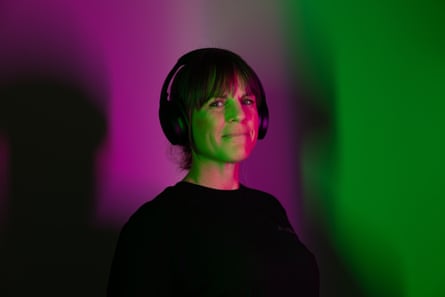
One day I was working as an assistant transcribing Indigenous creole languages for Wollongong University when my supervisor put me in touch with the head linguist for Apple. She was looking for someone really good with phonetics, who would be free to go to Japan for 90 days to work on a new speech-to-text project. On day one of the job I found out I’d been chosen to work on Siri.
I spent a lot of time in headphones over those next 90 days, as they recorded Australian voices and I sat in. I loved it and I’ve loved pretty much every work-day since. I’ve done speech-to-text projects for Tom Tom GPS and Bank of America, and a lot of my day-to-day work now is as a speech pathologist, helping children and adults to communicate and swallow better.
I’m not worried about the rise of AI because language is incredibly nuanced and robots simply aren’t good enough to pick up those subtleties. I can break down the western Sydney Lebanese accent in an instant. I wouldn’t trust AI to do it.
My form of synaesthesia comes with its challenges. I wear a lot of earplugs to block out the sound around me, and my brain feels busy pretty much constantly thanks to the noisy world we live in. Running to music is my favourite way to switch off. It’s the only time I don’t see sound and my brain is quiet.
All of that said, I wouldn’t change my synaesthesia for a second. I could lose my sight and cut my arms off, but if I couldn’t work with words and sounds it would destroy me. I feel so lucky that I found this field of work when I did, and I’ll keep going until I’m 80 if I can. It feels like my reason for being – my ikigai, they call it in Japanese. I’d do it for free if I didn’t have bills to pay.
-
Anina Rich, a cognitive neuroscientist and chair of the Synaesthesia Research Group at Macquarie University, assisted in reporting this series