.png) 2 months ago
51
2 months ago
51
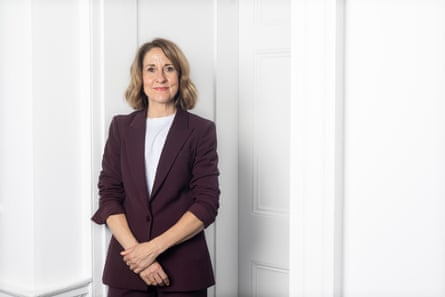
Liz Kendall has insisted Labour will make artificial intelligence “work for workers”, and not abandon people whose jobs are swept away by its rapid advance.
With public fears mounting about the impact of AI on employment, particularly for young people, the technology secretary claimed that the government could shape the way it is adopted.
“We’ve got to make sure AI enhances work: that we help people through the jobs transition, and we’re not like the Tories, who just leave people to cope on their own,” she said.
The former leadership contender is rumoured to be vulnerable to being ditched from the cabinet if Andy Burnham wins the Makerfield byelection, ousts Keir Starmer and shifts Labour to the left.
But before London Tech Week, which will see homegrown firms, US tech companies and policymakers gather in the capital from 8 June, she was keen to set out a distinctly Labour approach to the challenge of AI adoption.
Speaking in her office on Whitehall, Kendall said: “For everything that is going on in the world and within my party, every single day this government is making a difference.
“It’s up to us, collectively, to choose, to act, to make this in a way that works for Britain; and as a Labour government, to make sure that it works for workers and people living in the most disadvantaged areas, not just a powerful, unaccountable few.”
Kendall said she had adjusted the government’s £187m TechFirst AI training scheme, announced last year, so that 40% of the 1 million children it aims to reach will be in disadvantaged schools.
And she highlighted the launch of two schemes – in the north-east and north-west of England – to deliver summer skills camps for young people not in education, employment or training (Neets), or at risk of it.
These schemes will be delivered in collaboration with businesses and aimed at opening up the opportunity of an apprenticeship. They are very small – 60 places in the north-west initially and 20 in the north-east – but with the expectation of being scaled up.
“We will have a national programme to prevent young people who are at risk of becoming Neet, to make sure that they actually get a free summer skills programme that we hope will lead for many to a place on an apprenticeship course,” Kendall said.
The north-east scheme, which forms part of government plans for an AI growth zone in the region, is being funded by Labour’s Youth Guarantee, which promises support for young people who have been out of work for 18 months or more.
Kendall said: “We have got to make sure that everybody has got a chance to seize the opportunities from AI, and that means making sure the people and places that most need a decent shot at life, get the chances and choices they deserve.”
The former Labour minister Alan Milburn published his interim report last week about the mounting social challenge of young Neets, whose numbers have passed a million for the first time in a decade.
Kristalina Georgieva, the International Monetary Fund’s managing director, has warned that AI will be a “tsunami hitting the labour market”, with the young worst affected.
Kendall played down fears of mass job losses, however: “Jobs will be created. Jobs will change. And some jobs will go. That is what happens with the introduction of every general purpose technology.”
The Commons science, innovation and technology committee, which monitors the work of Kendall’s department, called this week for the government to cancel a big contract with the US tech company Palantir on digitising the NHS.
Kendall said she understood the concerns but the decision on whether to trigger a “break clause” in the contract would be made by the new health secretary, James Murray.
“Having our NHS digitised is really important. It’s really important to improve outcomes for patients and to make doctors and nurses’ lives easier. But you will also know, as I’ve said, we do want to see much more happening to back British AI companies,” she added.
Kendall declined to be drawn on another significant issue in her in-tray: the government’s consultation on banning social media for under-16s.
An announcement is expected soon and she has already made clear that the overwhelming response from parents was to call for action.
She stressed that ministers had been looking at a much wider set of issues than social media alone, including how children interacted with chatbots.
Kendall said: “We’re not just looking at social media for under-16s, yes or no. We’re looking at issues like ‘stranger pairing’ and livestreaming in gaming. We are looking at AI chatbots. We’re looking at better age-verification measures. So we’re looking at the whole issue of children’s lives online.”
Stranger pairing is where someone a child does not know can interact directly with them, via a video game.
Kendall said the government’s willingness to consider tough restrictions was part of a wider determination not to be passive in the face of big tech.
“Too much of this debate is as if this is being done to us, and we say yes or no,” she said. “But the truth is, the choice isn’t between having AI or trying to stop it, or having it or not. The choice is between shaping it to work for us or being left at its mercy and its whim.”