.png) 2 months ago
54
2 months ago
54
I wanted to hate the National Portrait Gallery’s new blockbuster show, Marilyn Monroe: A Portrait. It represents two things that really should be binned: anniversary exhibitions (it marks Monroe’s 100th birthday) and exhibitions of celebrity portraits. Anniversaries rarely signify anything other than the passing of time, which is an inevitable and uninteresting fact of life. As for exhibitions of celebrity photographs – they’re like anniversary shows, only with faces.
And yet … I didn’t quite hate this show, and the reason is Monroe herself. We first see her as Norma Jeane Baker, a regular-looking teenager with mousey brown hair, in a self-portrait taken in a photo booth in 1940. She then becomes the radiant, uncontainable, insanely glamorous film star, cheesecake pin-up and actor seen here in photographs, paintings, and excerpts from her films.
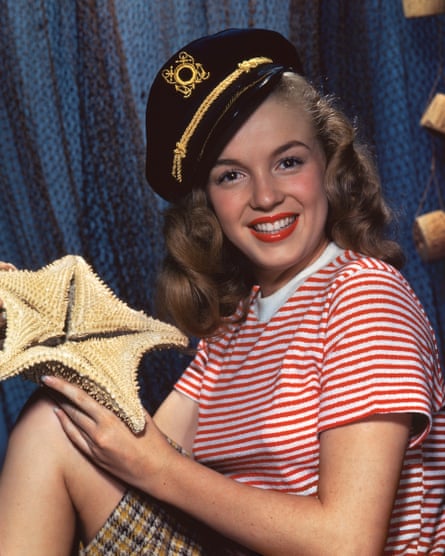
Evident in picture after picture, testimony after testimony, Monroe had a special, unselfconscious command of the camera, the kind of charm that could define a century. It’s amusing to see all the photographic big shots of the era, like Richard Avedon, Milton Greene, Cecil Beaton (of course there’s a wall of him – imagine an NPG show without it) and Eve Arnold try to create a Marilyn image of their own. Every single time, it’s Monroe who is in control, with the same unmistakable styling, hair, makeup, poses and pouts. This show disposes with the idea of finding a “real Marilyn” through the pictures. It’s more about the steadfastness of her agency over the decades. This exhibition gives you Monroe as she wanted to be seen.
Beyond the story about the self-creation of an American icon, there is a parallel narrative unfolding about photography and art. There’s a lot of experimentation going on with photographic techniques, from Philippe Halsman’s surrealist collages and solarisation methods, to Weegee’s use of curved lens and heat, to André de Dienes taking portraits he took of Monroe and altering them in the light of her death aged 36. There’s a deep melancholy in his visions of her as an adulated, celestial figure, an adoration of the vivacity and youth in which he, the much older male photographer and obsessed lover, sensed death. They’re some of the best works in the show.
There are paintings, too, that show how Monroe became symbolic of the midcentury US – Marilyns making their way into Pauline Boty paintings and Andy Warhol’s famous screenprint. A version also appears in the background of a Nan Goldin photograph. There are also moments of photographic history, such as when Magnum secured the exclusive rights to document the production of The Misfits, a breakthrough moment for Arnold and Inge Morath, two of nine photographers on the set. There’s also the well-known nude that almost derailed Monroe’s career. Taken before she was famous, it earned her $50. It was later appropriated – without permission or remuneration – by Hugh Hefner in Playboy as a centrefold.
The show does get dull, though, as it goes on. I wanted to see more contradictions, more slips of the mask. Why can’t we have sadness and fragility as well as dazzling performativity? I wanted to see her flaws, not in a salacious way, but because they are part of the story. The idea of Monroe deflating “like the air being let out of a balloon”, as Ed Feingersh described her in private moments, is only hinted at.
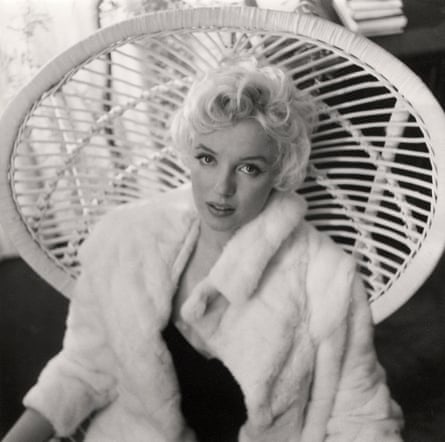
Monroe’s cheeriness, the glut of gleeful smiles, becomes overkill. And even the most charismatic celluloid figure struggles to be interesting over so many rooms of solo portraits. The smiles feel faker as you go along, but we never really get underneath them. In one of her last portraits by George Barris, taken on Santa Monica beach towards the end of her life, she seems for a fleeting moment a little less perfect, a little more ragged, crinkled, raw, tired.
Then the enormity of her death at 36 hits you – in a reappropriated paparazzi image of Monroe’s body bag being carried out of her home in Los Angeles in August 1962. Peter Blake – one of many pop artists who picked up on the Monroe motif – uses the papped picture in his 1988 collage Norma Jean Baker. This is where the show ends up for me: between the absolute aliveness of Monroe and the piercing finality of her death, which turns her back into a mere mortal. It’s a familiar tragedy of celebrity, fame and beauty, retold in a shimmer of manufactured smiles. I wanted to hate it – but I couldn’t.