.png) 3 months ago
71
3 months ago
71
The footballer Martin Chivers, who has died aged 80, made his name as a forward for Tottenham Hotspur and England during the early 1970s. Instrumental in helping Spurs to a Uefa Cup final win and two victories in the League Cup, he experienced rather less glory on the international stage, despite a fine ratio of 13 goals in 24 appearances, mainly because England failed to qualify for the World Cup during his time with them.
At 6ft 1in (1.85 metres) and 13st (82kg), with natural strength, a significant turn of foot, smooth in his movement and excellent in the air, Chivers was a superb finisher whose ratio for Spurs was also impressive, at not far off a goal every other game. He lies fourth on the club’s all-time list of scorers behind Harry Kane, Jimmy Greaves and Bobby Smith, with 174 in 367 matches.
Among Chivers’ most important goals were the two he scored to gain his first piece of silverware in the 1971 League Cup final against Aston Villa, delivering a 2-0 win. The next year, in the two-legged all-English Uefa Cup final against Wolverhampton Wanderers, he scored twice in the first encounter as Spurs won 3-2 on aggregate.
With England, between 1971 and 1973 under Alf Ramsey, Chivers appeared in the two-legged 1972 European Championship quarter-final defeat to West Germany, having been top scorer in the qualifying campaign with five goals. But he was also part of an underperforming side that failed to qualify for the 1974 World Cup, featuring in the calamitous last qualifying match against Poland in 1973 when England, needing a win, drew 1-1 despite having 36 shots on goal. Ineffective in that game, despite having been on good scoring form in previous internationals, he became one of the casualties of the defeat, and at 28 was never selected again.
Chivers was born in Southampton – his mother was from Germany and his father was a local dock worker. While at Taunton’s grammar school in the city, the young Chivers wrote to Southampton FC seeking a trial, and they obliged, later picking him for the club’s nursery side before he signed as a professional in September 1962 under Ted Bates as manager.
He made his first-team debut in the same month, aged 17, against Charlton in the Second Division, and broke through to become a regular during the 1963-64 season, over which he scored 21 goals in 28 appearances. Two seasons later his 30 goals in 39 games were key to Southampton gaining promotion to the First Division for the first time.
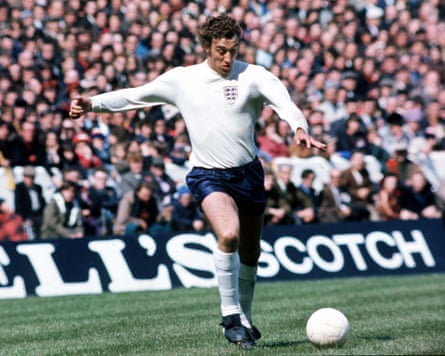
Chivers played just one season in the top flight with Southampton before big-spending Tottenham signed him in early 1968 for what was then a record British transfer fee of £125,000. In the days before player-power, the first he knew of the transaction was when he caught sight of the news on a billboard in Southampton High Street.
The Spurs manager, Bill Nicholson, had signed Chivers to mesh with the prodigious goalscoring talent of Greaves and the creative force of Alan Gilzean. His work with those two reaped immediate rewards, with 16 goals across his first 34 games before a serious knee injury put him out for the best part of a year between September 1968 and August 1969.
There were fears that such a long lay-off might knock him off his stride, but on his return he continued more or less where he left off. With the sale of Greaves to West Ham in 1970 he became Spurs’ most important attacking asset, now alongside the slightly older figure of Martin Peters.
During the 1970-71 season he played in every Spurs match, scoring 34 times as they finished third in the league and bagging two goals in the 1971 League Cup final, the first an opportunist tap-in and the second a much more impressive effort as he slotted the ball into the corner after showing great control and balance to beat two defenders in the penalty area.
The following year he kicked on even more impressively with 42 goals in 62 matches, including seven in the various rounds of the inaugural Uefa Cup, which he sealed with his brace in the first leg of the final against Wolves – the second of them a breathtaking piledriver from an enormous distance. He racked up a further eight goals in Europe in the defence of that title in 1972-73, which ended in the semi-finals, and another six in 1973-74, when Spurs again reached the final, only to lose to Feyenoord 2-4 on aggregate. In between he won his second League Cup winners’ medal as part of the team that beat Norwich City 1-0 in the final thanks to a Ralph Coates goal.
In 1976, at 31, Chivers took up an offer to play for the Swiss club Servette, in Geneva, with whom he won a cup and league cup final over two years, before returning for spells at Norwich City (1978–79) and Brighton & Hove Albion (1979–80), both in the top flight. After short periods as a player-manager with the non-league teams Dorchester and Barnet, he resisted any temptation to carry on in management, partly on the grounds that it would interfere with his family life.

Instead, with his second wife, Julia, he went on to run the Brookmans Park hotel/pub in Hertfordshire between 1981 and 1999, living in a house close to the premises. For many years he organised a Spurs veterans team that played in charity matches, and he was also an articulate, gentlemanly matchday host at Spurs home games.
He is survived by Julia and their two sons, Nick and Luke, and by two daughters, Andrea and Melanie, from his first marriage, to Carol (nee Maine), which ended in divorce.