.png) 3 months ago
54
3 months ago
54
This new film from Josh Safdie has the fanatical energy of a 149-minute ping pong rally carried out by a single player running round and round the table. It’s a marathon sprint of gonzo calamities and uproar, a sociopath-screwball nightmare like something by Mel Brooks – only in place of gags, there are detonations of bad taste, cinephile allusions, alpha cameos, frantic deal-making, racism and antisemitism, sentimental yearning and erotic adventures. It’s a farcical race against time where no one needs to eat or sleep.
Timothée Chalamet plays Marty Mauser, a spindly motormouth with the glasses of an intellectual, the moustache of a movie star and the physique of a tiny cartoon character. He’s loosely inspired by Marty “The Needle” Reisman, a real-life US table tennis champ from the 1950s who was given to Bobby Riggs-type shenanigans: betting, hustling and showmanship stunts. The movie probably earns the price of admission simply with one gasp-inducing setpiece involving whippet-thin Chalamet, a dog, a bathtub, cult director Abel Ferrara in a walk-on role and a scuzzy New York hotel room. Talk about not being on firm ground. Similarly disorientating is the climactic revelation of Chalamet’s naked buttocks prior to one of the most upsetting displays of corporal punishment since Lindsay Anderson’s If….
Marty is a young Jewish guy working in a New York shoe shop in 1952, dreaming of world-conquering success in the up-and-coming sport of table tennis and patenting his own brand of ball called the Marty Supreme. He’s having an affair with married childhood sweetheart Rachel (Odessa A’zion) and saving up his earnings to travel to Britain for the table tennis championships at Wembley. (There is a stirring shot of the old stadium’s twin towers, which American audiences may think is a reference to Tolkien.)
Getting his promised cash is the first of many bizarre uproars, but once in Blighty, brash Marty deliberately shocks British sports journalists with crass jokes about his pal and fellow player, a Hungarian-Jewish camp survivor called Béla, played by Géza Röhrig (from László Nemes’s Holocaust movie Son of Saul.)

Having hustled and blustered his way into a free room at the Ritz, Marty conceives an erotic obsession with a fellow guest, retired movie star Kay Stone – for which role Gwyneth Paltrow has very stylishly come out of retirement – and Kay’s later Broadway debut is wonderfully realised with a stunned Marty in the audience. Marty’s table tennis face-off with Japan’s ping pong superstar Koto Endo (Koto Kawaguchi) ends in disaster, and Kay’s husband and Marty’s possible sponsor Milton (Kevin O’Leary) shows himself to be bigoted to both Marty and Béla. Back in the US, pure chaos reigns, a nonstop hellzapoppin’ meltdown as Marty frantically tries to claw together the cash for a rematch with his Japanese nemesis, and with the charismatic Kay.
The film’s comic and absurdist effect resides in the slowly dawning realisation that it’s not actually about table tennis. Marty Supreme doesn’t behave like a sports movie: there are no training montage sequences, no scenes in which Marty explains his technique in voiceover, no scenes in which he either listens humbly to some ping pong mentor or Oedipally rejects him. And unlike Forrest Gump, who becomes a patriotic celebrity through his table tennis gift, Marty is always a reprehensible character whom no one really trusts – although it is arguably his pioneering 1950s work popularising the sport which made possible Forrest’s ping pong pre-eminence in the 1960s.
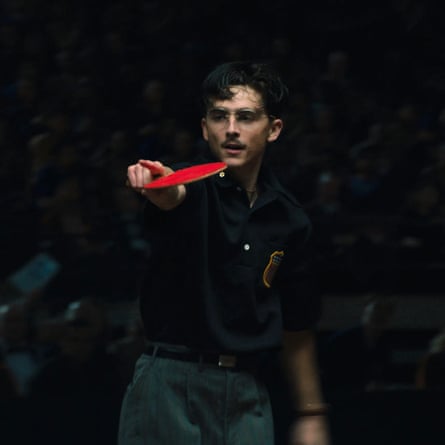
It is rather that the film is itself ping pong; the rhythm and spirit of table tennis is in every scene and the mesmeric effect of the spectacular, clattering, dizzying back-and-forth. Marty Supreme is on its own spectrum of determination and emotional woundedness, and Chalamet hilariously enacts an unstoppable live-wire twitch, powered by indignation and self-pity. And Paltrow gives us a clever and wittily conceived counterweight to Marty’s thrumming narcissism; she is amusing and sensual, she sees what Marty is up to and understands him better than he does himself.
By the end of this movie my head was oscillating from side to side as if it had been hit with cymbals. The catastrophes, the stunts, the shocks, the jabbering desperation and Marty’s supercharged neediness, with everything important in his life poised to be thrown away, like the box of Marty’s patented table tennis balls that goes out of the window. And yet somehow our pint-sized hero always comes back and even achieves a poignant kind of maturity in the final shot. The pure craziness is a marvel.