.png) 3 months ago
75
3 months ago
75
It’s the coat most associated with a beloved children’s character, so it makes sense that the duffel is a familiar sight in playgrounds across the country. But this year it is also – once again – quietly enjoying a moment on grown-ups.
In the Christmas advert for Waitrose, comedian Joe Wilkinson wears a duffel coat while in the supermarket with Keira Knightley. Footballer Cole Palmer wore one in 2024’s Burberry campaign, subtitled “It’s Always Burberry Weather”, and Tyler, the Creator wears a short one in the recent video for Darling, I. Meanwhile, Paddington Bear is sporting his on stage in the West End at the moment.
Duffel coats are on the high street too, from a £279 cream design in Labrum’s range for John Lewis to a £64 checked design at Marks & Spencer, a fashion favourite. John Lewis reports that duffel sales are up 75% compared with last month, while searches on resale app Depop are up 159% in the last four months.
The coat might seem genderless, but its newfound popularity is largely with men. Andrew Groves, director of the menswear archive at the University of Westminster, says this is part of a wider trend. “Menswear is shifting back to garments with clear origins and unambiguous functionality,” he argues. “[It] offers weight, insulation and a straightforwardness, which is what a lot of men want right now.”
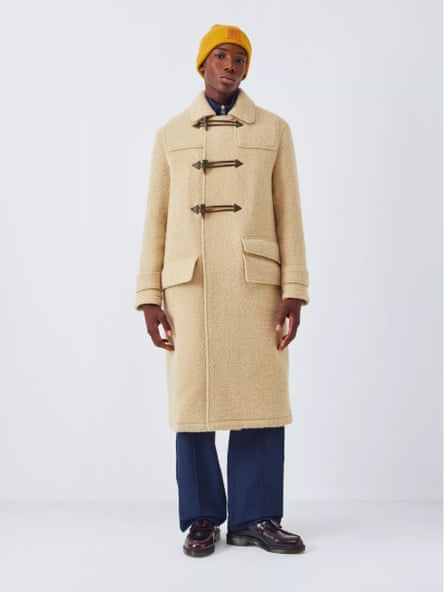
Although the coat is sometimes viewed as quintessentially British, the name actually derives from Duffel, a town in Belgium where the thick fabric originally used came from, while part of the design may derive from Polish frock coats. Duffels first became popularised when they were worn by the British Royal Navy.
The coat was a symbol of heroism in the second world war, as worn by Field Marshal Bernard Law Montgomery. The officer became so associated with the coat that it also became known as the Monty. In postwar years, it was sold at army surplus stores and became a favourite of creative and progressive types, worn by Jean Cocteau, young people marching against the Vietnam war and David Bowie on the cover of his 1977 album Low.
A Depop spokesperson says the trend aligns with an interest in “heritage fashion”. “Traditional pieces that bring a touch of the countryside are increasingly being brought into street style,” they say.
Despite their popularity, Teo van den Broeke, editor-in-chief of Esquire, believes duffels should remain on Paddington or in the playground. “There’s something really infantilising about them,” he says. “I really don’t like seeing a grown adult in a duffel coat. I find it incredibly unsexy.”
He acknowledges, however, that the duffel appeals because it ticks numerous boxes. “Men love things that function. They love things that have heritage. They love things that have stories behind them, garments that have been related in some way to military pursuits.”
after newsletter promotion
The duffel has long been a favourite of rock stars including Liam Gallagher, Graham Coxon and Alex Turner. Van den Broeke says the coat works for them because they “subvert” the duffel’s functionality. “It’s all about your attitude,” he says. “If you’re a musician, and you look like you don’t really care, then you could probably get away with it. If there’s an earnestness to your wearing of a duffel coat, it’s game over.”
Despite his misgivings, van den Broeke is well aware the duffel is going nowhere. He describes the design as one of a few items of outerwear that “exist in the annals of sartorial history that can go on loop”.
“It’s a classic because you can’t really reinvent it,” says Groves. “Whatever designers do to it, from Burberry to Prada, a duffel remains a duffel.”