.png) 4 hours ago
3
4 hours ago
3
As a first-call session musician in the Hollywood studios, the saxophonist Plas Johnson needed to be able to cope with anything the occasion might require. One day in 1963, during a session to record Henry Mancini’s music for the detective comedy The Pink Panther, directed by Blake Edwards and starring David Niven and Peter Sellers, Johnson was asked to apply his distinctive tone on the tenor saxophone to a stealthy melody suggestive of some sort of nocturnal prowling. Released as a single after the film had become a hit, the tune reached the US Top 10.
“I had a specific saxophone player in mind,” Mancini wrote in his autobiography. “I nearly always pre-cast my players and write for them and around them, and Plas had the sound and the style I wanted.”
Not unusually for the time, Johnson, who has died aged 94, was the only Black musician among the 20 assembled for the session. He was one of the first to make the breakthrough into the highly competitive Los Angeles studio scene, where the two local branches of the musicians’ union, divided according to skin colour, had been amalgamated less than a decade earlier.
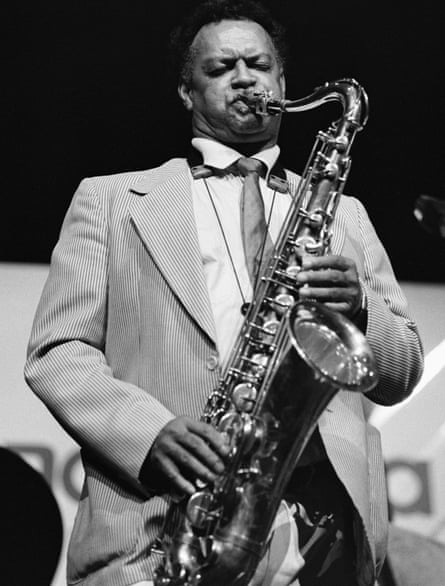
Johnson’s stylistic and technical versatility – he played all the saxophones from soprano to baritone, plus flute and clarinet – led to employment on a huge variety of sessions. He appeared on pop hits including the Platters’ The Great Pretender, Sam Cooke’s Twistin’ the Night Away, Bobby Day’s Rockin’ Robin (on which he played piccolo) and Larry Williams’s Bony Moronie. But he was also present on albums by Frank Sinatra, Peggy Lee, Nat King Cole and Ella Fitzgerald, and later those by Linda Ronstadt, BB King, Boz Scaggs, Steely Dan, Marvin Gaye, Tom Waits, Bette Midler, Etta James and countless others.
He was not best pleased, however, when Mancini chose to record the music for subsequent Pink Panther films in a London studio, with the English saxophonist Tony Coe replicating Johnson’s interpretation of the theme tune.
Born in Donaldsonville, Louisiana, a small town on the banks of the Mississippi, he was the son of Grace and Plas Johnson Sr, a musician who bought him his first saxophone. When the family moved to New Orleans he began to play in a group with his brother, Ray, a pianist, in clubs where they were billed as the Johnson Brothers Combo.
In 1951, aged 19, Plas went on the road with the band of the popular blues singer Charles Brown, an arrangement terminated six months later by the arrival of a draft notice. Emerging from the army in 1954, he moved to Los Angeles, where several other musicians from New Orleans, including the great drummer Earl Palmer, were establishing themselves in the studios and welcomed him into their fraternity.
His early patrons in Los Angeles included the bandleader Johnny Otis, the saxophonist Maxwell Davis, who also acted as an A&R man for the Modern label, and the record producer Dave Cavanaugh, who introduced him to Capitol Records. Johnson quickly became recognised as an ideal studio player, and found himself booked for two sessions a day, often for film and television soundtracks.
A favourite of the arrangers Nelson Riddle and Billy May, Johnson would pop up, uncredited, with contributions such as the 16-bar tenor saxophone solo midway through Sinatra’s finger-snapping 1961 recording of Blue Moon, orchestrated by Riddle. When Ronstadt recorded three successful albums of standard songs with Riddle in the 1980s, Johnson was a featured soloist, both in the studio and in concert, on songs such as Little Girl Blue and Sophisticated Lady.
He had made several rock’n’roll and R&B records of his own for the Capitol label in the 50s and 60s, but on the albums This Must Be the Plas! (1959) and Mood for the Blues (1960) he was able to demonstrate his jazz skills. For the CRC Charter label he recorded two albums of accomplished mood jazz, Sax 5th Avenue (1962) and On the Scene (1963), released for contractual reasons under the pseudonym Johnny Beecher.
The well-rewarded decades in the studios and a 15-year stint in the band on the nightly Merv Griffin Show prevented him from establishing a reputation as a top-tier jazz musician until much later in life. His own inspirations were saxophonists of earlier generations such as Earl Bostic, Louis Jordan and Illinois Jacquet, but the general public only became aware of his prowess when the session work began to dry up and he signed a contract with Concord Records. A warm reception for the albums The Blues (1975) and Positively (1976), and for subsequent records on his own label, led to appearances in clubs and at jazz festivals around the world.
In 2005, reflecting on the studio career for which he had eventually become famous, he told the Long Beach Press-Telegram: “I’d just go in and do what they asked for. It was easy for me, and they liked what I played. You just have to know when to start and when to stop.”
He is survived by his wife, Carol, and their two sons and a daughter; by two daughters and a son from his first marriage, to Elizabeth Blinkenberg, which ended in divorce; and by eight grandchildren and 12 great-grandchildren.