.png) 3 months ago
53
3 months ago
53
Los Angeles is known for famous museum such as the Getty and the Lacma, but perhaps fewer people are aware that – in the heart of the city – lies a museum that contains one of the world’s most remarkable fossil sites.
The La Brea Tar Pits and Museum is home to the remains of more than 2 million ice age flora and fauna, including mastodons and saber-toothed cats, that became trapped in oily pools that still bubble up today.
Since opening in 1977, this unique site has drawn legions of tourists, school-age children and other visitors. It is perhaps best known for its vast, dark Lake Pit with a fiberglass family of giant mammoths despairing at their sticky fate.
The research center, paleontology-themed museum and 5.2-hectare (13-acre) public park are the only urban, active ice age excavation sites in the world.
“There’s almost no other fossil site in the world that has this variety and number of fossils, with this quality of preservation,” said Emily Lindsey, the museum’s associate curator and excavation site director. “It’s incredible; it’s like Pompeii, but in the middle of a massive city which we’ve been able to excavate and study on a vast scale for more than a century.”
Now, for the first time in its almost 50-year history, big changes are afoot. The museum is preparing to close in July for a big, two-year $240m renovation project that will transform the space and the surrounding park.
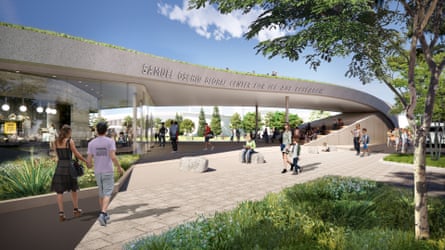
The museum’s current structure, hidden within grassy knolls, will remain largely the same, but the interior exhibition, research and learning spaces will be updated and reimagined. Dramatic walkways, bridges and other new landscape features will create a dynamic and fresh experience for park visitors.
The project started in 2019 with a public process initiated by the Natural History Museums of Los Angeles County (which owns and operates the museum and surrounding park) with extensive input from the community. In 2023, the subsequent design contest awarded the project to the New York design firm Weiss/Manfredi. The firm has a history of designing notable parks and museums, such as the Brooklyn Botanic Garden’s visitor center, Seattle Art Museum’s Olympic Sculpture Park and Hunter’s Point South waterfront park.
“It’s one of the only places that you can see the entire process of a scientific discipline in a single visit,” said Lindsey, referring to the fact that the process from discovery to restoration of fossils all takes place publicly on site. “As someone very concerned about scientific literacy, and the current misunderstanding and mistrust of science, this is a really unique, once-in-a-lifetime opportunity to showcase the process of science in a very intelligible, accessible way, and get people to understand how it’s done and how it relates to their everyday lives.”
The site’s colorful history was born from an unusual geological feature. An underlying fault created an upwelling of oil that turns to ponds of tar, or asphalt, when it reaches the air and biodegrades. This area was well-known to the region’s early human inhabitants; for thousands of years, the tar was used by the Chumash people to waterproof their boats.
The site took on a new life at the turn of the 20th century during an oil boom in Los Angeles. Long before the existence of the Grove and Miracle Mile, oil derricks dotted the Wilshire Blvd corridor and much of the surrounding landscape. On then privately owned land known as Rancho La Brea, immediately adjoining present-day Lacma, the excavation for oil wells prompted an amazing discovery: a treasure trove of tar-stained bones from creatures that had mostly been extinct for at least 13,000 years.
The masses of jumbled bones were miraculously well-preserved by the tar that had permeated and encased them and had thus prevented organic decay. In addition, the fossil samples retain collagen, a boon to modern research since it allows for very accurate carbon dating.
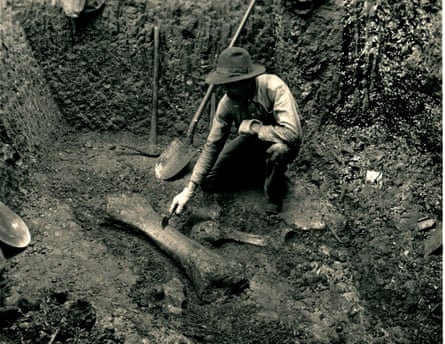
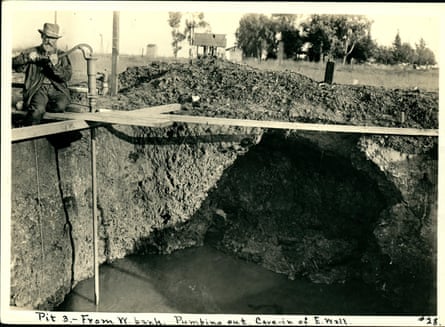
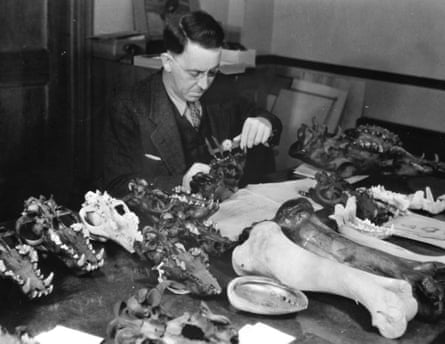
At the site, the task quickly shifted from drilling for oil to digging for fossils. During the peak years of the dig (1913-1915), about 750,000 remnants were unearthed. Among these strange trophies were all manner of late Paleocene fauna and megafauna like American lions (bigger than today’s African lions) and giant short-faced bears, which weighed up to 2,000 pounds and were among the largest terrestrial mammalian carnivores ever to exist.
In fact, 90% of the remains found belong to carnivores or scavengers, leading to the theory that the pits formed a predator trap. According to this theory, a large herbivore like a mastodon would unwittingly get trapped in the tar seeps (which were probably camouflaged by water and fallen foliage), and its cries would draw in predators. Unfortunately for the predators, they would eventually succumb to the same fate as their prey.
As a result, about 59 mammal species and 135 bird species, as well as abundant plant and insect life, form the backbone of the more than 2 million specimens that have been excavated from what the International Commission on Geoheritage calls “the richest paleontological site on Earth for terrestrial fossils of late Quaternary age”.
The Weiss/Manfredi renovation will maintain beloved features of the old site, such as the Lake Pit, a former quarry now filled with water and oil, and its perpetually panicked sculptural inhabitants, while modernizing other more dated elements.
The La Brea Tar Pits’ museum, originally known as the George C Page Museum, is a significant example of brutalist architecture. The museum, which houses the exhibits, the vast fossil collection and the research center, is hidden inside high, grass-covered berms on all sides.
The footprint of the current museum will be retained, but the tropical-themed plants that occupy its courtyard will be replaced with native plants and trees more typical of Los Angeles during the Paleocene. An outdoor classroom will be created around the excavation sites, while new walkways and a pedestrian bridge hope to entice the visitors who frequent more famous neighboring museums, such as Lacma and the Academy Museum of Motion Pictures.
“Right now, you can be out in the park and not even see a museum,” said Lori Bettison-Varga, president and director of the Natural History Museums of Los Angeles County. “You could be in the museum and not think about the connection to the tar pits themselves. So, the whole project has been to reimagine it as a true indoor, outdoor experience that is more visible and accessible to the public.”
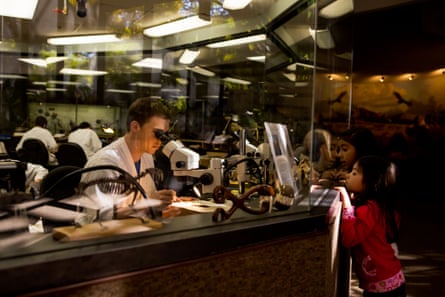
Inside, the museum will get a complete makeover. The Fossil Lab, the onsite research center, will retain its signature interior windows so that museum visitors can still watch as scientists and volunteers do the delicate work of preserving and restoring fossils. The collection will continue to expand, and its storage facilities will be brought up to date.
The well-known statues and skeletons of species such as the short-faced bear, dire wolves and mastodons will remain – but instead of being isolated on their own mounts, the new exhibits will put them in dynamic dioramas that aim to create a fuller appreciation of Los Angeles’s ice age inhabitants.
In an era of the rapid climate crisis and species endangerment, the new exhibits will tell the extinction story of the megafauna that lived here, as well as the survival and resilience of species like the coyote. The goal is to engage and educate the public about Los Angeles before humans arrived, while connecting that past to our current need to manage our ecosystems wisely.

As the La Brea Tar Pits and Museum undergoes a physical renovation, it’s also crafting a new image that seeks to grow beyond its old reputation as primarily a kids’ museum.
“Of course, we want kids to come to inspire their curiosity, to wonder about their natural environment and to understand the process of science and to think about their future and what they could be doing,” said Bettison-Varga. “But it is a place for everybody – cradle to cane.”