.png) 2 months ago
61
2 months ago
61
Reeves suggests UK won't impose EU-type retaliatory tariffs on US, claiming Labour can still get 'good deal' from Trump
At his press conference on Monday Keir Starmer played down the prospect of the UK imposing tariffs on the US in retaliation for the “Greenland tariffs” that Donald Trump says he will impose on the UK and seven other Nato countries that have opposed his plan to buy the Danish self-governing territory. Starmer said that he did not want a trade war, and tariffs would not be in anyone’s interests.
But No 10 later made it clear that Starmer was not 100% ruling out tariffs. And, in his interview on the Today programme this morning, Ed Miliband, the energy secretary, also refused to rule them out – although he did say it would be wrong to issue threats and “ratchet up the temperature”.
The EU is considering retaliatory tariffs, and at Davos yesterday several EU leaders said Europe should be more confrontational in response to the Trump threats.
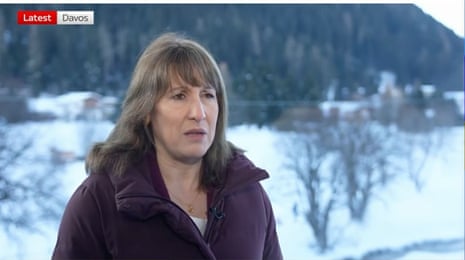
In an interview with Sky News this morning from Davos, Rachel Reeves, the chancellor, also played down the prospect of the UK imposing retaliatory tariffs on the US. Asked what her message was to Trump, she replied:
Britain is not here to be buffeted around. We’ve got an economic plan and it’s the right one for our country.
If other countries want to increase trade barriers, that is their choice. But we are determined to bring trade barriers down, which is why this week I’m meeting with European, Gulf partners, Canadians to talk about how we can free up trade and make it easier for businesses to trade around the world.
Asked if she would tell Trump that his Greenland tariffs were wrong, Reeve said:
At the moment, no tariffs have been imposed.
I think the right approach, and the approach that our prime minister, Keir Starmer, has taken over the last year or so is to try and de-escalate and get the best deal for Britain.
We got the best deal, and the first trade deal, with the US last year, and I’m confident that we will continue to get a good deal for Britain.
While Reeves is right to say that the terms of the UK-US trade agreement announced last year were better than those available to most other countries, there are concerns that the details are not as robust as both sides claimed. Eleni Courea and Lisa O’Carroll explained why in this story last month.
Key events Show key events only Please turn on JavaScript to use this feature
Rachel Reeves, the chancellor, has also given an interview to the BBC’s economics editor, Faisal Islam, at Davos. He has highlighted the fact that, despite her comments about wanting to bring down trade barriers, not put them up (see 10.35am), she is not ruling out retaliatory tarrifs. He says:
Just spoken to the Chancellor Rachel Reeves here in Davos, also trying to be diplomatic but clearly very frustrated at the trade war talk now re-emerging … asserting that the UK will not be buffeted around by anyone… and saying that “she would never rule anything out” in terms of joining in European retaliation, and talked to me about assuring with Trump’s Commerce Secretary that there should be no increase in US tariffs against the UK
West of England mayor launches what's billed as England's first food and essentials distribution hub

Steven Morris
Steven Morris is a Guardian reporter covering the West of England.
Plans for a food and essentials distribution hub – billed as the first of its kind in England – has been revealed by the West of England mayoral combined authority.
The idea is that a multi-million pound warehouse will serve as a central site to store, coordinate, and redistribute surplus items such as food, household products, clothing and bedding, much of which might have ended up in landfill.
This initiative has been inspired by the example of the Multibank, launched by former prime minister Gordon Brown, which works with a coalition of major retail manufacturers, suppliers, and philanthropists to give businesses a donations point for their surplus stock.
The mayoral combined authority is working in partnership with charities and local authorities including Bristol city council and Bath and North East Somerset council. They say this is the first time such a combination of organisations has worked together to design and run this sort of hub, which they hope will help the 67,000 children currently growing up in poverty in the west of England.
A problem charities and other organisations face at the moment is that they do not have anywhere to store donations of food and other items so they are unable to reach people who could use them.
Helen Godwin, mayor of the West of England, said:
These proposals are innovative and nation-leading, bringing together food and non-food redistribution together for the first time under one roof.
Gordon Brown described the project as ingenious and inspiring.
Ed Miliband, the energy secretary, was doing a media round this morning to promote the government’s £15bn warm homes plan. Fiona Harvey and Jillian Ambrose have the story here.
And here is the government’s news release.
The plan has been welcomed by green campaigners.
This is from Mathew Lawrence, director of the Common Wealth thinktank.
We face two major challenges: a cost of living crisis holding the economy back, and decarbonising in an uncertain world. The warm homes plan is an important moment because the £15 billion package makes progress on both.
The plan helps fight fuel poverty and cut bills, while contributing toward net zero. It is the type of action, uniting affordability with climate ambition, that we need to see more of to deliver genuine economic and geopolitical security.
And this is from Andy Hackett, a senior policy adviser at the Centre for Net Zero.
The UK has some of the highest energy bills and least efficient housing in Europe, so warm homes plan that tackles both is something this government absolutely has to get right. This is an important step in that direction.
The government is rightly moving away from a myopic focus on insulation. Funding has been extended to low-carbon technologies like heat pumps, solar panels, and batteries, which have the potential to cut bills and emissions faster, with far less disruption for households. But more grant funding is still needed – not just loans – to ensure that the benefits of solar panels and battery storage reach fuel-poor households, where they will make the most impact.
Reeves suggests UK won't impose EU-type retaliatory tariffs on US, claiming Labour can still get 'good deal' from Trump
At his press conference on Monday Keir Starmer played down the prospect of the UK imposing tariffs on the US in retaliation for the “Greenland tariffs” that Donald Trump says he will impose on the UK and seven other Nato countries that have opposed his plan to buy the Danish self-governing territory. Starmer said that he did not want a trade war, and tariffs would not be in anyone’s interests.
But No 10 later made it clear that Starmer was not 100% ruling out tariffs. And, in his interview on the Today programme this morning, Ed Miliband, the energy secretary, also refused to rule them out – although he did say it would be wrong to issue threats and “ratchet up the temperature”.
The EU is considering retaliatory tariffs, and at Davos yesterday several EU leaders said Europe should be more confrontational in response to the Trump threats.
In an interview with Sky News this morning from Davos, Rachel Reeves, the chancellor, also played down the prospect of the UK imposing retaliatory tariffs on the US. Asked what her message was to Trump, she replied:
Britain is not here to be buffeted around. We’ve got an economic plan and it’s the right one for our country.
If other countries want to increase trade barriers, that is their choice. But we are determined to bring trade barriers down, which is why this week I’m meeting with European, Gulf partners, Canadians to talk about how we can free up trade and make it easier for businesses to trade around the world.
Asked if she would tell Trump that his Greenland tariffs were wrong, Reeve said:
At the moment, no tariffs have been imposed.
I think the right approach, and the approach that our prime minister, Keir Starmer, has taken over the last year or so is to try and de-escalate and get the best deal for Britain.
We got the best deal, and the first trade deal, with the US last year, and I’m confident that we will continue to get a good deal for Britain.
While Reeves is right to say that the terms of the UK-US trade agreement announced last year were better than those available to most other countries, there are concerns that the details are not as robust as both sides claimed. Eleni Courea and Lisa O’Carroll explained why in this story last month.
Starmer to visit China with British business leaders next week
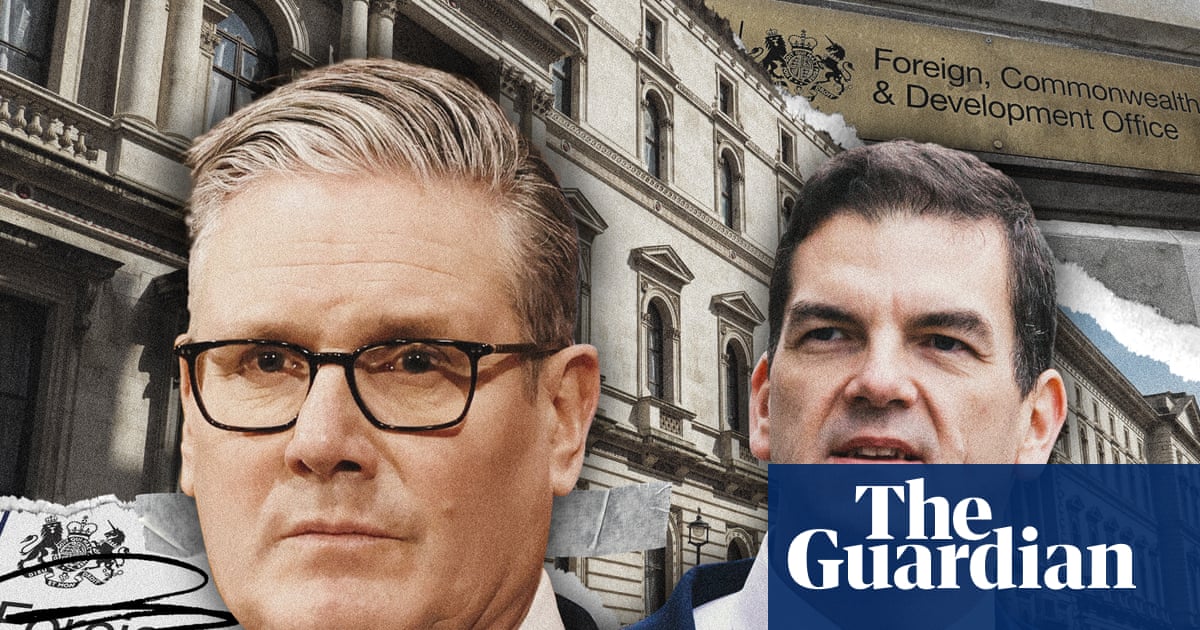
Keir Starmer will reportedly visit China next week after controversial plans for Beijing to build a vast embassy in London were approved by his government, Ben Quinn reports.
Farage says his outside intersts 'complicated' as he apologises for breaking Commons rules 17 times by declaring earnings late
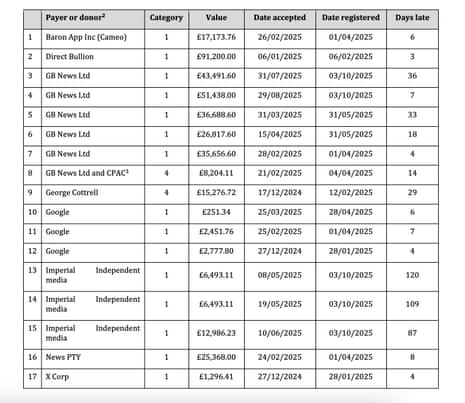
Nigel Farage, the Reform UK leader, has apologised to the parliamentary commissioner for standards for failing to declare income received in the Commons register of members’ interest on time on 17 separate occasions. In total, the earnings were worth more than £380,000.
Failing to declare interests within the 28-day deadline is a breach of the Commons code of conduct. But the commissioner, Daniel Greenberg, has the option of using a “rectification” process if he deems that an MP has made an honest mistake, and in these cases the breaches do not get referred to the Commons standards committee for possible punishment.
In a report published explaining why rectification was appropriate in this case, Greenberg said:
During my investigation, I established that there had been 17 breaches of rule 5 of the code by Mr Farage’s failure to add interests within the 28-day period 10 set by the House.
Having met with Mr Farage to discuss how these late registrations occurred, I concluded that the failure to register these interests on time was inadvertent because of staffing and other administrative issues.
In his report, Greenberg also includes a letter from Farage in which Farage said:
In relation to my alleged breach of rule 5 of the code of conduct for Members, I accept that I have breached this section of the code and take full responsibility, and I would first of all like to say I am sincerely sorry.
The late declarations … fall short of what you expect and indeed what I expect from public figures. This was an administrative error on behalf of me and my team, for which I can only reiterate our sincere apologies.
Unlike most members, I have a very complicated and complex set of interests, including my work as a TV presenter and as a successful private businessman, most of which were built long before I was elected as a member of parliament. Compared to most MPs, I have an unusually high number of interests which need to be declared, and I have always and will always continue to declare these. Please let me reassure you, there was no malicious intent to deceive or mislead you or the public in the lateness of these declarations; it was an honest and genuine error.
Farage also told Greenberg he did not claim any expenses as an MP.
And, in a subsequent letter, he said he had been “extremely let down by a very senior member of staff” in this case.
In his report, Greenberg included this list of the interests declared late by Farage.
Commenting on the report, a Labour party spokesperson said:
Nigel Farage is so distracted with tempting failed Tory politicians into his party that he can’t even get the basics right. He isn’t on the side of working people - he’s just lining his pockets when he should be standing up for his constituents.
He boasts about making money ‘because I’m Nigel Farage’, raking in millions through various outside jobs. But he neglects to do the important work that hard-pressed taxpayers fork out for him to do.
Labour will tighten the rules on MPs’ second jobs to make sure the public get the attention they expect and deserve from their elected representatives.
Ed Miliband defends Starmer’s ‘calm’ response to Trump as world leaders amp up rhetoric
Good morning. On Wednesdays, when it’s PMQs, the prime minister and the leader of the opposition are used to being the centre of attention at Westminster. But, with Donald Trump due to speak at Davos this afternoon – and European and other democratic leaders increasingly worried his Greenland imperialism ambitions will tear apart Nato – most MPs (and probably most Guardian readers too) will be more interested in what the US president has to say.
Some opposition leaders, and some Labour MPs, would like Keir Starmer to be a bit more robust – more like Mark Carney, the Canadian PM, or Gavin Newsom, the Canadian governor, or Emmanuel Macron, the French president, or Gordon Brown, the former Labour PM, or even Bart De Wever, the Belgian PM.
But, so far, Keir Starmer has resisted calls to be more confrontational. While clearly stating his oppostion to Trump’s call for the US to be allowed to buy or annex Greenland, he has avoided saying anything provocative, and has implied that the UK would not even join the EU in imposing retaliatory tariffs on the US, in response to the tariffs Trump says he will impose on some Nato countries that have opposed his Greenland ambitions.
In a good analysis, Pippa Crerar explains why Starmer is doing this – and why his cabinet colleagues are backing his “keep calm and carry on” strategy.
And in interviews this morning Ed Miliband, the energy secretary, said that Starmer was right to respond to Trump in the way he is doing. He told Sky News:
The bigger picture here is that the prime minister is, I think, navigating a really difficult international situation with great skill and in our national interest.
I know some people will want to say, why hasn’t the prime minister been matching Donald Trump tweet-for-tweet, all of that. I honestly say to you, we would be in a much worse position as a country.
He has shown calm leadership, which got us the first trade deal with the US, which got us the lowest tariff.
Now this is a very challenging situation, and we’ve got a principle, which is we seek common ground with Donald Trump, but where we disagree, we say so, and that’s what he said on Greenland.
But no, I think Keir Starmer’s leadership is absolutely right on this and I think at this stage, it’s about de-escalation and finding a way through this tricky situation.
Here is the agenda for the day.
Noon: Keir Starmer faces Kemi Badenoch at PMQs.
1.30pm (UK time): Nigel Farage, the Reform UK leader, speaks at an event at Davos.
2.30pm (UK time): Yvette Cooper, the foreign secretary, speaks at an event at Davos.
Late afternoon: Peers debate the children’s wellbeing and schools bill. They will vote on an amendment to ban under-16s from using social media. The vote is expected at around 6pm.
If you want to contact me, please post a message below the line when comments are open (between 10am and 3pm), or message me on social media. I can’t read all the messages BTL, but if you put “Andrew” in a message aimed at me, I am more likely to see it because I search for posts containing that word.
If you want to flag something up urgently, it is best to use social media. You can reach me on Bluesky at @andrewsparrowgdn.bsky.social. The Guardian has given up posting from its official accounts on X, but individual Guardian journalists are there, I still have my account, and if you message me there at @AndrewSparrow, I will see it and respond if necessary.
I find it very helpful when readers point out mistakes, even minor typos. No error is too small to correct. And I find your questions very interesting too. I can’t promise to reply to them all, but I will try to reply to as many as I can, either BTL or sometimes in the blog.