.png) 1 month ago
46
1 month ago
46
If Irvine Sellar, the larger-than-life developer who gave London the 95-storey hypodermic pinnacle of the Shard, had had his way, the UK’s tallest building would have been joined by a sibling: a 72-storey residential tower soaring above Paddington Station, the pair of leviathans winking conspiratorially at each other across the capital. In the end the Paddington Pole, as it became known, attracted the feather-spitting ire of heritage bodies and community groups, and after 1,800 objections, was refused planning permission by Westminster Council.
Undaunted, Sellar and his architect Renzo Piano – the Italian imperator of hi-tech and co-designer, with Richard Rogers, of Paris’s Pompidou Centre – went back to the drawing board and simply lopped off 54 storeys. And so, in a reverse ferret that was a gift to headline writers (“Pole-axed” trumpeted Building magazine), the Pole became the Cube: an 18-storey office block, homogenous, crystalline and curiously self-effacing, despite its cubic chonk, its glacial glass walls reflecting the grey London sky.
Beyond being a trophy tower, it also shapes a new public realm around its base, palpably uplifting the historically dispiriting experience of arriving at Paddington station. Previously, passengers were funnelled down a dismal ramp into what looked like a giant mouse hole. Now, they are ushered towards a paved piazza, part of a network of spaces and routes designed to embed the station more legibly and logically into its wider surroundings.
Sellar, who once said “with the Shard, we can kick sand in the face of the Eiffel Tower”, died in 2017, before he could witness either the Cube’s completion or celebrate a vindication of sorts by its inclusion, now rebadged as Paddington Square, in this year’s shortlist for the Stirling prize, the annual award for the best new building in Britain.
Coordinated by the Royal Institute of British Architects (Riba), an exhaustive odyssey of regional and national awards has finally concluded, with six contenders emerging to duke it out for the coveted Stirling, the winner being announced in October.
In a shortlist dominated by what might be described the “Jaguar dashboard” school of design – tastefully refined and quintessentially English, tonally as well as geographically – Paddington Square is the conspicuous outlier, in its sheer scale and also being the only scheme not made of brick. Otherwise, it’s a toss up between a brick house, a brick housing scheme, two brick additions to Cambridge colleges, and a brick extension to an existing theatre. In some ways, you’d be hard pressed to distinguish between these exemplars of the bricklayer’s art.
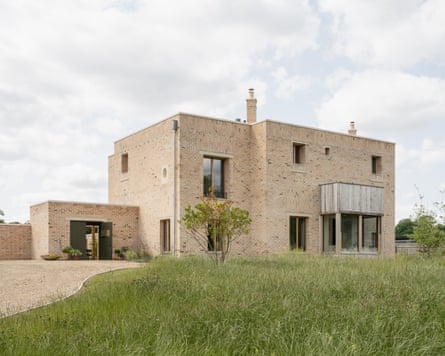
Set on the edge of Epping Forest, Sergison Bates’ Fairmead House (made of pale beige Cumbrian bricks) is a statement modern villa, drawing on and reframing local Georgian precedents. Mary Duggan and Ruff Architects’ Lion Green Road housing (brickwork in three subtle shades of brown) goes against London’s conventional urban grain of streets and squares in favour of a cluster of pavilions disposed around a sloping parkland site in verdant Croydon. Generous loggias and a considered connection with landscape elevate what might have ended up as just another new housing block.
The inclusion of not one but two schemes for Cambridge colleges points up how the rarefied groves of Oxbridge academe, characterised by lavish budgets, enlightened patronage and dogged inter-college rivalry, tend to have an insuperable advantage when it comes to producing good contemporary buildings. Nonetheless, allotting what amounts to a third of the shortlist to this niche milieu seems like a case of over-weighting.
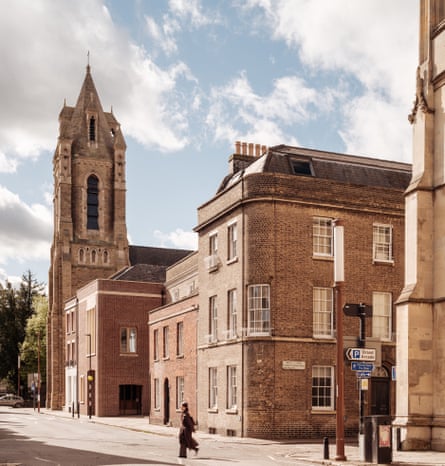
Haworth Tompkins has come out batting for Pembroke College, whose alumni include Tom Hiddleston, Edmund Spenser and Pitt the Younger. Its scheme features a new residential court (purply reddish brick), together with a disused church refashioned as a new auditorium for college and community use, among other thoughtful renovations. It’s an elegant yet robust ensemble (rather like Hiddleston) and will doubtless age well, as Pembroke itself has been doing since the 14th century.
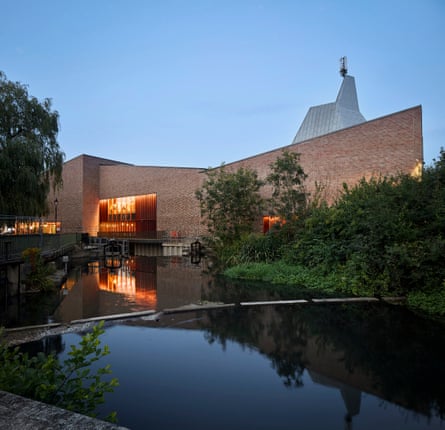
Last year’s Stirling winner Witherford Watson Mann has been shortlisted again for the River Wing at Clare College (more purply reddish brick, in this case infilling a timber structure), which navigates its way around a tight site backing on to the River Cam with the audacious dexterity of a ship in a bottle.
Finally, Bennetts Associates’ transformation of a 1970s theatre in Hertford (mottled light orange brick), takes the robust character of a sometimes unpopular and arguably dated building and reworks it into something clearly new, while maintaining its civic familiarity.
Exceptional though these projects may be, the shortlist does seem somewhat samey. It’s a bit like coming down to the breakfast buffet to discover that five kinds of muesli is all that’s on offer. And as was the case last year, the geographical range does not extend far beyond Cambridge: nothing in Scotland, Wales, Northern Ireland, nor indeed the north or west of England.
A quick trawl of Riba’s awards website gives a more conglomerate sense of national architectural activity, featuring a trove of ones-that-got-away, such as the Tarlair Pool, Britain’s most northerly outdoor lido, a delicious ice cream confection on the Aberdeenshire coast, restored and extended by Studio Octopi. Alternatively, for a different take on dreaming spires, there’s David Kohn’s fabulously eclectic housing for New College Oxford, which channels Gaudí and the Teletubbies in a fruity melange of rhubarb and custard-coloured stonework, topped by a serpentine roof. And not a brick in sight.
Down in Redruth, Cornwall, there’s the Buttermarket, a historic Georgian market complex inventively transformed by conservation specialists Thread to accommodate an array of civic and community activities. Or there’s Squire & Partners’ ambitious glow up of Space House on London’s Kingsway, a distinctive 1960s “corncob” tower originally designed by the once unfashionable modernist Richard Seifert, creator of Centrepoint, which shows what can be done, both architecturally and commercially, with a languishing structure.
All of these might have made the shortlist, potentially sparking wider public conversations about what constitutes good architecture. Instead, with this roster of stylistic homogeneity (Paddington excepted) it feels, yet again, as if architects are talking among themselves.