.png) 4 hours ago
5
4 hours ago
5
Once upon a time, in the woods outside Pola de Somiedo, lived a family of Cantabrian brown bears. The villagers reported sightings of a mother bear who had lost a leg to a hunter’s trap, her two cubs and two adult males, either of which might have been the father. In those days, at the end of the 1980s, they seemed to be the last of their kind in this part of Asturias. Meanwhile, the wider population dropped to about 60 bears across the surrounding Cantabrian mountain range that gave the species its name.
They have since clawed their way back from the edge of extinction here in northern Spain, and nature guide Luis Frechilla believes their numbers may now be upwards of 500 again. “They’re still classed as endangered,” he tells me, until the official count hits 1,000. But relative abundance makes them much easier to see today in Somiedo natural park – one of Spain’s first such protected areas, established in 1988.
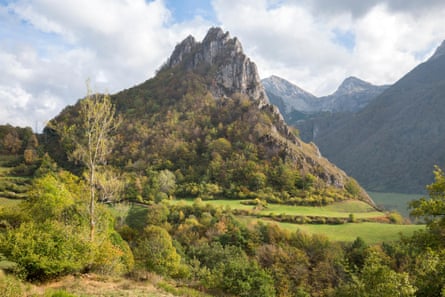
Setting his scope on a tripod in a steep-angled pasture, Frechilla spots a bear almost as soon as we start looking. A juvenile, apparently, which means the animal is old enough to be foraging alone, but it’s still too small, and too far away, for him to tell if it’s a male or female. Another bear-spotter standing near us seems more willing to take a guess.
“Ooh, look at his little ears,” she says delightedly, beaming behind binoculars. No expert myself, I watch that distant fuzzy shape move across the viewfinder and along the sharp ridges opposite, blinking in and out of sight like a cursor on the trend line of a graph. I’m not sure that we are close enough to call this an encounter, but it is an experience.
The sun drops behind the peaks; the birds sing a dusk chorus in the birches and oaks; cowbells ring through the valley from the dairy herds that help this region of so-called “Green Spain” look and sound like the Swiss Alps. It gets cold at night up here, and it’s been known to snow in summer, though my own visit in late spring sees the mountaintops looking whiter than anyone around here can remember so deep into May.
That weather, and the sheer calorific spend of living and working at a median altitude of 1,300 metres, has made the traditional cuisine much sturdier here than elsewhere in Spain.
Down at the village inn, Casa Miño, we share a bottle of regional cider and a cachopo (beef fillet topped with serrano ham, peppers and goat cheese, and pounded into a single solid unit the size of a solar panel). I want fabada, too, the famous Asturian stew of white beans, pork belly and blood sausage. Frechilla says it’s a winter dish, customarily eaten for lunch – too heavy for the body to process later in the day. But I would order fabada at midnight in a heatwave, and keep eating it even while they loaded me into the ambulance.
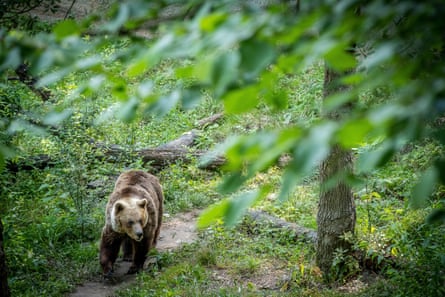
The bears, meanwhile, don’t have much to feed on at the moment. They only woke from hibernation a few weeks ago, explains Alicia Madrid the next day, on a forest trail above the century-old hydroelectric power station at La Malva. A biologist with the conservation group Fundación Oso Pardo, Madrid tells me that Cantabrian bears don’t hibernate as long or deeply as other brown bears and are generally smaller and lighter than American grizzlies.
“They’re adapted to this terrain, and they can’t be too heavy because they have to climb a lot,” she says. Their paw prints in the mud look big enough to me, and the bite marks where they chewed clumps of long grasses, and the hairs shed where they scratched their backs against trees. Madrid shows us, too, the hefty rocks they overturned looking for insects. Further into the summer, there’ll be plenty of berries, acorns, chestnuts and maybe some meaty carrion to fatten them up.
The foundation has played a major role in the regrowth of bear populations, building bio-corridors with strategic placements of trees and bushes full of all the things they like to eat. Another key factor is the hunting ban, introduced in 1973. The trick now, says Madrid, is coaxing isolated cohorts to breed with other groups and boost genetic diversity.
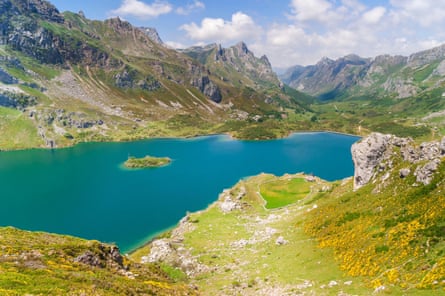
Also: managing the tourists who come to see them, and balancing ecological imperatives against financial incentives. Later, after a long hike through the Valley of the Lake to reach the aptly named Lake of the Valley, I overhear Frechilla fielding the related concerns of two local women. Against a backdrop of blue sky, bright wildflowers and silver waters, the women seem to argue that conservation efforts amount to commercial exploitation. Frechilla gently insists that Somiedo natural park is a model of good practice in Spain. Much of the bears’ territory is closed to the public, and spotting expeditions are only permitted in the company of licensed guides. Nature tourism, he says, keeps villagers in jobs where farming culture cannot, and is proving vastly more sustainable than hunting bears for sport. As for protecting humans, there has been only one bear attack in recent memory, on an elderly lady whose evening stroll led her between a mother and cubs. She survived.
after newsletter promotion
For now, at least, most residents seem willing to share the bears with outsiders. That evening, a small crowd gather by the side of a winding back road near Saliencia, some sitting comfortably on camping chairs with spotting scopes in their hands. Everyone is watching a large male bear – so big and so close that they don’t need the viewing equipment – as he lopes across a meadow to take a quick splash in the river. Another male is spotted in the treeline above, and the two circle each other at a distance for a while. There is some speculation that they might fight for this turf, and a man with two leashed greyhounds seems ready to take bets on it. Frechilla shakes his head.
“Maybe later in the season, when they’ve gained enough weight.”
These bears are doing better now, but it’s still a tough life. The reality of their ongoing baby boom is that only 30% of juveniles will survive on their own, after a year of maternal supervision. This is surely why I find it so moving when we follow reports of another sighting in the twilight: a mother and her two young cubs have been seen climbing a slope called El Diente, or “The Tooth”.
It’s getting dark and cold, but we can see them through the scopes, about a mile away from us across the high mountain pass at La Peral. I watch the mother bear waiting and cajoling as needed while the siblings struggle up the vertical planes of rock like toddlers trying to climb a baby gate. On the ridgeline, they turn to silhouettes, play-fighting against a white sky.
They disappear over the far side, but then a little one comes back, seeming to wave goodbye with both front paws in the air. I remember a story I read to my daughter once, which put a poignant time limit on the usual fairytale ending: “And they all lived happily together, for as long as they could.”
The trip was provided by the Spanish Tourist Office, Turismo Asturias and Casa Miño in Pola de Somiedo. Bear-spotting tours with nature guide Luis Frechilla can be organised through Wild Spain Travel. For more information on the Cantabrian brown bear and related conservation efforts, visit Fundación Oso Pardo