.png) 4 hours ago
5
4 hours ago
5
Linda Matthews has rarely had to stop a production in its tracks. Steve Stone’s 2017 psychological horror In Extremis was an exception. Set on an isolated country estate during an apocalyptic storm, it follows a family that have to confront the oncoming disaster and their own personal demons to survive. For Matthews, however, the real drama unfolded behind the camera. “I don’t mind being the big bad person,” she says. “I was working with a young girl who was playing a cancer patient. She had to wear a bald cap and everything. Just as we were about to film, she burst into tears. She told me it reminded her of her friend’s mum, who was going through cancer treatment. That was the end of that.”
You may assume Matthews is a producer or a very hands-on investor, but you would be mistaken. After leaving a career in banking, she founded Premier Chaperones in 2010 and has spent the past 15 years safeguarding children on some of the world’s biggest film and television sets.
By law, all children under 16 on UK film and television sets require a chaperone. In practice, the role means shapeshifting between that of a pseudo-social worker – making sure children are fed and watered, rested and protected from harm – surrogate parent, and when necessary stand-in sheriff, reinforcing the boundaries of the law.
Unlike fellow crew members, chaperones have a duty to protect the child, not the production. Vetted through enhanced DBS checks and licensed by local authorities – some of which ask for safeguarding training and references, others requiring applicants to pass the first stage of a social worker’s assessment – they enforce child performance regulations, and have the authority to call time on a shoot when a child is distressed, regardless of the wishes of executives or its impact on the production company’s bottom line.
The rules are undeniably strict, forged by cautionary tales such as Judy Garland’s, whose childhood was sacrificed at Hollywood’s altar. Aged 13, she signed to Metro-Goldwyn-Mayer, the studio which controlled her diet of black coffee, chicken soup and cigarettes, while routinely supplying her with amphetamines. She would later die from an accidental barbiturate overdose aged 47.
Garland’s experience was sadly no anomaly. In 2022, more than 50 years after starring in Franco Zeffirelli’s Romeo and Juliet, Olivia Hussey and Leonard Whiting sued Paramount Pictures alleging child abuse and sexual exploitation. Both were minors when they starred in the Oscar-winning movie, and they claimed they had been promised flesh-coloured undergarments for an intimate bedroom scene, only to be persuaded by Zeffirelli to shoot nude in order to ensure the film’s artistic vision and commercial success.
Although the courts dismissed the case, it posed the uncomfortable question of how much agency a minor has, when creative licence can hold more weight than a child’s ability to say no. Accounts such as these also help explain the penalties productions can face if they breach modern safeguarding rules. In the UK, fines can reach up to £1,000 per offence, with the most serious violations carrying a custodial sentence of up to six months.
Yet despite decades of reform, the entertainment industry’s reckoning with child safety remains a work in progress. In the 2024 documentary Quiet on Set: The Dark Side of Kids TV, former Nickelodeon star Drake Bell alleged that he was sexually abused at the age of 15 by dialogue coach Brian Peck, who was later convicted of child sexual abuse offences.
Such incidents reveal the true value of having someone like Matthews in a child’s corner. Although chaperones are often dismissed as little more than glorified prefects, they are the last line of defence for some of the most vulnerable people on set, ensuring that under-16s don’t share toilets or changing facilities with adults, and that children with medical conditions have immediate access to any medication they may need.
On the set of the BBC’s 2015 adaptation of Cider with Rosie, Matthews insisted on a closed set when a child was filming a nude swimming scene. “She wore a waterproof bodysuit and had long hair covering her breasts,” Matthews says. “It was important that it was just me, the cameraman and the director with her. Nobody else needed to be there.”
Her job is to anticipate problems before they arise and quietly make decisions in the child’s best interest. It’s essential work that largely goes unseen and unacknowledged – an irony Matthews knows well. After spending an entire summer working on The Fantastic Four: First Steps, she took her husband to the cinema, expecting to show him her name on the big screen. It never appeared. “Sometimes they’ll credit the janitor,” she says, “but not the chaperones.”
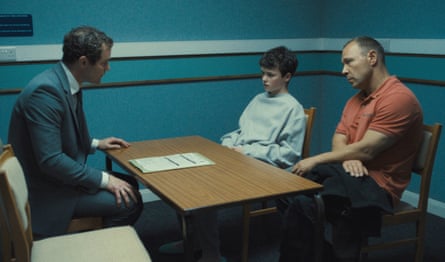
Stephen Rawnsley, head chaperone on Adolescence – Netflix’s record-breaking drama about misogyny, social media and unchecked teenage rage – is also part of the invisible collective. He was in charge of more than 350 child actors and coordinated a team of more than 40 licensed chaperones during production. Yet look at the show’s IMDb page, and it’s easy to underestimate the significance of his role. He is credited somewhere near the bottom, sandwiched between the runners and a person whose job is listed as “insurance”.
Chatting over video call, a few days before his latest stint on the BBC’s Emmy-winning children’s TV show Odd Squad, Rawnsley is pragmatic about where he sits in the pecking order. Though, the more we talk, the disappointment of being TV’s shadow man becomes increasingly clear. “We do an important job,” he says. “It would be nice to get a bit more recognition from production companies and to be treated like the rest of the crew.”
If Matthews is more of a disciplinarian, Rawnsley is the everydad, leaning into the pastoral side of the role. He pays particular attention to children stepping on to a professional set for the first time, making sure they find friends and understand the unwritten rules of the world of make believe. “I talk them through how it all works,” he says. “I let them know they haven’t done anything wrong if a director asks them to film the same scene again.”
That reassurance, however, is matched by rapport-building candour. Rawnsley is clear with his charges that, while they have agency, their choices have consequences. “Some of the kids don’t want to do the work,” he says. “I’ll tell them that if they want to go home, they can. But the production may not ask them to come back because they’re being paid to do a job.”
For many former child actors, it’s this sweet and sour dish that makes a great chaperone. Montanna Thompson, who played Justine Littlewood in CBBC’s The Story of Tracy Beaker, goes so far as to describe her “cheeky” chaperone Mary as “family”. For the best part of half a decade, the pair travelled and worked together, staying in adjoining hotel rooms while filming on location in Cardiff, Newcastle, Manchester and Bristol.
Mary was there for Thompson’s big on-screen moments and girlhood’s quieter milestones. “I actually started my period on set,” Thompson recalls. “I didn’t know what was happening, but Mary talked me through it and went to Boots to get me everything I needed.”
Then there was Russell, a chaperone with two daughters who made the apartment that Thompson shared with two other child actors feel like home. Sometimes it was the small things: letting her paint his nails, or cooking dinners that helped with homesickness. “I remember thinking he was really cool. He was a great person to have around when I missed my mum,” she says. “If I saw either of them now, I’d give them a big hug.”
Despite being among the lowest-paid people on set – often earning little more than minimum wage – having no dedicated trade union behind them, and regularly facing long delays in payments as sign-offs ping-pong between agencies and production companies, it is stories from insiders such as Thompson that illuminate why chaperones keep doing what they do.
Both Matthews and Rawnsley keep in touch with some of the children they chaperoned. Several have requested them for future projects, and gone on to full-time careers in film, television and theatre. “A lot of the girls I worked with on Hetty Feather are in their early 20s. I’d consider them friends now,” says Matthews. “They’ll invite me to come and see them in their shows.” Rawnsley has also attended opening nights and film premieres on account of once being the adult in the room who made a child feel safe.
This is the kind of recognition that matters most to chaperones. Still, in a billion-dollar industry that trades in underdog narratives and ribbon-tied endings, it still feels as if they are undervalued. After all, chaperones as a group aren’t asking for the spotlight – rather just a validating moment as they watch the credits roll.