.png) 3 months ago
49
3 months ago
49
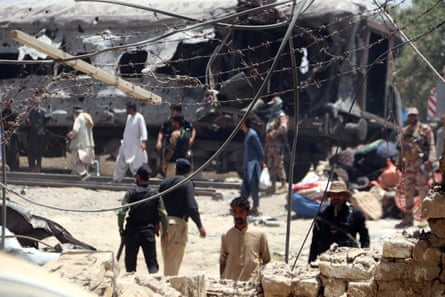
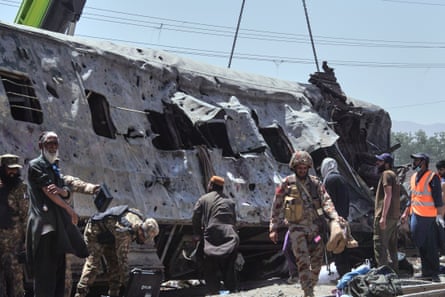
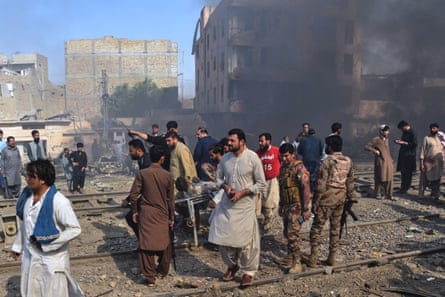
A suicide bomber detonated an explosives-laden vehicle near a railway track as a passenger train travelled through the south-western Pakistani city of Quetta, killing at least 23 people and wounding more than 70 others, officials have said.
The force of the explosion on Sunday caused two of the train cars to overturn and catch fire, sending thick black smoke into the air, according to footage shared online.
The attack happened in an area where security forces are usually stationed, badly damaging several nearby buildings and smashing more than a dozen vehicles parked along the road, according to witnesses and images circulating on social media.
Doctors at local hospitals said they had received the wounded, with 20 in critical condition. Three security officials told the Associated Press on condition of anonymity that the bodies had been transported to hospitals after the attack.
The outlawed Baloch Liberation Army, or BLA, which demands independence from Pakistan’s central government, has claimed responsibility for the attack in a statement sent to reporters. The militant group said it had targeted a train carrying security personnel.
Quetta is the capital of insurgency-hit Balochistan province. The oil- and mineral-rich region has long been the scene of a low-level insurgency. The insurgents have frequently targeted security forces, government installations and civilians in the province and elsewhere in the country.
Shahid Rind, a Balochistan provincial government spokesperson, said: “We strongly condemn the targeting of innocent civilians and are deeply saddened by the loss of precious human lives. Terrorist elements deserve no leniency.”
He said after the explosion a medical emergency was declared at hospitals in Quetta and an investigation had been launched.
Pakistan’s prime minister, Shehbaz Sharif, strongly condemned the attack, calling it a “cowardly act of terrorism” in a post on X and offering condolences to the families of the victims.
Balochistan’s chief minister, Sarfraz Bugti, strongly condemned the attack in Quetta, saying the militants had targeted “innocent civilians, including women and children”, and vowed to “hunt (them down)” in a post on X.
Bugti and the federal government in Islamabad often use the phrase “Fitna al-Hindustan” to refer to the BLA, which they allege is backed by India. New Delhi denies the allegation.
Pakistan’s president, Asif Ali Zardari, denounced the bombing, saying militants and their backers sought to undermine Pakistan’s role in regional and international peace efforts.
The attack came a day after Pakistan said the US and Iran were close to reaching a “memorandum of understanding” to end the war in the Middle East that began on 28 February after the US and Israel attacked the Islamic Republic, upending global travel and spiking oil prices. The US president, Donald Trump, said a deal related to the conflict had been “largely negotiated” after calls with regional allies, including Pakistan.
Zardari promised in a statement that Pakistan would “defeat terrorists, their facilitators, financiers and those providing them safe havens”.
Pakistan and India have long had strained relations and fought two of their three wars over Kashmir, which is claimed by both in its entirety.
Although Pakistani authorities say they have quelled the insurgency, violence in Balochistan has persisted. At least 26 people, including soldiers, were killed in 2024 when a suicide bomber attacked a train station in Balochistan.