.png) 3 months ago
47
3 months ago
47
Aminah Ali, 63, was at home in the Pidie Jaya district of Indonesia’s Aceh province when the rains started at midnight on Wednesday. The waters rose gradually. It seemed like the usual flooding that happens during monsoon season, but then came a loud roar of water: her village was suddenly inundated.
With help from her son, she managed to clamber on to her rooftop, where she waited for 24 hours. Flood waters, 3 meters high, stretched into the distance. “I saw many houses being swept away,” she said.
“Now my house is ruined, full of mud. I never imagined a situation like this. Now I only have one shirt left, I don’t even have any underwear, all my possessions are gone.”
The monsoon season often brings heavy rains that can cause flooding or trigger landslides, but the levels witnessed over recent days are far more devastating. More than 1,100 people have now been killed across the region after seasonal rains combined with tropical cyclones to inundate Indonesia’s Sumatra island – where more than 600 people were killed – Sri Lanka, southern Thailand, Malaysia and Vietnam.
Busra Ishak, 60, also from Pidie Jaya, lost his house, which was swept away without a trace by the force of the waters. “There were hundreds of tons of logs [in the water], and even an elephant could be killed by the incredibly strong current,” he said.
He survived by swimming and grabbing on to a coconut tree, where he stayed for more than 12 hours. One of his older sisters was killed. He still hasn’t been able to tell relatives outside Aceh province because electricity and phone lines are down.
Natchanun Insuwano was among those stranded in Hat Yai, one of the hardest hit areas in Southern Thailand, a region where at least 176 have been killed. He waited, waist deep in water, on the first floor of his flooded home, while his parents balanced precariously through a window, leaning on metal roofing. He was too afraid to perch alongside them, nervous the roof panels below might collapse.
“I could see the current in the water was so strong,” he said. Sofas, TV and home appliances rushed past in the muddy waters.
From evening on Sunday 23 November until Tuesday 25, Natchanun and his parents had just one bottle of water to share. “I looked in the sky to see if a helicopter or drone might drop some food,” he said. Nothing came. “It rained all night so we were so cold with the rain and wind.” He messaged every hotline he could see and posted on social media to ask for help.
The family had listened to the advice of the local authority, which had suggested the water levels would be manageable. When a national disaster agency told residents to evacuate, it was too late – waters had already rapidly reached chest-level.
The failure of Thai authorities to give adequate warning has been strongly criticised.
On Tuesday morning, Natchanun was able to flag down a nearby volunteer rescue boat after shouting at the top of his lungs. “My mom was very weak and unconscious. I just knew we needed to get out of this place so I shouted and shouted,” said Natchanun.
His mother, who was carried out on a stretcher and given first aid, has recovered. They still haven’t returned home, he said. Water has not been restored, and everything is caked in mud.
Chutikan Panpit, 32, who also lives in Hat Yai, believes it is a miracle she is alive. She had walked on to her terrace to check water levels when she was bitten by a Malayan pit viper. Waters were so high that she could not reach a hospital for 32 hours. The pain was worse than childbirth, she said.
“I was scared of dying. My son just turned one. He just learned how to say ‘mummy’ a few days earlier. In the [rescue] boat I was so scared but I just thought of my son’s face,” she said. The current was so strong that rescuers told her to hold on tightly as they accelerated rapidly to move through the gusts of water.
“With this snake (a Malayan pit viper) and 32 hours, people say either you die or have to amputate the leg,” she said. “My parents were so scared, they prayed and prayed and tried everything to wish for me to be safe.”
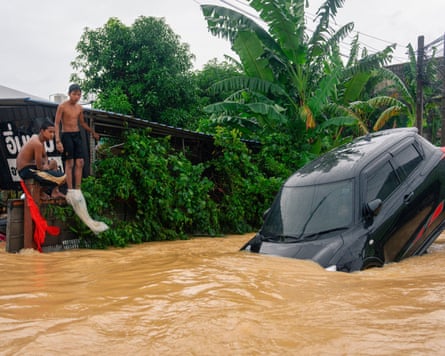
Waters have now receded in Hat Yai, though the scale of the recovery and clean-up work needed is immense. Tens of thousands of homes are damaged. Debris – broken, muddied furniture, strips of wood and rubbish – is strewn in the streets. Many residents have lost almost all their belongings. Today, just the sound of rain is enough to induce panic.
On Sumatra, the largest Indonesian island, at least 11 bridges connecting different regions and sections of the national highway have been cut off. Some villages are still completely inaccessible by road. Even in areas that have been reached by recovery teams, local people say they do not have enough food or clean water.
Many flood victims remain at rescue shelters, relying mostly on donors in the community for food and drinks. Others are trying to salvage what remains. Busra has gone to his brother’s home to try to clean and protect his valuables. The disaster is far worse than any flooding in previous years, he said: “This year’s flood is the worst tragedy in history.”