.png) 1 month ago
75
1 month ago
75
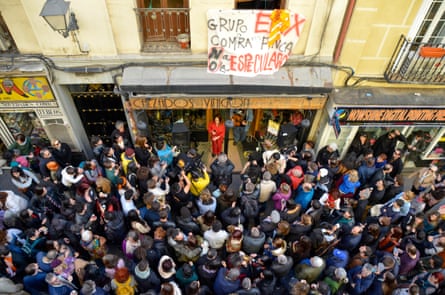
Spain’s housing crisis finally came for the tenants of Madrid’s Calle Tribulete 7 when their block was sold to an investment fund. Feeling pressured to leave by rent increases and aggressive construction works that flooded some apartments, they did everything they were supposed to do: organise meetings, contact the tenants’ union and find a lawyer. They also protested, spoke to journalists and created an Instagram account to spread the word. But they also did something I’d never seen before.
They opened up their homes to the public and invited musicians to play inside, in the very flats and shops that were suddenly at risk. A month later they flipped this concept on its head and took their furniture out on to the street. There the tenants cooked, knitted, played chess in their dressing gowns, worked from home and bobbed in their armchairs to a local band playing a brass version of Freed from Desire. It was a spectacular theatrical performance of everyday existence, but also a fight for their lives.
In the years after the 2008 global financial crisis, and the Spanish housing disaster that followed, the country’s campaigners have slowly changed tack. Back then, banks and their reckless mortgage loans were the main problem, and defining the frontline was the Plataforma de Afectados por la Hipoteca (PAH), the organisation that launched Ada Colau to fame and the Barcelona mayoralty, and helped stop countless evictions. Though the PAH is still relevant today, the Spanish housing crisis of the 2020s involves the buying up of entire residential buildings – some of which have a hundred tenants inside – by domestic and foreign investment funds such as Blackstone.
The media framing of Spain’s housing crisis has evolved, too. For decades, photographers such as Olmo Calvo and Alberto Astudillo have documented the most brutal cases: armed police battering down doors, personal belongings piled on to pavements, grieving parents doing their best to shield their traumatised children. But a new style of coverage is emerging – one that celebrates the community under threat, in the hope that the act of celebration can inspire citizens to mobilise to protect the right to a decent home.
This is exactly what myself and fellow documentary film-maker Elisa González have been involved in for two years in our own neighbourhood of Lavapiés in central Madrid. From that first day of living-room concerts, we realised we weren’t simply documenting Spain’s housing crisis, but witnessing the emergence of a new social movement.
The tenants of Tribulete 7 are a typical cross-section of Lavapiés society: young families, pensioners, single women, migrants, teachers, healthcare workers, writers, actors, musicians. They are all deeply woven into the cultural fabric of Lavapiés – a neighbourhood renowned for its creativity and historical resistance. So when their homes came under threat, they instinctively reached for the tools they had to hand: their social and cultural capital. That’s how an apartment block in Madrid became a stage, broadcast on every news channel.
Nani, who lives on the second floor of Tribulete 7, runs El Elemento, a DJ collective for people with disabilities. One of her star performers, DJ Jessy, played at the residents’ first musical protest, inside the now-closed shoe shop in the building. DJ Jessy’s popularity also brought her to the biggest stage of the Madrid neighbourhood fiestas, organised by Madrid city council. But Nani is fearful for the group’s future if they are forced out of the neighbourhood. The council is happy to champion local culture, but takes little interest in addressing the housing crisis that will ultimately destroy that very cultural fabric.
Worse still, critics say Madrid’s recent planning reforms, presented as a way of regulating tourist accommodation, have also made it easier for entire residential buildings to be converted into tourist accommodation, with a simple change of licence. With its position right next to the city centre and its attractions, Lavapiés already has one of the highest concentrations of unlicensed tourist rentals in Madrid – and this situation looks likely to worsen. Among the first buildings in Madrid to fall victim to this conversion scheme is, unsurprisingly, just around the corner from Tribulete 7.
For the residents of Tribulete 7, the battle rages on. After years of campaigning against their new landlord, the residents and their prolific lawyer, Alejandra Jacinto Uranga, filed what could become Spain’s first successful lawsuit against an investment fund for alleged real estate harassment – the building’s owners reject this and are fighting the case. Beyond the groundbreaking legal fight, the protests and the viral concerts, the tenants of Tribulete 7 are tapping into something even more important: community care.
after newsletter promotion
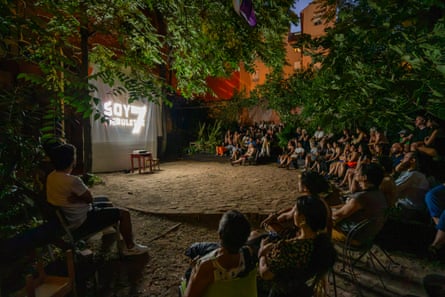
I’ve watched with admiration how the tenants have brought the entire neighbourhood together, giving people purpose and a shared sense of joy in the midst of one of the most aggressive housing crises in Europe. We have sought to replicate this same spirit when organising free local community screenings of our documentary Soy Tribulete 7.
One of my favourite screenings so far was with DJ Jessy in local nightclub Club 33. After the film, DJ Jessy and her crew ascended to the DJ booth, and the neighbourhood tore up the dancefloor. It was a moment that made me realise that culture is not merely a reflection of resistance – it is resistance, and it is part of Spain’s new fightback, for the right to good, affordable, secure housing for all.
-
Leah Pattem is a multimedia journalist based in Spain