.png) 3 hours ago
3
3 hours ago
3
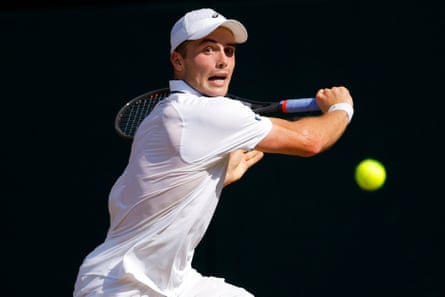
“I was around 300 in the world and still really struggling with my arm,” Arthur Fery says as he explains how life has changed from this time last year when, after his shock appearance in the Wimbledon semi-finals, he rose to No 36 in the rankings. His run of five victories, which produced a stunning turnaround in his career, was celebrated as a glorious “Fery-tale”.
But it does not take long in the company of the measured and thoughtful 24-year-old for the grit to emerge from the deeper shadows in his story. There has been more pain than glory in the long hard slog to this point but, amid the doubt caused by his injury, Fery’s self-belief has remained intact. As he says in Cincinnati, his success at Wimbledon provides a dizzying contrast to the testing times he has endured.
Last year he did not even play the qualifying rounds in New York but he will now make his debut at the US Open which begins this week. Memories of his travails from 12 months ago are still clear as Fery says: “I came back from an arm injury before Wimbledon 2025. I won a round at Wimbledon so that would have pushed my ranking up. But this time last year I had an MRI scan because my arm was really painful again. I was battling arm pain for a long time.”
Fery has been able to play many more tournaments over the past year but he nods when asked if he had begun to doubt he would become a leading player? “Definitely. Between 2023 and 2025 I barely played a full schedule because of my arm. I was battling for two years and it’s still not completely resolved. But it’s on the way there. It’s getting better and I’m able to play a lot of tournaments.
“There was definitely a lot of doubt and some moments where you just can’t find a way out, or see a way of improving things. It’s difficult. But that helped shape me as a warrior who has a good mentality – even though I wish [the arm injury] had never happened.”
Fourteen months ago, while Fery was mainly playing Challenger events where it is so hard to make money and rack up ranking points, his friend Jack Draper had risen to world No 4. Draper looked ready to fight Jannik Sinner and Carlos Alcaraz for grand slam titles – only for an arm injury to ruin his past year. He has slumped to No 143 and, after breaking down in tears in Toronto this month, Draper has withdrawn from the US Open.
When we discuss his empathy for Draper, Fery says: “It’s the same injury. We text because sometimes his arm’s doing well and mine’s not or vice versa. We always keep in touch and exchange thoughts because it’s not an easy injury at all.”
When Fery beat Grigor Dimitrov and Flavio Cobolli, the world No 10, to reach the Wimbledon semis, many people were amazed by his composure. Fery had not been expecting to reach the last four at the biggest tournament in the world but he was impressively unsurprised by the quality of his play. “I always had belief in my level,” he says now, “but my body was stopping me from playing much. When you don’t play much, you can’t play at your top level. You need to practise and have matches under your belt to reach the best of your ability.”
Fery pauses: “There were some moments when I was thinking: ‘Oh, this [injury] is what’s going to make me stop playing tennis, or be the limiting factor in my career.”
He played his first tournament since Wimbledon when, last week, he reached the third round of the Cincinnati Open. Fery made a commendable comeback and reeled off five games in a row in the second set before losing 7-5, 7-6 to the world No 8, Alex de Minaur.
It was different a year ago as Fery initially did not even make qualifying at Cincinnati. He smiles ruefully: “It was very weird because I wasn’t in the draw and then someone pulled out that morning and in 30 minutes I had to go from breakfast to the court. I beat Zachary Svajda in the first round, 7-6 in the third. Really tough match. I lost to [Martin] Landaluce in the second round of qualifying in three sets but I had some good sensations.”
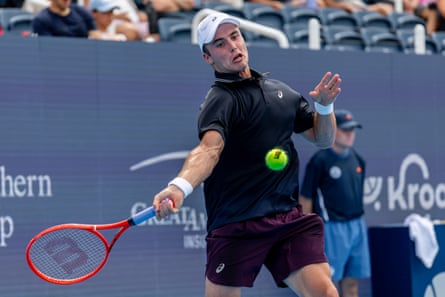
Fery returned to the Challenger Tour in Colombia next and those positive feelings continued as he won his first ATP title in Barranquilla. He earned $14,000 (£10,260) and climbed to No 237 in the rankings. A year on, having graduated to the main tour, he made $36,100 in Cincinnati after a grinding victory over James Duckworth was followed by his loss to De Minaur. It must seem like small change compared to the £900,000 he won after reaching the semi-finals at Wimbledon against world No 3 Alexander Zverev.
But it’s important to remember how much it meant last August for the injury-ridden Fery to win his first Challenger title. “Challengers are really difficult and everyone is really hungry to win and it’s tough,” Fery says. “The conditions are not as good as they are on tour – where everyone wants to be. So a lot of players there are tough to beat. The average level is a little lower than the ATP tour but the willpower and hunger to win is very high.”
Wimbledon has changed everything and Fery now sails into the main draw of the US Open and just misses being seeded. This will be his first taste of the senior grand slam at Flushing Meadows because he has only previously played at two junior US Opens. The second, in 2020, was largely devoid of spectators because of Covid-19 but he sampled the raucous atmosphere a year earlier. “I lost in the second round of juniors to Liam Draxl [the Canadian who is currently the world No 216] 7-6, 6-1.”
This is another example of Fery’s remarkable recall for he knows the exact score of a junior match which took place seven years ago. When I interviewed Taylor Fritz last year he showed a similarly exceptional memory as he told me the score and detailed incidents from otherwise obscure junior matches. Has Fery always been like this too?
“Definitely. Some [players] really like to remember or they feel things quite deeply. I’m someone who remembers and lives matches intensely so I’d be able to tell you a few things about that match against Draxl. I was using a racket that was way too heavy for me and I struggled big time on my strokes. I was tinkering with my racket for a valid reason but it went too far. I also remember it just being really hot and struggling physically, sweating so much.”
after newsletter promotion
Fery’s memories of Wimbledon this summer are, of course, much sweeter. “I played so many incredible players who had incredible careers at Wimbledon and managed to get through. I never thought that the semi-finals were possible. But I just took one match at a time and played the opponent, not the stage, and there was never a match up until the semis which I thought I couldn’t win.”
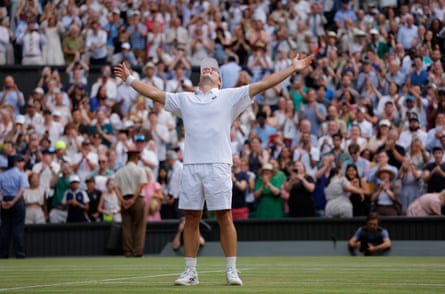
What was his favourite victory at Wimbledon? “I would say the match against Zizou Bergs on the Saturday [the third round on court 18]. That was the most special because it was the match that made me break top 100. I was very close to losing in four sets, when I was a break [and 4-1] down in the fourth, and same again in the fifth, and I just clawed my way back. It was my first five-set match that I won, and it took almost five hours with everyone watching.”
What does he remember most of his straight sets defeat in the semis by Zverev – who had just won the French Open before pushing Sinner so hard in the Wimbledon final? “I knew that day was definitely a step up in terms of opponent but I was able to stick with him in the first. I’d been broken early but I broke back and stayed him until the tie-break.
“Yes, my level dropped a little in that tie-break and his average level was so high, with his full quality so high on both wings and with the serve. If mine dropped by even 5% I was in trouble. I lost that tiebreak 7-0 and then it was tough to fully believe, 100%, like I did in my other matches. I was obviously playing the No 3 in the world and the French Open champion. So I had to face a tennis issue as much as the mental one.
“I hate losing and, no matter how good the opponent is, I always feel like I could have done better in most matches that I lose. But that one was definitely a bit easier to swallow, even though it would have been great to keep the dream going, and winning the tournament was only two matches away. But I had two of the three best players in the world to beat.”
Fery knows that there are many areas in which he can become stronger. “I can improve my game on clay, for example, which will be very important. I also need to get better at dealing with high balls, serving better, being able to play long matches in a row more.”
He is only 1.75 metres (5ft 9in) tall whereas some of his opponents, like Zverev, are 1.98 metres (6ft 6in). “But there are other things that I can do better than them when using my height. I return very well, I can move very well because of how low to the ground I am. But I need to work on my mindset, taking the ball early, using my hand skills, things like that.”
Fery adds: “We haven’t spoken about ranking goals since Wimbledon. I started the year at No 180 and I wanted to be top 100 by the end of the year. I’ve got that done but I now need to stabilise as a top 30 player and then push on because there are a lot of things I feel like I do better than those players above me. But there are also lots of things where I’m not as good as them.”
Are there lessons to be taken from his British compatriot Emma Raducanu, who won the US Open as a qualifier in 2021, but has since struggled with injury while changing her coach multiple times? “Yes, definitely. It’s really important to have good people around myself. My coach, my parents, my agent are in it for the right reasons and are going to guide me down the right road even when there are so many more commitments. That’s the first step towards not being distracted.”
Has he noticed a change in other players’ attitudes towards him since Wimbledon? “Yes and no. I’ve been congratulated quite a lot but the tennis schedule is pretty relentless and I feel like everyone forgets quite quickly, which is good, because it means you don’t get stuck in one tournament or result. You always have to keep pushing forward. But it definitely feels good to be around the top players in the world.”