.png) 3 months ago
69
3 months ago
69
Tom was my hero from the night I first saw Travesties in 1979. I was 15. The older kids at school did a production of it and I was spellbound; it was glamorous, sensual and completely incomprehensible. I wanted to know everything about this cool, obscure playwright. I started in the school library with the Encyclopedia Brittanica. Then I read Rosencrantz and Guildenstern are Dead (incomprehensible) and then I read a third of Jumpers before giving up (totally incomprehensible).
As an English Lit student in the mid 1980s, I studied Stoppard and found his work slightly less incomprehensible. But in 1993, I saw the original production of Arcadia and felt that same spell I’d felt as a child. Let’s call it art. And beauty. And words spoken from a stage like no one else. A couple of years later, my first play, Dealer’s Choice, had just opened at the National Theatre and Tom was on the board. Someone told me: “Stoppard saw your play and mentioned it in some speech to donors as a good example of new writing at the NT.” A week or so later, I met him at a drinks do. He approached me. He approached me. All hair and suit and cigs and warmth. He gave me a hug and told me I was a proper young playwright.
He was the rarest of men. Very few can carry off polite English gent and Jewish mensch simultaneously. Over the next 20 years, he saw all my work and I saw all of his. We corresponded by mail, had lunches, mutually commiserated our failures: “Patrick, to be a playwright is to have one’s heart broken every day.” Said with a grin, always. He made me lunch (pasta) at his big flat in Chelsea and then gave me notes on my new play, Howard Katz: “I don’t think you should kill him off at the end. Condemn him to life. Much better.”
And then in 2015 everything changed. Or so it seemed. One night my mobile flashed: “Tom Stoppard.” It must be important. I was at the time “about my toilet” – but a call from Tom had to be answered and I calculated that even a man as clever as him would not divine my whereabouts.

“Patrick, it’s Tom.” “Hello Tom.” “Do you by any chance know my play Travesties?” “Yes I do. It’s marvellous.” “Oh, do you think so? Well, thank you. Now, the thing is that the Menier Chocolate Factory would like to revive it next year.” “Great!” “Yes, it’s exciting. May I ask you something?” “Of course.” “Do you think Sam West would be a good director for it?”
Pause. “He’s terrific, Tom. He did me very proud with his revival of Dealer’s Choice.” “Oh good! Thank you!”
Before he rang off, I managed to blurt: “If for some reason Sam can’t do it, please will you consider my hat in the ring?”
Two weeks later I was offered the job. I said a grateful “Yes” and then re-read the play for the first time in 36 years. It was incomprehensible. But I was doing it.
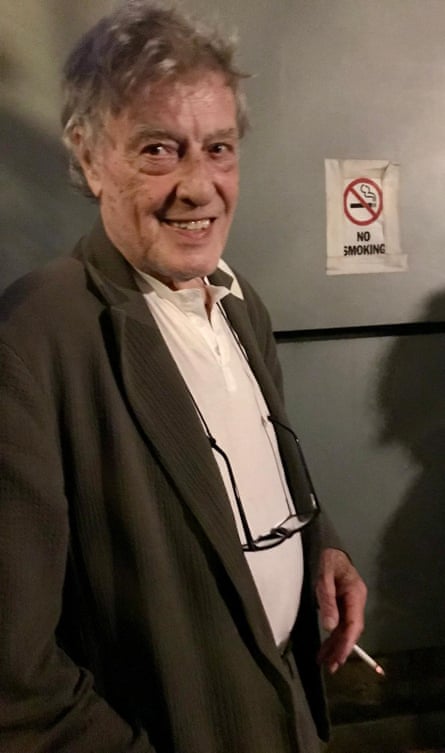
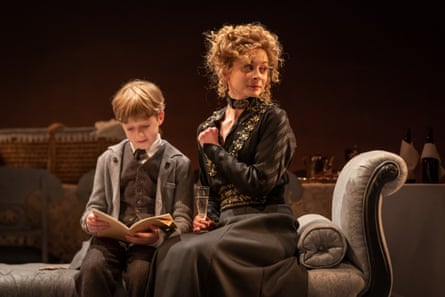
Now we were working colleagues the relationship became more complicated. We had long, smoky meetings. I soon realised that to work closely with Tom, I should resume smoking. He smoked from dawn to bedtime and it seemed to me bad manners not to join in. We compared different drafts of Travesties, about a consular official’s adventures in 1917 Zurich. He was a serial “re-publisher”: he liked tinkering with each revival. Something to do with exerting authorial control over what were now set texts and established modern classics. He wrote some new lines for this revival and came to rehearsals almost every day.
My wife, Debra, and I were often at the house in Dorset during the Travesties years. Tom and his beloved wife Sabrina were great hosts. Their garden was perfect. The sun shone. We often stayed up late watching TV. One night Jaws was on. Tom insisted we watch it. He declared it one of his favourite films. He knew it shot by shot: “Here comes the floating head.” Every morning, the newspapers arrived. He read them all day. He was possibly the last man in England to do this. He spoke with love of his early days in Bristol as a journalist.
Tom had famously good manners and was extremely generous. It took me years of accepting his hospitality before he let me pay for a meal. And there were many. But there was one place where he didn’t always have good manners – the rehearsal room. I had been warned by others who had directed his work. And so it proved, startlingly at times. We’d be working a scene, stumbling, trying things out and out of nowhere he’d shout: “I hate this, I hate it!” The whole room would fall silent. I’d go over to his table, whisper: “We’re just exploring an idea. It probably won’t make it into the show.” He’d look up, longsuffering: “Please let it not.” And then he’d be completely charming for the rest of the day.
Over the following years of working together, we never discussed his outbursts. I think it was the only thing we never discussed. But once he trusted that I cared about the play as much as he did, he became angelic. I loved him for baring his teeth. I loved his passion for the work and his tough love for getting it right. There was a preview of a show in which an actor had struggled a bit with their performance – lines, blocking and so on. At the interval, Tom whispered in my ear: “He’s like a dormouse in a hurricane.” I loved discovering that he wasn’t always nice. His occasional acts of contempt made me feel like a proper collaborator. Inside the tent.
Anyway. Travesties was a hit and Tom was thrilled and perhaps slightly surprised. I think he thought my production was a bit “out there” but he was delighted it had worked. Some time after we opened, he phoned and asked if I was at home. He said he had a delivery for me. An hour later, he arrived with a big antique corner chair which he carted into our flat. The chair had belonged to Peter Wood, the original director of Travesties; it was the chair Tom had always sat in when Peter was giving him notes. And now it was mine. My children thought of Tom as the chair delivery man thereafter.
Travesties transferred to the West End and then Broadway. In spring of 2018, Tom and I were standing smoking on West 42nd Street. Travesties was in preview and it was intermission. He quietly mentioned that he was jabbing in the dark with a new play. The humility was typical. A new Stoppard play was headline news and had been so since the late 1960s. Yet here was the globally acknowledged magician suggesting that he was “having a go” like some novice.
Ever since I’d begun preparing Travesties (back in the summer of 2016) Tom had been desperate to write a new play. He often exclaimed so with considerable frustration. At one point during that period, he said that if he couldn’t write a new one, he might as well be dead. I took it that he meant it in a writerly sense. Tom was a natural born playwright. He didn’t really regard his screenplays, lectures or talks as proper writing. They were just distractions from the real thing.
In April 2019, the new play – later titled Leopoldstadt – arrived; old-style, hard copy in the post. A note from his long-term secretary: “Tom asked me to send you this.” I sat down and read the new one. And then I sat in silence for an hour, overwhelmed. Elated for him that he’d written it, and elated that he and his producer Sonia Friedman were asking me to direct it.
The first read-through of the new play occurred that summer. Tom, me, Sabrina, Sonia and Debra round a table in Dorset. Tom played the leading role of Hermann. We did the others. It was jovial and merry despite the material. All of us happy that Tom had pulled this late great play out of the bag. (Sidebar: I am using cliches like the above in tribute to him. I once queried his use of a tired old phrase somewhere and he said: “I like cliches! I use them often. With my work it helps for the audience to know where they are now and then.”)
So we read the play and it was going quite well, but then in the last scene I broke down in tears as I tried to read one particular line about the decimation of Jewish life in Vienna. The women comforted me with tissues and hugs. Tom not a bit. I thought he’d be pleased that his director was so moved by his play. Not at all. I was stopping the flow. He allowed me a moment to mop up and then plunged back in, taking over my role.
And this is the thing: it does Tom a disservice if his generosity of spirit, his kindness, his charm are the only story. In truth, he could be tough as an old boot. Tomáš Sträussler. Czech refugee. A fatherless Jewish boy who came to England aged eight and encountered rife antisemitism in his new home. A man whose stepfather, Major Stoppard, never bothered to see a single one of his plays and then wanted Tom to lose the name “Stoppard” as soon as his beloved mother had passed away. At the time, Tom was a globally revered playwright. He told the major that losing the name “might be somewhat inconvenient”.

There was rage and pain and iron in Tom. It’s in the plays, it was in the man too. His famous remark about having lived “a charmed life” has always struck me as double-edged. “Charmed” is a lovely word for it. The implications are of luck and magic, but also something haunting, as if the life lived was not entirely his own. Leo, the character in Leopoldstadt based on Tom, uses the phrase too. But Tom told me that the key line in the play, the motor for him of the whole thing, is said by the tortured Holocaust survivor, Nathan. A line spoken in accusatory scorn to Leo: “No one is born eight years old …” And then: “But you live as if without history, as if you throw no shadow behind you.” This brave, painful play, the last Tom wrote, was him looking at his own dark shadow. It’s all there in an article he wrote for Talk magazine in 1999. He had the play in prototype two decades before he wrote it. He turned facts into poetry.
Anyway. Leopoldstadt began rehearsals in December 2019, opened in London the following February then closed seven weeks later for lockdown. Tom made some cuts, did a few rewrites and we reopened in August 2021. We finally opened in New York in October 2022.
When we’d done Travesties he was still pretty vigorous, but Tom was 85 now and stairs were a menace. He would sometimes take my arm in the street. I no longer let him get a cab without putting him in it. But we had fun. There was smoking and drinking and eating. There was gossip and his incredible stories of times gone by. There were old pals to see and a company of actors young and old who adored him. But he was also having nightmares and talking about his own death. Regularly. As if he saw it on the horizon. We talked about the next play. He had ideas but none that were ready to be written. He won his fifth, record-breaking Tony in the summer of 2023 and I found myself thinking maybe he’s made of some other stuff and he’ll simply live for ever. But he got ill in early 2024 and the slow descent commenced.
About a year ago, I was at the flat in London. He’d stopped smoking – a very worrying sign. Said he just didn’t feel like it. He said he occasionally had the odd puff but couldn’t finish them. He was thin. Very thin. But all there. In his gown and slippers. Something Chekhovian about him. Anyway. Sabrina had gone out leaving us to ourselves. He told me it was fine to smoke, would welcome the old reek of it, so I did. He eyed my packet and asked if he could have one. I hesitated. I really didn’t want to be responsible for killing the greatest living playwright. He insisted. We smoked four fags each, back to back. He was chuckling away. Guilty schoolboy. Then he said he was very tired now and would I help him to bed. I walked him to the bedroom and tucked him in. I gave him a hug. Told him I loved him. He said the same. I saw him many times again after this, but it was the last time I saw him alone.
Since Tom died, so many actors we worked with on these two plays have texted and emailed to express their love for him, their admiration, their sense of joy to have worked with him. I feel all this too. It was the greatest honour and luck of my life to spend these years directing and redirecting two staggering plays by Tom Stoppard.
Travesties and Leopoldstadt travel beautifully through time; the young become old, people love and kill, the world keeps flipping its coin; war and peace. All this life from plays set in one room in a middle European city in the first half of the 20th century.
Well, of course. The playwright was born in former Czechoslovakia in the summer of 1937. A part of him was always there. No one escapes their childhood. Not even a genius can do that. Rest in peace, Tom.