.png) 1 month ago
44
1 month ago
44
When millions of voters across Great Britain go to the polls on 7 May, the result will have a profound impact on the future of Keir Starmer’s government.
In Wales and Scotland, nationalist parties are expected to be in charge for the first time simultaneously, joining Sinn Féin in Northern Ireland. In London and the cities, the Greens are on the charge.
But it is across Labour’s former heartlands in the post-industrial swathe of the Midlands and north of England where Starmer faces losing hundreds of councillors to Nigel Farage’s Reform UK
That result would alarm several cabinet ministers whose seats are in the once-solid “red wall”, including Yvette Cooper, John Healey, Ed Miliband, Dan Jarvis and Bridget Phillipson.
The Guardian spoke to voters and politicians in three traditionally Labour strongholds – Barnsley, Sunderland and Wakefield – to test the mood.
1. Barnsley
England’s longest-serving council leader, Stephen Houghton, has outlasted eight prime ministers in his three decades in charge in Barnsley.
The South Yorkshire town is unrecognisable from the one that had “gone off a cliff” after mine closures and the loss of 20,000 jobs. Yet for all the council’s achievements, Houghton said it was “very difficult” to get a hearing on the doorstep as two issues dominate: “It’s the prime minister. And it’s migration.”
Houghton, who was knighted in 2013 for his services to local government, said the mood was dire: “We’re walking into a political abyss in three years’ time. That’s where we’re going. Very rarely do governments recover from what might be coming in two weeks.”
Farage, who visited Barnsley this week, is increasingly confident of toppling the Labour council for the first time since the modern borough was formed in 1974. Houghton said the challenge for his party was much bigger than Starmer. “Labour has got to stop looking like and feeling like a big city party,” he said, urging the government to focus strategic investment in technology, defence and roads into areas across the Midlands and north.
In the village of Cudworth, Richard Key, the owner of Deacons DIY store, said many of his customers were disillusioned Labour voters who have said they would never vote for the party again and that many were going to Reform UK.
Richard Key said many of his customers were disillusioned Labour voters who have said they would never vote for the party again. Photograph: Christopher Thomond/The Guardian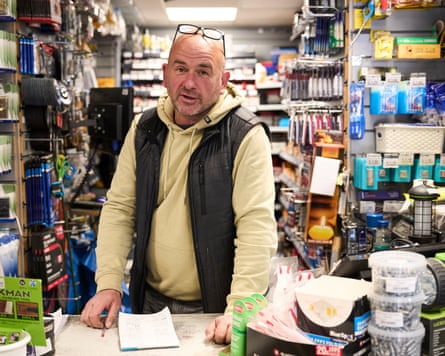
Key, 55, described the Labour government as “useless” but that he was prepared to give the party his vote because it had done a good job locally.
Jason Evans, a critical care practitioner, agreed. “In terms of around here I don’t think Labour have done a bad job. As a family man, my kids have been really well looked after by Labour,” he said.
But that is where his enthusiasm ends. Evans said the government had failed to deliver its promises and was handing benefits to families who did not need it.
The Reform candidates trying to unseat Labour in Barnsley include a man who appeared on the Channel 4 documentary My Online Bride in 2014, in which he admitted spending £8,000 to secure a visa for a Thai woman who would do “chores”. In one clip he points to a cupboard of cleaning products and tells her: “That’s your cupboard.”
Another Reform candidate is a self-described “spiritual medium” who appeared on a TV show to reconnect with his “past life” as a Native American. His website advertised ghost nights and ceremonies to clear unwanted “earth-bound spirits”.
A third was criticised for mocking a man shopping in Aldi as “his Pip money had landed”, posting a covertly taken photograph of the shopper “looking for provisions to take back to [his] nest of claimants”.
Farage allies know, however, that most voters will not carry out research on individual candidates before polling day. What matters is the party logo.
Steve Houghton, leader of Barnsley metropolitan borough council: ‘We’re walking into a political abyss in three years’ time.’ Photograph: Christopher Thomond/The Guardian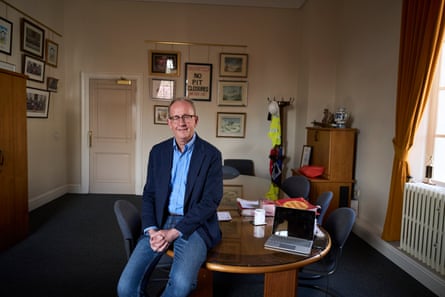
2. Sunderland
In the north-east of England last year, Labour were humiliated and almost wiped out in their former stronghold of County Durham. In 2017, the party had 94 of the county council’s then 126 seats. It now has five of 98.
The runaway winners were Reform and no one would be surprised if the same thing happens in the elections for Sunderland, Gateshead and South Tyneside councils.
Each one is an all-out election, with all council seats being contested. Each council has a Labour majority. None has a single Reform councillor. Yet Farage is so confident of victory in Sunderland that he chose the city to formally launch his party’s local election campaign.
Talking to voters in the city centre revealed strong Reform support, although it may not be the juggernaut some are predicting. Chinks in the Reform armour are appearing. The party lost ward byelections in Durham and Northumberland this year.
The most common view was an almost visceral antipathy towards politicians of all parties. “I cannot stand the lot of them,” said Ronnie Smyth, a retired building site worker, out with his wife, Joyce. “Starmer is a waste of space, he’s just clueless. I was Labour all my life when Labour was for the working class, now they’re for people with money.
“We just don’t want to vote any more. Sometimes I just don’t want to listen – they are all just the same.”
He added: “Everyone is just sick to their back teeth of politicians, especially in the north-east, in Sunderland. We are the forgot-about city.”
Joyce and Ronnie Smyth in Sunderland city centre: ‘We just don’t want to vote any more.’ Photograph: Mark Pinder/The Guardian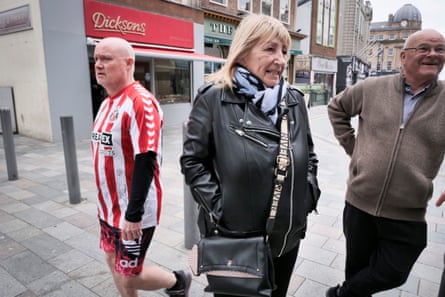
Ernie Mileham, 79, a former miner who supports Reform, said: “I always voted Labour, but not now. They’re screwing us. If the 600 MPs sitting there [in the Commons] were all vetted, well there’d not be many still there.”
Labour has been in control of Sunderland since the council was created in 1974. Local councillors hope voters will vote for local reasons, pointing to improvements across the city – a new cultural venue, a new eye hospital, a footbridge over the Wear, more office space and the jobs they bring, a film and TV studios.
That hope is optimistic. “Labour deserve to lose,” said Janet Wight, out with her husband, Morgan. “They do a lot now but all the improvements have happened since Sunderland lost out to becoming city of culture [in 2021]. That’s when it started. Before then everywhere, the seafront and everything, was rubbish. I think they deserve what they are going to get.”
3. Wakefield
In Wakefield, a Labour stronghold since its inception in 1974, voters were conflicted. With 49 of 63 seats now held by Labour, the idea the party may not win in Wakefield would have seemed preposterous to many only a few years ago but May’s result is less than certain.
For Jenny Lake, who was taking her dog Lily to the Bakes by Vanilla Bean coffee shop for a treat, the only strategy was tactical voting against the Conservatives. “It’s less clear this time,” she said. “Previously it’s been clear but I don’t know who to vote for for safety.”
She would not vote Reform because they have put too many leaflets through her door. “They’re trying very hard,” said Lake, who works in the NHS.
Jenny Lake and her dog Lily: ‘Previously it’s been clear but I don’t know who to vote for for safety.’ Photograph: Richard Saker/The Guardian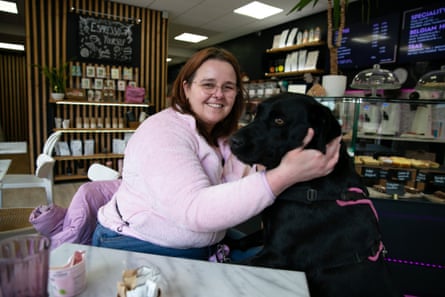
Her view of Farage was the same as other politicians: “I always think they’re idiots. You have to be a certain personality to make it in politics and I don’t like that kind of person.”
Farage was not popular in Wakefield but this did not stop people considering voting for his party in the local elections. There are two Reform councillors – both Tory defectors – in the city, making it a tough, but not impossible, task for the party to cause real disruption.
A street cleaner, who did not want to be named, said he felt Reform had some appeal, especially because of its pledges to tackle illegal immigration. “Legal I don’t have a problem with. Doing this job you get to talk to all kinds of people and I think people in Wakefield tend to be generally pleasant and welcoming.”
Islem Jandoubi, who owns the Mexican-Italian restaurant No Manches in the city centre, said he was not worried about the effect of the anti-immigration sentiment as a Tunisian living in Wakefield, because “civilised people don’t have a problem – or they don’t voice it”.
Islem Jandoubi, a local business owner in Wakefield, West Yorkshire. Photograph: Richard Saker/The Guardian
The overriding sentiment was that people were feeling let down by Labour. “I can’t vote Labour and I’m not going to vote for anyone else,” said Jeff Thomas, a retired construction manager. “I can’t vote for [Starmer] – he doesn’t come out with anything.”
Thomas had voted Labour in the past but voted Conservative in the last election. This time he would not be voting at all.
The street cleaner, who was using a jet wash on the cathedral steps, added: “The Labour council has been fine and where I live the councillors are quite good. But the national party has missed the point. The policies are not for the working man.”