.png) 6 hours ago
10
6 hours ago
10
Forty years ago, as an undergraduate in Hokkaido, Toshiyuki Nakagaki came upon a lemon-yellow stain in a petri dish. That encounter turned him into a doyen of slime mould research – and fed a storm of biological and philosophical debate about the meanings of life and intelligence that persists to this day. Before, no one would have called a slime mould “intelligent”; the popular adjective, in fact, was “simple”. “A simple mass of protoplasm,” one 1895 description ran; “among the most simple of organisms”, said another. And it was hard to argue otherwise. A slime mould can appear to be just a small cell, capable only of feeding and reproducing. Simple is as simple does.
Of that first meeting, Nakagaki said: “I was just impressed with how fast it moved.” Physarum polycephalum, the slime mould species in that petri dish, has a top speed of 1cm an hour. For amoebic organisms, that’s gold-medal standard. At first glance, Physarum seems to spread as irregularly as ink on blotting paper, but in fact it senses its meals of bacteria or other microbes and reaches for them with a long, thin finger of protoplasm – which not only digests its food but then forages further or pulls back into the rest of the mould. It’s impossible to watch a slime mould over many days without sensing some deliberation at play.
Physarum is often found as a glistening patch creeping over leaf litter in forests; hence its nickname: “dog vomit mould”. Even at its most expansive, occupying a couple of square metres, it is a single cell containing many nuclei – the tiny microdots holding its DNA. (Technically, this kind of structure is called a “syncytium”.) The fact that you can see it with the naked eye, and even perceive the swells and contractions of the protoplasm within, makes it ideal for experiments. So Nakagaki got to work.
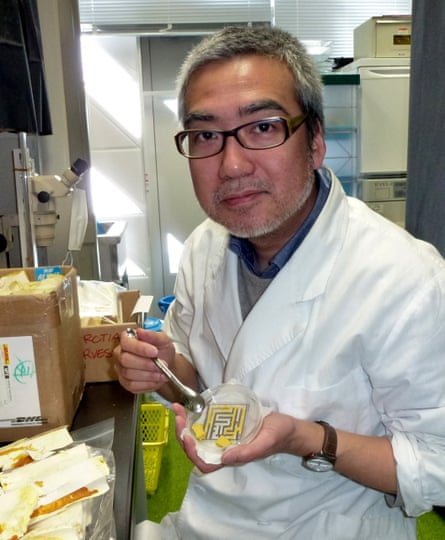
In 2000, his astonishing research began to surface in the media. “Slime mould solves maze puzzle,” one headline ran, summarising an experiment in which Nakagaki induced a Physarum to find the shortest route through a maze in search of food. (In labs, slime moulds are reared on oat flakes, a convenient diet that can double as a researcher’s breakfast.) In 2010, the New York Times wrote about Nakagaki’s most famous experiment – the canonical study that scientists offhandedly call “the Tokyo railway one”. Nakagaki placed oat flakes to resemble the map of Tokyo and 35 of its satellite towns. Then he let the Physarum loose from the centre of “Tokyo”. From that one metropolitan oat, the mould spread outwards seeking the others, stretching towards them with its tubules. Then, putting out more branches, it linked up with itself, from one suburban oat flake to the next.
In doing all this, the mould displayed such a verve for efficiency – no wasted motion, an optimal pursuit of its food – that it ended up nearly retracing the route map of the greater Tokyo area’s railway system. Nearly, Nakagaki said – because, in fact, free of human bias or politicking, Physarum may have improved the design of the network. Later, when Nakagaki twice won the Ig Nobel – the prize for research that is both amusing and thought-provoking – the first award cited his maze paper in the field of “cognitive science”, but the second, cheekily, hailed the Tokyo railway study as a breakthrough in “transportation planning”.
Over the past four decades, Nakagaki’s hair and stubble have greyed, but he still betrays a sense of wonder while discussing Physarum’s “intelligence”, a word that biologists invoke carefully. After the maze experiment, he said: “I thought we’d have to rewrite the dictionary.” Others have since justified the use of the word “intelligence”, as well as other fraught ones such as “learning” and “memory”, in describing Physarum. Which poses a mystery: how is Physarum, this cell without even a semblance of a brain, capable of it all – the decision-making, the memory, the processing of information?
For more than a century, scientists were sure that cognition and intelligence required neurons, the cells that make up brains and nervous systems. These neurons form and reform connections between themselves to create pathways for thought and memory. This understanding of intelligence was an implicit argument that animals occupy a special place within the living kingdom – separate to plants and microbes – and that humans are most special of all.
But since the 1980s, more and more scientists have argued that traits such as cognition are intrinsic not just to animals but to all life – a stance that Pamela Lyon, a philosopher at Adelaide University, calls “biogenic”. Some scientists have claimed that plants connect to each other underground through networks of fungi (nicknamed the “wood wide web”), which allow them to communicate, “recognise” each other, and even share resources as a form of vegetal mutual aid. Others have suggested that any individual cell, even a bacterium, can make memories. And that slime moulds are intelligent.
To those of the old consensus – the neuropurists, as I came to think of them – these claims are sacrilege. Lincoln Taiz, a veteran plant physiologist, has dismissed biogenic theorists as having “brain envy”. In 2007, a few dozen neuropurists signed a declaration in a scientific journal arguing that plants weren’t intelligent and that “plant neurobiology” was nothing more than a pretty catchphrase. One signatory called the letter “the last serious confrontation between the scientific community and the nuthouse on these issues”.
The battle is fraught, sometimes dirty. Michael Levin, a Tufts University professor who is perhaps the most polarising figure among the biogenic group, believes that every individual cell is intelligent and cognitive in its own way; for this, he told me he regularly receives hate mail. (One letter called him “dangerously insane”.) Anthony Trewavas, a biologist in Levin’s camp, wrote that the 2007 declaration was framed “as though plant biology would collapse if people did not sign up”. It wasn’t so much a reckoning with the biogenic stance, he complained, as “an attempt to strangle it at birth”. When, in 2021, Lyon co-edited a special issue on cognition for the Royal Society’s Philosophical Transactions, “one of the reviewers told us, in effect: ‘This is the greatest thing since sliced bread’; another said: ‘This looks interesting, but I’ve got my qualms about this, this and this’; and the third said: ‘This is dangerous. You must not dignify this idea in a journal of this stature.’”
Perhaps they were right to be so torn, Lyon told me. Human beings have regarded themselves for too long as “the crown of creation” because of our intelligence, she said. “The locus of intelligence and cognition is now finally shifting from the human paradigm. We’re on the cusp of a Copernican revolution, and it’s barreling towards us.”
Before the mighty debate about whether slime moulds can think, there was the debate about what slime moulds are. They certainly exude slime, but they’re not moulds – that is, they’re unrelated to the white fuzz that grows on a strawberry left too long in the fridge, or the bilious stains in the corners of water-logged buildings. Those are fungi; slime moulds aren’t. Nor are they plants or animals, which they’ve also been mistaken for. So confounding were they that Carl Linnaeus, who spent his life taxonomising life, lumped them into a genus called “chaos”.
In 1866, the German naturalist Ernst Haeckel cast the 900-odd species of slime moulds – Physarum among them – into a different bracket altogether, which he called “protist”. Still, one kind of slime mould can be hugely different from another, says Anne Pringle, a professor of biology at the University of Wisconsin-Madison. “It’s like if someone picked birds and manatees and decided they have something in common, like eyes, and therefore belong in the same group.”
The first slime moulds emerged 600m years ago, an eternity compared with the 300,000 or so years that Homo sapiens have been around. Some species are found in the unlikeliest places: in the soil crust of the Sonoran desert, on decaying dung in the Sahara, in cushions of Antarctic moss. Their folk names are legion: wolf’s milk, scrambled egg slime, tree-bark flower, demon droppings, witches’ butter. Some books speculate that The Blob, the 1958 film about an extraterrestrial amoeba that swallows people whole in rural Pennsylvania, was inspired by the Physarum. I scoffed at the frivolity of these theories – their reduction of a marvellous organism to a cinematic villain. Then, while talking to Audrey Dussutour, a scientist in Toulouse who works on cognition, I noticed the walls of her office were mottled with paper cut-outs of a yellow blob with eyes, resembling a Pac-Man ghost. One of her books is titled Everything You Wanted to Know About the Blob But Were Afraid to Ask. Another is simply called Moi le Blob.
Dussutour is one of many scientists who have adopted slime moulds as their organisms of choice for experiments. Google Scholar returns more than 10,000 results for publications about Physarum in the last quarter-century. Partly, this is because Physarum promises to throw light on the big, controversial traits of life – such as intelligence and cognition – but also because it’s an amiable colleague. Dussutour spoke fondly of Physarums past, as though each had possessed its own smidge of something like personality. Every specimen can surprise you, she said. “If you cut one slime mould into four pieces, those pieces are all the same – they’re clones of each other, so you’d expect them to behave the same way,” Dussutour said. “But they act differently. In an experiment, one piece will pick option A, and another will pick option B. This is something I love.” Chris Reid, a researcher at Macquarie University, told me: “It’s good to have a mould with a strong will to live. You go away for the night, come back the next morning, open the drawer, and find that it has spilled out of its petri dish. The really vigorous moulds escape frequently in this way.”
Hearing all this made me want to get acquainted with Physarum myself. You could go into the woods to scrape up some of your own, but scientists usually buy Physarum from vendors of biological supplies. On Etsy, I found a company in Germany and ordered myself a trainee pack of schleimpilz: two petri dishes, sachets of oat flakes, filter papers and a rectangle of Physarum roughly as big as half a postage stamp. The blob was in its sclerotium form: dried out, dormant, waiting to be revived by the addition of water. I cut the Physarum in half, placed one piece on moistened filter paper, nestled an oat flake next to it, and spritzed it with water. Then I put it in a dark corner of a warm closet and waited for it to bloom.
The way Physarum can exist in sclerotic suspended animation made it especially easy for scientists to think, for centuries, that slime moulds were near-inert – that their dormancy and revival were just mechanistic responses to chemicals around them. The cycle seemed automatic: feed, reproduce, drowse, wake, repeat. Those of the biogenic school disagree. Pay attention, they insist, and signs of cognition reveal themselves.
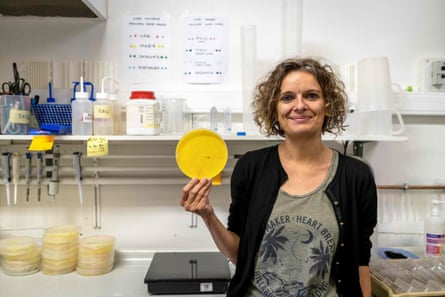
For a period after being roused, the Physarum seems to be sensing its surroundings; Nakagaki calls it “a contemplation phase”. Patience is essential. “You spend a lot of time rearing them: two hours a day just feeding them, putting them in new plates, putting away the old plates. Super exciting,” Dussutour said with an eye roll. “My students either like it or hate it.” When the mould does move, it’s only possible to follow its progress on speeded-up footage from a video camera trained on it day and night.
Given that the mould has no brain, slime is evolution’s way of “storing” memories of spaces. One of Reid’s experiments suggests Physarum uses its slime as an aide-memoire to recognise the paths it has travelled and those it hasn’t. The yellow slime, sticky but more watery than human mucus, is a soup of sugars and proteins. Its presence, Reid believes, tells a mould that it has already foraged in these parts and consumed any food there was to be had. When Reid’s team harvested slime from a mould, coated one route in a maze with it, and introduced the mould into this set-up, it nearly always chose to traverse the dry, un-slimed areas. More impressively, the Physarum can distinguish between its own slime and that discharged by of other species – as if Hansel could tell his breadcrumb trail apart from Gretel’s.
Over the past three decades, as the study of intelligence has broadened beyond humans, slime-mould research has gathered speed. We know now that Physarum is made up of thousands of tiny oscillators that sense their environment. If they pick up the chemical markers of a meal, these units oscillate faster, in turn causing the cell’s protoplasm to flow more thickly towards that area. This is how the mould moves.
But how these oscillators, so minuscule and seemingly so rudimentary, manage to sense so much – proteins, salts, acidity, light, heat, humidity, perhaps even gravitational and magnetic fields, and masses looming at a distance – is still unclear. In 2008, Nakagaki and his colleagues subjected a Physarum to cold, dry air streamed at regular hourly intervals, prompting it to slow its locomotion. After three such gusts, the mould spontaneously slowed on the top of the fourth hour – even when the mistral didn’t blow. No one can figure out how the slime mould keeps time.
It’s natural, then, for a layperson to wonder: if it’s so difficult to thoroughly decipher a relatively basic being such as the slime mould, how could we ever understand the human brain? If it’s a mystery how the Physarum remembers, is it hopeless to look upon the other end of the spectrum and attempt to grasp how, say, a middle-aged man calls to mind a tune from his childhood and plays it on a flute?
The questions that divide neuropurists and their biogenic rivals, though, are different: they argue about whether these abilities – recognising caffeine and recollecting music – are comparable, and whether slime moulds and human beings belong on the same spectrum of cognition at all.
We live in a time when scientists claim degrees of intelligence and cognition for trees, cuttlefish and ant swarms, for things with neurons and things without neurons, things that move and things that stay still, things made of carbon and things made of silicon. These ideas have captivated a public that has already realised that all of humankind’s intelligence hasn’t stopped it from wrecking its own planet. Little wonder we’re primed to believe in the wisdom of other species. In Ted Lasso, that most wide-eyed of TV shows, a philosophical football coach reminds a colleague: trees in a forest don’t compete, they cooperate.
Some biologists will grumpily admit that their discipline is fond of the status quo, and that the theories of people such as Levin and Lyon are like intellectual grenades lobbed into dogma. Still, it would be wrong to paint neuropurists with a single brush – to categorise them all as older, conservative sticks-in-the-mud. What they do share is a tone of exasperation, a sense that they’re defending both well-established truths and a more profound scientific stance on life.
The truths are rooted in semantics. Unlike, say, the word “haemoglobin”, terms such as “cognition” have been around for so long that they’ve been coded into colloquial use in phrases such as “cognitive decline” and “cognitive bias”. To freely stretch the word beyond its wider connotation of the workings of a brain – to apply it to brainless beings such as slime moulds – “misleads the public”, Alex Kacelnik, a zoologist at the University of Oxford told me. “It hollows out the word itself.”
Kacelnik, who has studied the New Caledonian crow’s nimble use of tools, pointed out that “even an oak tree ‘decides’ – in inverted commas – how many acorns it will produce, what size each acorn is going to be, and when it will shed them. But when people say they’re going to cognitive therapy, they mean something different from what the oak is doing, right?” Misusing the word, he said, is counterproductive. By likening the tree’s function to cognition, “you haven’t solved the problem of how the oak does what it does – you’ve just trivialised it, or defined it out of existence”. He uses the term “cognition” in his own writing only when he can show that it involves “some kind of internal algorithm, with some kind of concept formation, in some kind of ‘language’ – in inverted commas”.
These criteria may only ever fit animals with neurons – and perhaps, in their strictest interpretation, humans and no other species, which can feel like narrow anthropocentrism. But it’s even more self-regarding when human scientists “translate the human experience on to other creatures, however distantly related”, said Pringle, the University of Wisconsin-Madison professor. “Why? Why should we be so arrogant as to assume that our behaviour and our natural history is the lens through which to understand Earth?”
Botanists, in particular, attract accusations of trying to anthropomorphise their subjects. The philosopher Stella Sandford deplores the use of the human notions of “male”, “female” and “mother” in the study of plants. Taiz has been one of several scientists who ferociously dismiss the idea that plants can match the complexity of animal brains. (Facing such criticism, the Society for Plant Neurobiology renamed itself the Society for Plant Signaling and Behavior.) Some biologists say they’ve looked for evidence of the sharing-is-caring qualities of trees in a forest and found none. Even Dussutour told me, diplomatically, that, in the case of the wood wide web, enthusiasm got too far ahead of the data.
Even among slime-mould enthusiasts, Nakagaki’s maze study doesn’t convince everyone. The maze as we know it – all right-angled turns and clean routes – doesn’t resemble anything the Physarum may encounter in its own, natural environment; it’s an artifice premised on the fact that we, as humans, regard the solving of a maze as intelligent behaviour. The Physarum doesn’t even “solve” the maze, strictly speaking, as a person would do. “It grows across all of the empty spaces, and then withdraws from everything but the shortest route,” Pringle said. The way she described it put me in mind of large language models and their techniques of brute pattern-matching – an incomplete simulation of human thought that is described increasingly as intelligence.
A few scientists have speculated that slime moulds can be deployed to design rail networks, build logic circuits and solve other computational problems. “If you’re interested in better engineering – OK, I love that, but why does Physarum have to be useful to humans to be interesting?” Pringle said. “Being a good engineer and being intelligent – those are human values, and because of them, this entity suddenly becomes more important. Isn’t that the reason you’re writing about Physarum and not some other organism?” Kacelnik is more blunt: “If I apply the word ‘emotion’ to a jellyfish, then I sell my paper better. Scientists are human beings! They have their weaknesses, they want their papers to get more coverage.”
Biologists of the old consensus charge that some experiments of the biogenic variety aren’t convincingly grounded – that they set up the wrong problems, such as the maze, or arrive at conclusions too spectacular given the results of their data. But even this masks the most contentious question of all: what would even constitute proof of intelligence or thought or cognition? We have spent, as a species, hundreds of years changing our minds about this and still arrived nowhere near an answer.
In deciding what intelligence is, humans are easily influenced by the religions, politics and technologies that surround us. It’s been a wild ride. In the 17th century, Descartes believed all non-human animals were automata, lacking the immaterial mind that gives humans thought and reason. That view held even after Charles Darwin proved earthworms could learn and described the root tip of a growing plant as an analogue to the human brain. In both cases, he didn’t hesitate to use the word “intelligence”. Through the first half of the 20th century, the rise of behaviourism led scientists to disregard internal processes of thought altogether, to focus on an organism’s actions and reflexes only. For a while, even asking questions about cognition was frowned upon.
More tumult followed. Midway through the last century, computers became the new point of comparison for the mind, and it followed that humans too, like their new machines, thought by building internal models and systems of mathematical rules. This “cognitive revolution” only extended to organisms with brains – with neurons, the wetware version of the microprocessor. Then, in the 1990s, a roboticist named Rodney Brooks built a series of small robots that could trundle through the halls of MIT, dodging obstacles or collecting soda cans, all without constructing any mental models or simulations. This was a revolution in its own way – but as a philosopher named Fred Keijzer told me, even this was unsatisfying, because it failed to approximate the sheer complexity of, say, a jellyfish moving in the ocean. “Cognitive science is still at the stage that chemistry was before the periodic table,” he said. “It’s a mess.”
In this choppy way, we’ve come into the AI age, which exerts its own perverse pressures. Silicon Valley loves the biogenic camp – loves any move to categorise intelligence as a data and computation problem, since that would validate the I in AI too. No better way, one scientist remarked sardonically, to treat humans as machines than by starting to treat machines as humans. But placing humans and machines on a continuum of intelligence doesn’t in itself feel like a problem to Michael Levin, who has argued extensively that even single cells can learn and solve problems. “For Michael,” one scientist told me, “it’s just cognition all the way down.”
Levin can ventriloquise clearly the difficulties that other scientists have with his work. They see the habits of the slime mould arising from “mere” physics and chemistry – just the actions and reactions of atoms, as though part of some complex but insentient clockwork. But, Levin responds, physics and chemistry lie behind any intelligent behaviour – even that shown by human brains. This has not won his critics over. “From one side,” he said, “I get angry stuff from some biologists who say: ‘Look, for hundreds of years we’ve tried to point out that life is not a machine – that life is special, that minds are special.’ And by bringing computers and molecules into it, they think that’s a licence to skew the whole thing back to the life-is-a-machine metaphor all over again.”
From the other side, scientists who regard the behaviour of cells and their molecules as pure physics and chemistry worry that imbuing them with shades of cognition, as Levin does, verges on animism – an enlivening of inert matter. Even to talk about cognition and intelligence as attributes common to all organisms is to invite the accusation of dabbling in the metaphysical waters of vitalism, the 18th-century belief in a fundamental life force, Lyon said. “It’s like they think: ‘You know, if we don’t hold the line here, these vitalists are going to be letting ghosts into the living world next.’”
Among scientists who extend our notion of intelligence to slime moulds and even smaller cells, the experiments of David Glanzman are frequently called upon for support. Over the past two decades, Glanzman, a UCLA professor, has offered bold new answers to the question of where memory resides. En route, he has suggested that practically any cell can “remember” – a notion that is anathema to the neuropurists.
In one study, Glanzman experimented on nerve cells from a sea slug called Aplysia. Scientific gospel holds that retaining a memory relies on the shape and strength of synapses – the connections between neurons. Using a strong dose of a neurotransmitter called serotonin, he induced these neurons to form strong new synapses – the equivalent of building a long-term memory. Then he “erased” the memory with a chemical, causing the synapses to retract. A good result – a result true to the gospel. “If we’d stopped there, everything would have been fine,” Glanzman said.
But to these same cells, his team then administered a mild serotonin dose – a mere nudge that ought to have resulted only in the formation of weak new synapses. Instead, they saw strong synapses grow again, as though the old, long-term memory had been hiding in the cell all along. The synapses were mere expressions of the memory and not its very substance, Glanzman said. “The analogy I like to make is: you take an accomplished pianist and cut off his hands, and he can’t play the piano any more. But if you give him artificial hands, he’s able to play.”
Later still, in 2018, Glanzman gave mild electric shocks to a group of sea slugs, getting them so used to the experience that they stopped withdrawing their gills in alarm. From these slugs, he extracted RNA – tiny cellular molecules that help produce new proteins – and injected it into untrained slugs. A day later, the untrained slugs showed the same lack of alarm to their first electric shocks, as though the memory of the experience had been transferred along with the RNA. But in suggesting that RNA, and not the synapse, was the key to memory, it was as though he had broken some taboo about the nature of cognition. “That paper destroyed my ability to get NIH [National Institutes of Health] funding, because people just didn’t buy it. They wouldn’t even discuss my applications. Ultimately, I had to let go of most of the people in my lab.”
The implications of Glanzman’s results are immense: the ability to learn or remember doesn’t have to be the sole preserve of living beings endowed with neurons; it could be found in plants, bacteria, slime moulds, or even the individual cells of an organism. At Tufts, Levin claims to have demonstrated that even the networks of molecules involved in regulating genes – far smaller than a single cell – can be trained; they can “learn” and “remember”. “Nature is telling us that there’s a continuum – there are no bright lines that appear to say: ‘This side cognition, that side not’ or ‘This side intelligence, that side not,’” he said.
Levin doesn’t believe this should be incendiary in any way. “If you think brains and neurons are special, you have to ask yourself: ‘How did they get here?’” he said. In the yawning span of time before evolution produced the first neuron, cells found other ways to navigate their environment, “doing pretty much the same thing that neurons do, just at slower speeds”. There’s no reason to think that, upon the arrival of the first synapse, evolution – a notorious hoarder – would merely have wiped away the older mechanisms that had existed for billions of years.
Which isn’t to say that humans are indistinguishable from single cells, Levin pointed out. “The way I explain the continuum is with the word ‘adult’.” The word’s function is to smooth the business of everyday life: voting, driving, drinking, buying fireworks, joining the army. “But we all know that no great shift happens on your 18th birthday, right?” Levin said. “The word ‘adult’ sweeps under the rug all the deep questions about personal responsibility, and when we acquire it, and how we acquire it.”
Many of these terms such as “cognition” and “memory” are just like that, Levin said. “They’re not sharp scientific categories.” He considers putting quotes around words a weaselly move. “Sometimes the slime mould knows, not ‘knows’, and there’s nothing scientific added by using the quotes,” he said. “Of course, that’s not the same thing as saying it knows that it knows. So we just need to have the right words and use them carefully, and not invent new ones because we want to be special.”
The unexpected truth of the debates stirred up by slime moulds, trees and AI is that they show up the inadequacy of human language. Trying to capture the endless nuance of life on Earth with our clumsy words is like recreating the Pantone colour catalogue with three crayons. Worse still, words bear different meanings at different times and to different people; it’s as though no one can even agree on what shades the three crayons are. In 2009, three Berkeley researchers surveyed 174 members of scientific societies devoted to the study of animal behaviour, to ask them what “behaviour” is. They received more than 25 distinct definitions and 100 other edge cases. In their headline, the researchers concluded: “Behavioural biologists do not agree on what constitutes behaviour.”
Would it help, I asked Levin, if scientists didn’t describe slime moulds as intelligent? If their abilities were instead called, say, “informatic reflexes”, would we stop recognising something of ourselves in a being so utterly unlike us? This may be the wrong question to ask, Levin thinks. “It’s the job of scientists and philosophers to lead the use of language,” he said. “We do owe the public better replacements, as words and terms go. We can’t just tear them down and not offer anything in their stead.”
The first half of my Physarum never came to life; it remained sclerotic even after days of careful moistening and some curious prodding. The second chip, though, started to spread, first swathing and digesting the oat flake and then expanding over the rest of the filter paper. After a few days, it had colonised the entire dish, so that it looked as though someone had crushed and roughly smeared a yellow crayon. I sliced out a part where the slime mould was thickest, placed it in a new dish, and constructed a crude maze with strips of thick black cardboard that my schleimpilz guy had thoughtfully included. Then I laid a cluster of oat flakes on the periphery, such that, from mould to meal, there was one roundabout route and one short route – a home-brewed version of Nakagaki’s 2000 experiment.
In my maze, the Physarum advanced towards its snack through both the long and the short routes I’d laid out. At some point, the finger of mould in the short route won the race – and then, over the next two days, I thought I saw the mould along that path thicken: the Physarum displaying its vaunted efficiency. I’d planned further tests, but before I could conduct them, the mould dried up altogether. Perhaps I’d placed the dish too close to a radiator, or perhaps I’d drowned the Physarum while moistening it.
Around the time I was performing these experiments, I had another subject of study at home: a five-month-old baby, just starting to feel ticklish, pay attention to his hands, and giggle like a maniac at unexpected sounds. He was a cognitive organism, in full and vibrant colour, and even if he couldn’t find his way to food yet, he was already capable of associative learning. For a few days in a row, as he lay on his changing mat, I waggled my fingers above his face before plunging them to the sides of his chest for a tickle. Soon enough, the instant he saw my fingers begin to flutter, his face would change, and he’d kick and squeal with excitement.
Some mornings, I went from mould to son, from son to mould, feeding them, watching their progress, trying to gauge how I felt about the theory that they existed on the same spectrum of cognition and intelligence. There’s something sublime about this kinship, but also something unsettling – a reminder of grand evolutionary and biological processes wheeling on beyond our control. Or maybe, Lyon said, “people are just afraid of acknowledging that this thing we call intelligence which we value in ourselves – all living things have a share of that, in whatever attenuated sense. If we do acknowledge that, we might have to start paying attention to the shocking and horrible things we’re doing to the rest of the living world.”
Broad though the term “cognition” is, scientists still gain from applying it across the kingdom of life, Levin claims. “Drawing hard boundaries – ‘This is cognitive, this is not cognitive’ – prevents you from moving concepts from one field to another,” he said. “If Newton, worried that people wouldn’t understand, had decided to call the force that makes an apple fall from a tree ‘gravity’ and the force that keeps the moon going around the Earth ‘shmavity’, maybe it would’ve been simpler,” Levin said. “But he’d have missed out on a great conceptual unification.”
It would have been impossible, though, to unify “gravity” and “shmavity” without a widely accepted definition of “force”. Biology is struggling with definitions: clear terms of reference, even if they are works in progress, for fundamental concepts such as “intelligence”. Perhaps this is unavoidable for a species that has long used itself as a measure of intelligence – without even knowing how its own intelligence comes about. But ambiguity will hobble us as we try to understand what life is and how many different ways it has found to do what it needs to do. Reproduce. Survive. Find its way to food through a literal or metaphorical maze. Stay in the shade, unless the sun is more beneficial; stay where it’s dry, unless the wet is better. Sense the world, and find a place in it.
Listen to our podcasts here and sign up to the long read weekly email here

Last chance to buy the summer issue of The Long Read magazine, now with 15% off
AI in the classroom, vending machines in the canteen, homeless people in the library, no one in the pub. Surprising stories from our strange new world in the new edition of the Long Read magazine. Buy your copy here