.png) 4 hours ago
8
4 hours ago
8
Morning opening: Trump threatens Europe, again

Jakub Krupa
US president Donald Trump has threatened the European Union with “serious tariffs” and a cut to trade after the bloc proposed to make Canada its first ever associate member, calling the idea “laughable”.
Suggesting the move was a “hostile act”, the US president told reporters he could put “very serious tariffs or stop trading with Europe”. He added: “If it’s a good intention, that’s fine. If it’s a bad intention, we’ll put very heavy tariffs on Europe.”
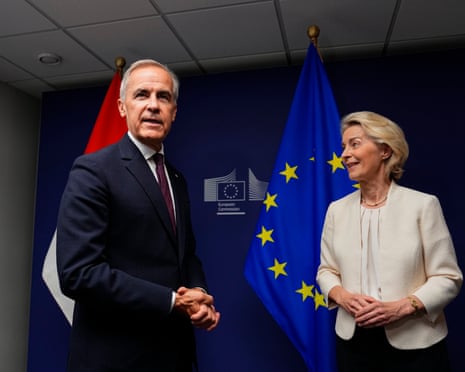
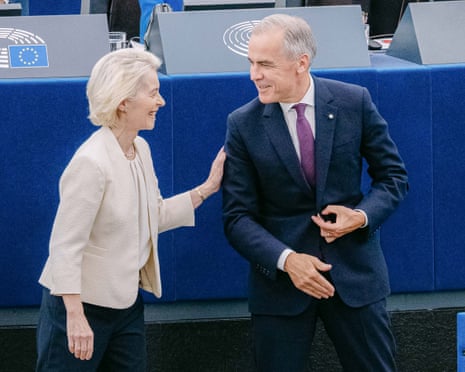
European Commision president Ursula von der Leyen insisted yesterday that “this is not a partnership against anyone else, but for our common strength,” and deputy chief spokesperson Olof Gill repeated this line this morning in response to Trump’s overnight threats.
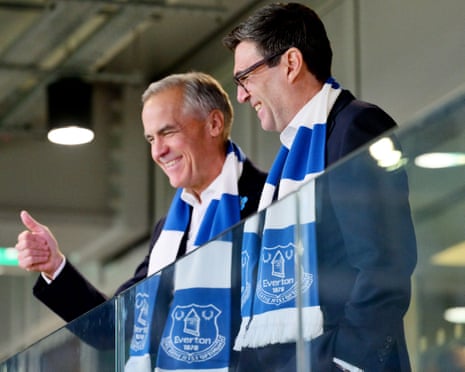
Canadian prime minister Mark Carney – fresh from watching Everton’s Carabao Cup win over Wolverhampton Wanderers in Liverpool – will address the European parliament late morning. Let’s see if he has anything to say on this.
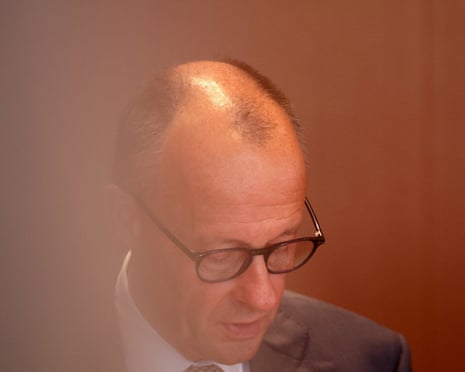
Separately, our attention is increasingly turning to Germany, where embattled chancellor Friedrich Merz is set to join the campaign trail today in Berlin ahead of this weekend’s two state elections that just could determine his political future.
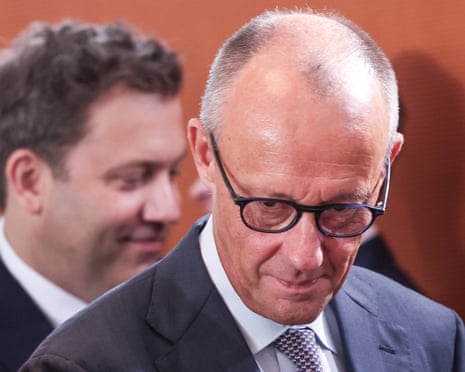
Powerful German state leaders from his party have rallied behind the chancellor as speculation builds that his days in office may be numbered, and he cancelled his trip to the UN general assembly next week.
Our Berlin correspondent Deborah Cole will be joining us just after 11am to answer your questions about Merz’s future, the two state elections, and what’s next for Germany. You can post your questions to her below the line from 9am.
Lots for us to cover today.
It’s Thursday, 17 September 2026, it’s Jakub Krupa here, and this is Europe Live.
Good morning.
Key events 8m ago French president calls party leaders for crisis talks on Middle East, Ukraine, energy market 21m ago Ask your questions: Q&A on Germany, Merz, state elections and what's next 22m ago Germany's Merz faces tricky state election in Berlin, Mecklenburg-Western Pomerania this weekend 26m ago EU has 'never been as attractive as it is today,' enlargement commissioner says 40m ago Nato leader warns of ‘most dangerous and complex security environment in a generation’ 1h ago 'Not up to the US to choose political and geopolitical direction of the Europeans,' French minister says 1h ago Ask your questions: Q&A on Germany, Merz, state elections and what's next 2h ago Morning opening: Trump threatens Europe, again
French president calls party leaders for crisis talks on Middle East, Ukraine, energy market
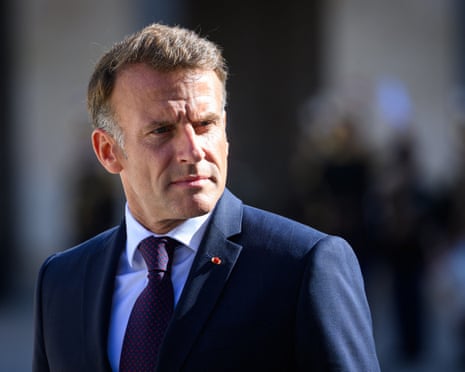
Meanwhile, we are getting some interesting lines from Paris that the French president, Emmanuel Macron, convened the chiefs of the different political parties to discuss the crises in the Middle East and Ukraine and their consequences on the energy market.
The meeting will be held on Friday morning at 10:30am local time on Thursday (that’s 9:30am UK) and military and intelligence officers will share the information they have provided to Macron, his office said in a statement.
Ask your questions: Q&A on Germany, Merz, state elections and what's next
Just a reminder that our Berlin correspondent Deborah Cole will be joining us later this morning to answer your questions on Germany and Merz.
Our comments section is open – post your questions and Deborah will answer them after 11am this morning.
Germany's Merz faces tricky state election in Berlin, Mecklenburg-Western Pomerania this weekend
Back on Germany, AFP warns that two German state elections Sunday could deal a double blow to embattled chancellor Friedrich Merz, two weeks after his party suffered a stunning defeat at the hands of the far-right AfD.
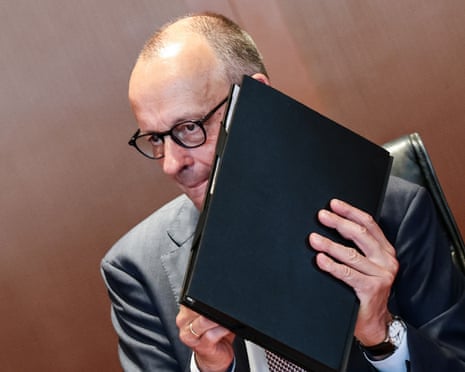
Tight races for power – each with their own unique electoral dynamics – are expected in the city-state of Berlin and the northeastern state of Mecklenburg-Western Pomerania.
The far-right Alternative for Germany is expected to make strong gains in both, a fortnight after it trounced Merz’s centre-right CDU by a margin of almost 44 to 17 percent in the ex-communist eastern state of Saxony-Anhalt, AFP said.
In Mecklenburg-Western Pomerania, Merz’s party is an onlooker to the main battle between the SPD of popular state premier Manuela Schwesig and the AfD.
While the AfD was polling at 37 percent against the SPD’s 35 in the latest INSA survey, Merz’s CDU, at just seven percent, may drop dangerously close to the five-per cent hurdle needed to stay in the state parliament.
In Berlin, the ruling CDU is running a neck-and-neck race against the far-left Die Linke, which is popular with many young people and promises drastic steps to solve a dire housing crisis.
The AfD is meanwhile expected also to do well in Berlin, although it is set to remain shut out of power in both states because all other main parties have agreed on a “firewall” of non-cooperation with it.
EU has 'never been as attractive as it is today,' enlargement commissioner says
Europe has “never been as attractive as it is today”, as demonstrated by plans for Canada to become an “associate member” of the EU, EU’s enlargement Commissioner Marta Kos.
“When I speak about the attractiveness, I don’t mean only becoming or not becoming a member. It is wanting to work with us stronger or in any other ways we haven’t explored yet, like Canada,” Kos said in comments quoted by AFP, expressing “regret” but “respect” for Icelanders’ recent decision to reject the resumption of EU membership negotiations.
Nato leader warns of ‘most dangerous and complex security environment in a generation’

Dan Sabbagh
Defence and security editor
Meanwhile, Nato’s secretary general said the alliance needs “more UK and more Europe” to deal with the most dangerous security environment faced by the west in a generation.
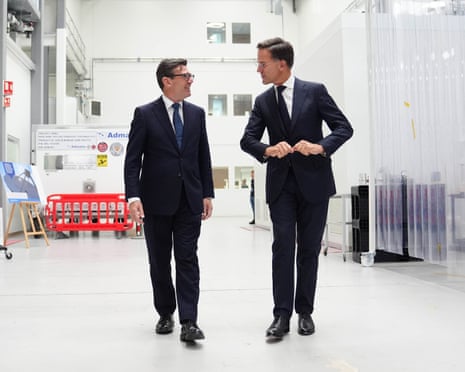
Speaking on a visit to the UK, Mark Rutte praised Britain for promising to increase defence spending in line with US demands after a meeting prime minister Andy Burnham – but argued that the military and financial effort must continue into the future.
“It is essential that your armed forces continue to provide the hard power Nato needs,” Rutte said in a speech to a specialist audience at Ditchley Park, a wartime retreat used by Winston Churchill in Oxfordshire.
It was a plea for the UK to make progress towards an alliance-wide target demanded by Donald Trump of spending 3.5% of GDP by 2035, about £30bn in real terms, money that has to be found from extra taxation, borrowing or reducing other spending.
Britain has so far only budgeted to increase defence spending to 2.7% of GDP by the end of the next decade. Short-term financial pressures have meant that the army has been told to stop non-essential training by the end of the year.
Chancellor John Healey resigned as defence secretary from Keir Starmer’s government in June because the former prime minister would not commit to 3% by 2030, arguing that it would require too great a step up in the next decade.
But Healey refused to recommit to the interim target when he was appointed to the Treasury by Burnham a month later, raising questions that the new government was backloading spending increases until after the next election.
Rutte said that he had discussed Britain’s “Nato commitments” when he had met Burnham at a science business park in Oxford earlier on Wednesday, without offering any details, in the first one-on-one meeting between the two.
'Not up to the US to choose political and geopolitical direction of the Europeans,' French minister says
Back to Trump’s threats over the proposed “associate membership” for Canada overnight, France’s Europe minister Benjamin Haddad said in response that the US has no power to veto EU’s geopolitical choices.
“It is not up to the United States – or anyone else – to choose the political and geopolitical direction of the Europeans. Once again, we have a relationship with Canada, and we are fully entitled to seek to deepen it,” Haddad said in an interview on Public Senat TV channel, reported by Reuters.
Ask your questions: Q&A on Germany, Merz, state elections and what's next
Our Berlin correspondent Deborah Cole will be joining us later this morning to answer your questions on Germany’s embattled chancellor Friedrich Merz as he braces for two more tricky state elections this weekend.
Our comments section is now open below – post your questions and Deborah will answer them after 11am this morning.
Earlier this week, Merz cancelled his planned visit at the UN general assembly in New York next week, saying he needed to be in Berlin. It’s never a good sign when a political leader feels he needs to do that.
Leyland Cecco
in Toronto
There are also lots of reactions from Canada.
Roland Paris, the director of the Graduate School of Public and International Affairs at the University of Ottawa and a foreign affairs adviser to the former Canadian prime minister Justin Trudeau, said the term “associate member” has taken too much focus and “doesn’t really matter” in the long term.
“My hunch is that von der Leyen was hoping to rally supporters of much closer cooperation with Canada by using that label. In the end, what I expect is that we’re going to see a collection of agreements rather than membership in any institutional sense,” he said.
Carney’s decision to formalise close ties with Europe however prompted outrage from Conservatives at home.
Pierre Poilievre, the Tory leader, posted on social media that he feared Canadians “struggling to pay their rent” would have to pay more taxes “to fund the European Union’s heavy bureaucracy”.
“The welder from Welland didn’t elect a Eurocrat to regulate our steel. The farmer from Saskatchewan and the fisher from the Atlantic provinces didn’t choose a Brussels food regulator who has never seen our prairies or our coasts,” he wrote. “We will NEVER be the 51st American state. And we will NEVER be the 28th state of the European Union.”
Another, Jamil Jivani, posted that Conservatives “will NEVER support Mark Carney’s Liberal plan to have Canada join the hopelessly run, over-regulated, and self-destructive EU”.
Paris said no Canadian leaders “would be interested in formal EU membership if it involves subordinating Canadian law and regulatory structures” to Europe.
“I don’t think that’s on the table right now. There has long been a bipartisan push in Canada to deepen trade connections between Canada and Europe,” he said. “We’re now seeing now is a logical extension of those trade discussions into other areas.”

Jennifer Rankin
in Brussels
The 27-member EU has never had an associate membership category, although it has close ties with Norway, Iceland and Switzerland, allowing deep economic integration with these countries, who follow many EU rules.
It remains to be seen what associate membership means, including for Canada’s relationship with the EU single market. When the UK was negotiating its departure from the bloc and post-Brexit relationship, EU officials repeatedly said there was no status that enabled a foreign country to be half in and half out of the single market.
The phrase itself took EU insiders by surprise since von der Leyen had not used the term when she briefed senior EU diplomats ahead of her speech last Friday.
One EU diplomat said member states were “generally very supportive of ambition” in the EU-Canada relationship, but had been slightly worried in recent weeks that von der Leyen was overpromising on Canada.
“‘Associate membership’ sounds like a nice headline but in reality 10 member states have still not ratified Ceta,” the person said, referring to the EU-Canada trade agreement that was agreed 10 years ago.
A second EU diplomat described associate membership as “an empty phrase”.
Martin Leng at the Brussels Institute for Geopolitics thinktank said a world in flux was “pushing the EU towards far greater flexibility in its relations with third states”.
He said von der Leyen’s speech, with its focus on different sectoral areas of cooperation “points to the ambition and strategic breadth of the associate membership which the parties have in mind but also suggests that, in reality, Canada’s ‘membership’ may consist of ‘plugging in’ to existing programmes and frameworks, such as the European Defence Agency, rather than joining the union in any traditional sense”.
Morning opening: Trump threatens Europe, again
Jakub Krupa
US president Donald Trump has threatened the European Union with “serious tariffs” and a cut to trade after the bloc proposed to make Canada its first ever associate member, calling the idea “laughable”.
Suggesting the move was a “hostile act”, the US president told reporters he could put “very serious tariffs or stop trading with Europe”. He added: “If it’s a good intention, that’s fine. If it’s a bad intention, we’ll put very heavy tariffs on Europe.”
European Commision president Ursula von der Leyen insisted yesterday that “this is not a partnership against anyone else, but for our common strength,” and deputy chief spokesperson Olof Gill repeated this line this morning in response to Trump’s overnight threats.
Canadian prime minister Mark Carney – fresh from watching Everton’s Carabao Cup win over Wolverhampton Wanderers in Liverpool – will address the European parliament late morning. Let’s see if he has anything to say on this.
Separately, our attention is increasingly turning to Germany, where embattled chancellor Friedrich Merz is set to join the campaign trail today in Berlin ahead of this weekend’s two state elections that just could determine his political future.
Powerful German state leaders from his party have rallied behind the chancellor as speculation builds that his days in office may be numbered, and he cancelled his trip to the UN general assembly next week.
Our Berlin correspondent Deborah Cole will be joining us just after 11am to answer your questions about Merz’s future, the two state elections, and what’s next for Germany. You can post your questions to her below the line from 9am.
Lots for us to cover today.
It’s Thursday, 17 September 2026, it’s Jakub Krupa here, and this is Europe Live.
Good morning.