.png) 2 hours ago
6
2 hours ago
6
As £72m in donations makes its way to Reform UK’s bank accounts, consider what Nigel Farage said on the eve of Britain’s vote to leave the European Union a decade ago. “This referendum is the people versus the establishment,” he declared. “It is the vested interest, it’s the rich, it’s the big business.”
Just two years ago, Farage assailed “an unholy alliance of big business, big banks and big government”. He is also the same man who, when he debated with the then Liberal Democrat leader, Nick Clegg, in 2014, claimed to “represent the mercantile, trading, entrepreneurial end of society”, while his opponent “represents big banks, big government and big business”.
To be clear, Farage’s political outfit is being bankrolled by two cryptobillionaires. One of them is Ben Delo, who once developed high-frequency trading systems for JP Morgan. That investment bank was a particular bete noire of Farage: when it backed the Remain campaign, he savaged “the unholy alliance of big banks and big politics”. The other is the Thailand-based cryptobillionaire Christopher Harborne, who gave Farage his pre-election £5m gift and provided two-thirds of Reform’s funding – until now, that is.
Neither of them is the plucky small merchant evoked by Farage’s rhetoric. The man who denounced banks buying political influence is now dependent on two wealthy figures from the world of finance. Predictably, Reform says its benefactors want “nothing” in return for their colossal donations. Yet the two businessmen who have just coughed up the biggest donations in British political history will surely be delighted with Reform’s plans to slash taxes on crypto assets and set up a “bitcoin reserve”.
The political fraud that is rightwing “populism” is quite something to behold. These movements claim to champion the little guy against the elites. Whether embodied by wealthy tycoon Donald Trump, whose relatives and friends are making a killing from his administration, or the privately educated millionaire ex-City broker Farage, the formula is straightforward. Dupe struggling people into believing their problems are caused by migrants, refugees and minorities – while championing the interests of the mega-rich who actually hold the power.
Sure, British democracy has always come with heavy caveats. Political parties and politicians have always received hefty donations from an economic elite that, to be clear, does not give money away without expecting a return. They can also rely on powerful lobbyists to advance their interests. Then there’s the “revolving door” through which politicians and civil servants leave public office for lucrative jobs with companies in the very industries they were previously responsible for overseeing and regulating. And there’s a British newspaper industry mostly owned by rich moguls with a vested interest in defending a status quo they profit from.
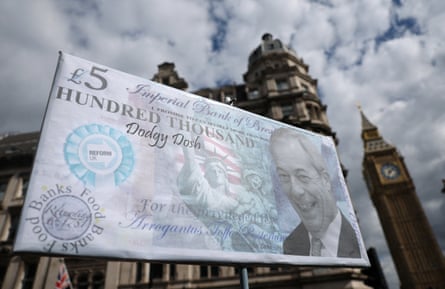
But these latest donations take the corruption of our democracy to a whole new level. That two donations to Reform in a single weekend now eclipse the total amount spent by all political parties at the last general election tells its own story. Indeed, these donations amount to about 14 times the total spent by Farage’s party at the last election – when, it should be noted, it won more than 4m votes, or one in seven votes cast.
The party can now pay for hundreds of full-time staff, build local political hubs and massively expand its polling and research infrastructure. Crucially, it can throw vast sums at digital advertising, which can be uniquely tailored to the interests and concerns of individual voters. We know from research in the US that digital ads can shift voting intention. The more money a political party has, the more it can afford to experiment until it finds the ads that work.
Indeed, all the evidence suggests that money wins votes. A recent peer-reviewed study examined every British general election between 1857 and 2017, and found a strong relationship between relative campaign spending and votes. Rich donors really do shower political parties with money for a reason. Reform’s mega-donations underline that democracy is for sale.
But could this spectacularly backfire? Reform is, after all, already embroiled in multiple controversies over gifts and donations from wealthy donors, and its ratings have taken a bad beating. Polling earlier this year found that 83% of Brits believe that “wealthy individuals use political donations to influence the government to further their own personal interests”. That figure was only four points lower among Reform voters, who were also nearly 10 times as likely to say they would view a party more favourably if it promised to cap donations as to view it less favourably.
after newsletter promotion
It would be naive, alas, to believe that this will finally burst the gilded Reform bubble. What it does do depends on what the national political conversation is about. Labour has had long enough in government to change the law to block such donations, and tragically Andy Burnham has retreated from his stated desire to cap them at £500,000.
But that would mean a Labour party that was determined to confront wealthy vested interests. Because Starmerism had no desire to replace an economic order rigged in favour of elites, it was unable to redirect anger away from the scapegoating of migrants. Instead, it simply replicated Farage’s xenophobia, which only ever legitimises the arguments of the anti-migrant right.
A different approach, based on redistributing wealth and power, would force a different conversation. So far, thanks to pressure from Zack Polanski’s Green party, Burnham has shifted some of the rhetoric. But if Labour were to, say, hike taxes on wealth in order to invest in crumbling services, it could pair that with a sustained attack on Farage as the plaything of wealthy vested interests.
Otherwise, the outrage over these donations will fade. The old poison will remain – and this time it comes with £72m behind it.
-
Owen Jones is a Guardian columnist. His latest book, The Fall of the West: How They Really Lost It, is released in October. Order your copy at the Guardian bookshop
-
Do you have an opinion on the issues raised in this article? If you would like to submit a response of up to 300 words by email to be considered for publication in our letters section, please click here.