.png) 3 hours ago
7
3 hours ago
7
Kiat Lim wanted to see Valencia play so badly, so that is what he did. It was week four in La Liga, 6 September, and for the first time since he was given the presidency 18 months earlier, the owner’s 33-year-old son was going to watch his team play a competitive game. He was going to do it from the inside, too, so he took a flight to Spain, landing at Manises in a black mask and cap, a van to the hotel, then the team bus to Mestalla. He looked through the window as they rolled along Avenida Suecia, a huge, noisy crowd waiting, but when he got off and headed through the iron gate with its ornate club badge, he saw that this was no welcome.
Above him as he went in were giant portraits of Mario Kempes, Antonio Puchades, Juan Sol, Gaizka Mendieta, David Villa and Santiago Cañizares, footballers from a better time; around him were yellow banners and whistles for the footballers there now. Inside, Lim saw the game start with the lower south stand empty as fans stayed away until the 19th minute, the sound of another protest drifting in from the street. They were out there still when, sitting alongside Joan Laporta, he saw Lamine Yamal score the sixth-minute opener then get a second. And although that, also from Lamine Yamal, was ruled out, he eventually saw Barcelona get four more, presiding over a 5-0 debut defeat.
He had seen supporters leave early, seen those that stayed turn towards him, chanting for him and his family to leave for good. He had seen the hankies come out and his players head into the tunnel heads bowed. He heard his manager insist that they were hurt but not sunk. What he did not see – what no one had seen yet but everyone would see soon enough – was the verdict from the bench.
Withdrawn after an hour to a standing ovation, the World Cup winner Rodri took a towel and turned to Pau Cubarsí. “This lot are very weak, eh?” Spain’s captain said. “Very weak, mate. Very bad.” He asked where they finished last season, pulled a face that said seriously?! when he was told just outside Europe, and noted that they had not left their own half. Valencia, he said, were malísimo. Awful.
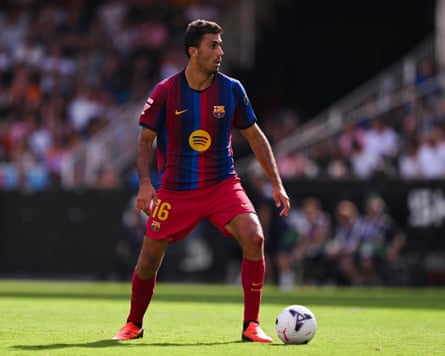
The sequence was caught on camera by El Día Después, and soon it was everywhere. Rodri called Valencia’s captain José Luis Gayà, saying sorry. After Barcelona’s Champions League win against Feyenoord three days later, he offered a public apology. It was, the Valencia coach, Carlos Corberán, said, a touch of self-preservation about his reaction, the least Rodri could do: apology accepted but his “unfortunate” words had “not been born of respect”. Yet there was no taunt, no mocking, no derision, no sign of a smile; instead there was a kind of shocked sadness. His words had not been thrown in anyone’s faces and were not for sharing. They were also true.
And if Corberán noted that “Mestalla had applauded him too”, an aggravating factor, some of them would do it again: it had needed saying. Within a few days someone had designed T-shirts declaring: “They’re very bad.” Underneath it read: “We’re all Rodri.” They had barely started printing off before Corberán was gone. Shoot the manager, not the messenger.
Barcelona’s victory over Valencia last Sunday was the third time in four games that they had scored five. Three days later they did it again. But those were not really the same – at Mestalla it was hard to avoid the feeling that Hansi Flick’s side could have scored 10 if they wanted to – and this was not just about Barcelona, this was about them. Valencia really are malísimo. Four games into season, they had conceded nine and scored one – and that was a gift, scored by a man who is now seriously injured. They had a solitary point, were bottom, and things were not about to get any better. This Friday, they lost the Used To Be Big Derby, 1-0 to Sevilla at the Sanchez Pizjuan, Juan Iglesias’s header condemning Valencia to the worst start in their history and Corberán to the sack.
There is something about these two; the last two times Sevilla fired their manager (García Pimienta and Matías Almeyda), it was after defeat to Valencia, while this is the third time Valencia fired a coach having lost at the Sánchez-Pizjuán: Quique Sánchez Flores in 2007, Nuno Espírito Santo in 2015 and now Corberán. Sánchez Flores got sacked at 4am. This time the wait was a little longer, if not much. When Valencia’s players and staff got back to Paterna to collect their cars in the small hours of Saturday, 100 fans waited to shout abuse and by the time training had finished there on Sunday morning the decision was made. Corberán was told during a video call from Singapore, Lim 10,000km away again.
The coach who arrived in December 2024 with Valencia in the relegation zone and pulled them up to 12th; the manager who saw them slip into the relegation zone again at the halfway stage last season only to pull clear all the way to the edge of Europe, would not get the chance to try again. Just five weeks into the season, two months after his contract was extended for another year, and 10 days after the CEO, Ron Gourlay, insisted that stability meant standing by a coach he believed in even if fans, some players and an increasingly belligerent media might not, he was gone.
Mind you, Gourlay has gone too. At that defiant two-hour, via-translator press conference Gourlay insisted that if his critics were going to wait for him to go, their coffee would get cold, but he has been sacked along with all his staff. Braulio Vázquez, has joined from Osasuna – even though Braulio recently said Osasuna are the “only real club left” – given the task of finding a new coach, with the B team manager taking over for the time being. His arrival ushers in a restructuring and a “new era” at Valencia, the statement said.
after newsletter promotion
La Liga results
ShowSevilla 1-0 Valencia
Racing Santander 2-1 Alavés
Osasuna 0-2 Espanyol
Athletic Bilbao 1-1 Elche
Real Madrid 4-1 Rayo Vallecano
Celta Vigo 1-1 Málaga
Levante 2-4 Barcelona
Getafe1-1 Deportivo A Coruña
Braulio knows the club – he was sporting director there between 2011 and 2013 and his son is the left-back – and has been successful at Osasuna, widely considered a more convincing candidate than the man who was there until Sunday afternoon. Few fans are sorry to see Corberán go: in fact they have been chanting for just that, the social fracture another factor. A change of coach can change things, a change of CEO or sporting director too. Look at Valencia’s squad and they should and probably will be better than this, the academy keeps producing talent, and Mestalla still fills weekly. There are coaches out there that would convince, with Ernesto Valverde and Jagoba Arrasate’s names the first to be floated. They certainly couldn’t be much worse than they have been so far. But patience is thin and faith thinner, a pessimism long since having crept in, and not unjustifiably so.
The only thing most fans want of the owners now is for them to leave which plays a part too, everyone caught in the never-ending tension. It is less than two years since Gourley took over, a year since Lim said that they have a “proper sporting plan now ... which is not to say we did not in the past but now we have professionals in place.” He was already the sixth man to supposedly have responsibility for signings since Peter Lim bought the club in 2014. Óscar Sánchez will be Valencia’s fifteenth coach since then – and even Voro, the eternal caretaker who has had the job six times does not want it any more. Only Nuno and Marcelino have better win percentages than Corberán. This summer, they spent €9m (£7.7m); 13 clubs spent more. More than 20 players have come in and gone out in the last two years. Over the last seven seasons they have spent short of €70m; they have sold for more than €230m.
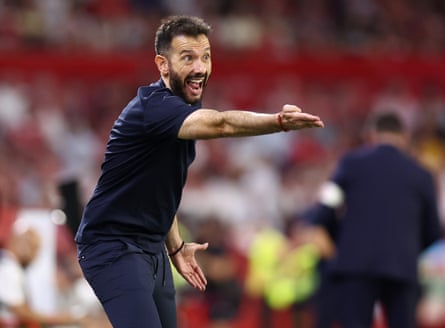
There was a line in Rodri’s apology that talked about context and context is everything: Valencia being bad was not one Sunday; the fear is that it’s any given Sunday, that the days when they were good may be gone. He said that his comments were born of surprise, sadness, but the saddest thing is many weren’t surprised at all. This is what it is, they thought, grateful that someone else said it; forgive them if they do not foresee a way out. Yet if ambition must be adjusted it is hard not to hold on to what you were, your identity still, and maybe that’s a problem too. The Valencia Rodri returned to is not the Valencia he left behind. The year he went to England, they were a Champions League team; they have not made Europe since. And on Sunday he was right, Corberán taking the fall within a week.
“We all want Valencia to get back to where they should be, one of the best clubs in our league,” Rodri said three days later, but he had already said enough, a truth told. Sitting in the stands, Lim had just about seen enough too.