.png) 2 hours ago
6
2 hours ago
6
Sweden’s political parties have launched coalition negotiations as the Social Democrats leader, Magdalena Andersson, started the long and difficult process of trying to form a new government.
Full results from Sunday’s election are not expected until after overseas votes are counted on Wednesday, but with 95% of the votes counted, the Social Democrats and the centre-left bloc had a narrow but growing lead of 176 seats to the right-leaning parties’ 173.
After losing support for the first time since they were founded, the far-right Sweden Democrats, who were hoping to enter government for the first time, appear to be out of the picture. But many of its policy ideas – on immigration laws, integration and crime – have become mainstream, including in the centre-left.
Both Andersson and the outgoing centre-right prime minister, Ulf Kristersson, of the Moderates have each said they want to explore possible coalition options to secure power.
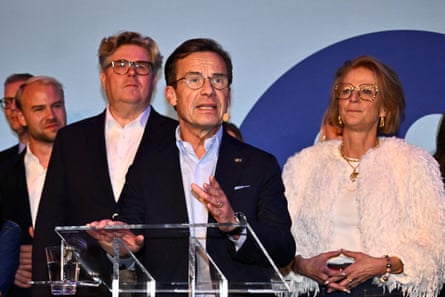
After a long election night during which there was just one seat between the two blocs, Social Democrat leaders met Andersson on Monday morning at the party’s Stockholm headquarters.
Questions remain as to whether the bloc is willing to work with the Left party (Vänsterpartiet), which the Centre party has previously ruled out.
The Social Democrats press secretary, Tobias Baudin, said he had been in contact with colleagues from opposition parties and called for the resignation of Kristersson, who led the rightwing Tidö coalition government with the support of the Sweden Democrats.
“Now the voters have had their say and they have given him a failing grade for himself and his government,” Baudin told the Swedish broadcaster SVT, adding: “He should resign himself. In fact it doesn’t matter, if he doesn’t resign he will be removed. How he does it is up to him.
The Centre party said that in talks with the Social Democrats it would be seeking a government with a “desire for political stability” and a “clear centre-right character” with no “fringe politics”.
The Social Democrat Morgan Johansson, who under the last Social Democrat-led government was deputy prime minister, said the Centre party’s announcement was a positive development and that overall there were “good prospects”.
All of the left-leaning parties want a change of government, he said. “That is the starting point. I don’t think anyone wants us to end up in a situation where blockages lead to a new election.”
Meanwhile, Kristersson appears to be keeping his options open.
after newsletter promotion
On Sunday night he said the result could lead to a “complicated government formation, where it ends remains to be seen”. On Monday, before a meeting with his fellow Tidö coalition leaders, he declined to elaborate, saying he would wait for a full result before having conversations. “If all the red lines remain then Sweden won’t have a government at all,” he added. “I plan to pursue a number of possibilities that may exist.”
The Liberals and Christian Democrats have both said they will not work with the Social Democrats.
After the overseas votes are counted on Wednesday, the final election results are not expected until the weekend.
The new parliament will meet for the first time on 28 September and the earliest date that the speaker can suggest a prime minister is 29 September, but talks could take considerably longer. If, when parliament votes for a prime minister candidate, more than half say no, then the speaker must find a new candidate. If there are four failed votes there will automatically be a new election.
After the 2022 election, it took 37 days to form a government; in 2018 it took 134 days to form a new coalition.
Fredrik Furtenbach, the senior political correspondent at Sveriges Radio (Radio Sweden), said: “I think it will end with either the Left or Centre party having to give way. It might take several failed prime minister votes first.” But he does not believe the Social Democrats and Moderates, who he describes as “traditional archenemies”, will end up working together. “You cannot share the position of prime minister.”