.png) 2 months ago
73
2 months ago
73
Cameron Roach, executive producer
I was working on women’s prison drama Bad Girls when the idea for Waterloo Road came up. Bad Girls creators Maureen Chadwick and Ann McManus had a fiery belief in social justice and did rigorous research. Those are often the foundations of successful serial drama. Ann had once taught in a Glasgow comprehensive and was passionate about education: she believed we write off young people too readily. That became the basis of Waterloo Road.
You can’t make a British school show and not be influenced by Grange Hill. But this wasn’t children’s programming – it was primetime. High-school dramas are perennial because it’s the ultimate shared experience. There tends to be a Waterloo Road in most UK towns, so the title had universality. It also worked with The Battle of Waterloo Road, our chaotic first episode. That anarchy remains a key component of the show.
It ran for 10 series but grew stale and got axed. Then, during Covid, old series suddenly did huge numbers on iPlayer. I think viewers missed that sense of community, and for a certain demographic, it was bigger than Strictly or Doctor Who during lockdown. The BBC asked me to reboot it and here I am, seven series and 70 hours of TV later.
It’s hugely popular with young and diverse audiences. I think that’s about people feeling seen and not patronised. We treat teachers like they’re human and teenagers like they’re adults. Teachers are grateful someone is telling the world how tough their jobs are. We do regular Zoom panels with educators to canvas opinion. Recently they told us we don’t show enough sex between teachers. We’ve introduced more staffroom affairs on the back of that.
TV has the ability to open conversations at home. If suddenly a character viewers love is suffering the pain of endometriosis, they want to know more. Our plot about the plight of young carers led to questions in Parliament. Derbyshire Police linked to our grooming storyline from their website because it helped highlight the warning signs, and our storyline about coercive control got screened in schools across the north-west. It’s public service broadcasting, but not in a po-faced way. Issue-led stuff is balanced with humour. Ann always said that every episode should make you laugh and cry.
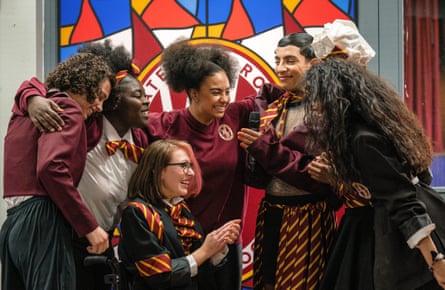
I went to Los Angeles to visit the set of an amazing show called East Los High, set within the Latino community. Despite living in the entertainment capital of the world, young people couldn’t get jobs in the industry, so they crowdfunded their own show. It became a cult hit and ran for five seasons. That planted a seed in my mind, so we started an initiative called Rope Ladder Fiction to encourage new voices. We have trainee schemes across all departments and do outreach work around Greater Manchester. Too often we hear that TV and film are intimidating environments, but kids can come to Waterloo Road with its school setting and feel comfortable. It’s the perfect training ground. One of our team, Laurie Kirkham, was an extra on the show when she was still at school. Now she’s producing it.
Considering the show’s ups and downs, it’s mad that it has run for 20 years. Because so many young people work on the show, we marked the anniversary with a prom, which was huge fun. When Ann sadly died last year, we named a character, Noel McManus, after her. He led the house band and there was a lovely moment when [co-creator] Eileen Gallagher got on stage to play tambourine. It felt celebratory of the whole two decades.
Angela Griffin, actor and director
It was always drummed into us that we weren’t making Grange Hill: this might be set in a school but it’s about the teachers as well as pupils, and the storylines are edgier and more adult.
I started out playing Kim Campbell, the art teacher and head of pastoral care. She was in constant conflict with Andrew Treneman, played by Jamie Glover, the strict deputy head – naturally, they eventually fell in love. Kim thought every student was an individual. Her catchphrase was: “One size doesn’t fit all.” I based her on my old drama teacher.
The show was a big success, pulling in 5 million viewers. I still get recognised most for Coronation Street, which is nuts because I left 25 years ago, but suddenly I was being stopped in the street by teenagers too. I left after five series, but then a decade later lockdown happened and the show found a whole new audience. The rekindled love for the show was nuts. Even my own teenage daughters were interested when their friends started saying: “Your mum’s Miss Campbell!”

I was surprised when Cameron approached me about coming back for the reboot in a very different guise: Kim was the new head teacher, so I visited schools and did lots of research. Not only was it a much more ordered job for her but, post-Covid, the landscape of schools had changed. Returning to see a new generation of pupils gave me goosebumps.
What Waterloo Road does for the north of England, for working-class actors and for up-and-coming crew is huge. It’s a massive breeding ground for talent outside London. Great names have come through its doors – Jodie Comer, Jenna Coleman, Phoebe Dynevor, Holliday Grainger – and I feel like they’re all my children! Filming isn’t as chaotic as you might think because it’s a tight ship. I’ve seen worse behaviour on adult shows.
It tackles issues in an accessible way. I’ve had handwritten letters from viewers who’ve been deeply affected by episodes. Bullying storylines tend to resonate and people felt like Kim was their pastoral care teacher too. I strongly identified with Kelly Jo wrestling with her mixed-race identity. I felt fortunate that I got to both direct and be part of that story. It was an enormous moment for me when Cameron trusted me enough to start directing. It has utterly changed my life and career. As a northern, working-class woman of colour, I’m the last person who’s usually found behind the camera. Hopefully it shows people what’s possible.
In series one, it might have been physical bullying, drugs and alcohol; 20 years later, it’s cyber-bullying, vapes and bloody energy drinks. The same problems affect young people today as they’ve always done. There will always be a space for Waterloo Road.