.png) 3 months ago
68
3 months ago
68
China’s National People’s Congress (NPC), the state legislature, will vote on Thursday on a suite of new laws agreed at this year’s annual two sessions gathering, including a piece of legislation that will diminish the role of minority ethnic languages in the education system.
NPC delegates are expected to approve a new ethnic unity law, along with a new environmental code and the 15th five-year plan, the economic planning document for 2026-2030. Delegates have spent the last week debating Beijing’s proposed bills, which they are all but certain to approve. The NPC, which is often described as a rubber-stamp parliament, has never rejected an item on its agenda.
The votes will take place at this year’s two sessions, concurrent meetings of the NPC and a separate Communist party advisory body, draws to a close. The main headline from this year’s gathering was the historically low 2026 GDP growth target, which China’s premier, Li Qiang, announced on 5 March. At 4.5%, it is the lowest growth target in decades, and reflects Beijing’s shifting priorities and challenging domestic economic situation.
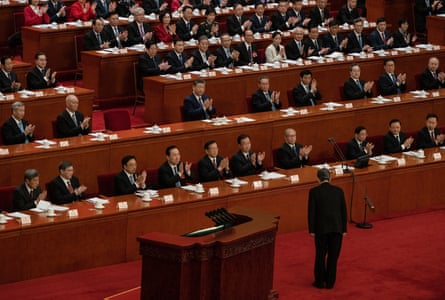
Aside from the economic targets, the NPC is the forum in which Beijing’s policies become law.
One key policy for Xi Jinping, China’s president, is the “sinicisation” of China’s ethnic minorities – ie, assimilating their cultures as far as possible into that of the Han ethnic majority. Xi has said that China’s ethnic groups should be like “pomegranate seeds that stick together”.
To that end, China’s new law on ethnic unity will require schools to use Mandarin by default, taking priority over minority ethnic languages such as Tibetan, Uyghur and Mongolian.

The law also requires that Mandarin be displayed more prominently than minority ethnic scripts on public signage. Recent reports from Inner Mongolia, where there were protests in 2020 over the erosion of the Mongolian language, have suggested that some public signs have already been renovated to show Mandarin characters more prominently than Mongolian script.
Yalkun Uluyol, a China researcher at Human Rights Watch, said: “Many of the policy directives proposed in the new law already exist in practice in Xinjiang, Tibet, or Inner Mongolia.” He said the law “is a blatant move by Beijing to legalise forced assimilation and political control”.
According to NPC Observer, a website that tracks Chinese politics, the ethnic unity law has been treated with particular importance by the Chinese Communist party. In 2025, the CCP’s full politburo, led by Xi, discussed a draft of the law, something that has not been reported in four decades.
The NPC is also expected to approve a new ecological and environmental code, a unified framework that will repeal and replace various laws on pollution and environmental protection as China moves towards its “dual carbon” goals of peaking carbon emissions by 2030 and reaching net neutrality on emissions by 2060.
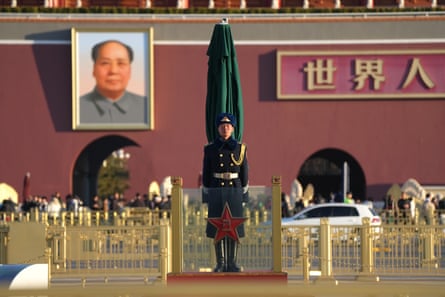
The lengthy draft includes chapters on waste management, pollution prevention and climate change adaptation.
Li Shuo, the director of China Climate Hub at the Asia Society Policy Institute, said that the code “represents a step forward in the development of China’s environmental legal system”.
“For decades, China’s environmental regulation has consisted of many separate statutes, leading to fragmentation and (as new environmental issues such as climate change emerge) inconsistency. By elevating environmental protection to a codified legal framework, it signals that environmental governance is not only a policy priority but a long-term legal commitment,” Li said.
The NPC will also vote through the annual budget, the government work report, and the 15th five-year plan.
Additional research by Yu-Chen Li and Lillian Yang