.png) 3 hours ago
8
3 hours ago
8
Working in contemporary music, I am used to eyebrows being raised by friends and family when I answer their seemingly innocent dinnertime question, “What are you up to at the moment?”. My responses over the years have ranged from “staging an opera about alien abduction underneath Concorde” to “ensuring that a soprano can get a tattoo live on stage while she sings”. However, I’ve never previously experienced anything like the familial spluttering in response to my most recent answer – “putting on a concert with 100 tuba players in a garden outside Edinburgh”.
I do understand some of their surprise, but to be honest 100 tubas seemed like such a logical solution to the problem I was given that I’m not sure I understand it entirely! James Waters, artistic director of the Lammermuir festival in East Lothian, Scotland – and regular partner-in-crime for some of Red Note Ensemble’s wilder productions, including the aforementioned opera under Concorde – phoned me one day last year to say “I have found an interesting – and very beautiful – place to put on a concert. I just don’t have a clue what music to do. Come and have a look!”
Duly invited out to look at Amisfield Walled Garden – a beautifully laid out space near Haddington, maintained and much cherished by a group of committed volunteers – I was taken not only with how lovely it all was, but also just how big. Originally the kitchen garden for a now vanished stately home, it must have been quite the kitchen. The walls are those of a castle – an intimidating 20 feet high– and the space itself extends over the equivalent of several football pitches. James – face beaming with delight at setting a challenge that he knows I’m not going to turn down – turned to me and said: “Let’s fill the garden with sound!”
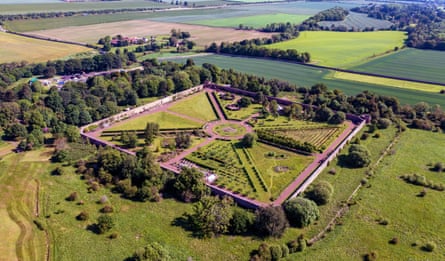
Photograph: Amazing Aerial/Alamy
Challenge duly accepted. But how? To my mind, with something that size, you’ve got three options. Either massive amplification (a little rock’n’roll for Lammermuir, perhaps), a lot of bagpipes (always an option in Scotland, but the contemporary repertoire is sadly limited), or those quintessential outdoor instruments – brass ones. And then the essential question: what on earth are they going to play?
I do have some history with large-scale brass performances. I myself don’t play a brass instrument – although my brother was a founder member of the brass band in the town that we grew up in – but I have worked with many brass players over the years, and staged a number of mass-participation brass events in my other job as festival director of New Music Dublin. However, I have no handles at all on the contemporary brass repertoire beyond that, so it was time to call in a second associate from the contemporary music underworld – the celebrated trumpeter Marco Blaauw, well-known for his playing with Ensemble Musikfabrik in Germany to help us work out what everyone was going to perform.
Marco breezed into Scotland, trumpet in hand, to “try out the acoustics” of the garden. Those bitingly cold days in Amisfield in December are precious memories, as Marco also brought along John Wallace – fellow trumpeter extraordinaire, former principal of the Royal Conservatoire of Scotland and best known to the general public as the impeccable soloist performing alongside Kiri Te Kanawa at Charles and Diana’s wedding – to have a listen. Very sadly, John died earlier this year, and this year’s Lammermuir festival is dedicated to his memory. I have a very clear memory of John dancing around the garden to Marco’s wild improvisations in the fading winter light, coat flapping, eyes shining with joy. I hope his spirit lives on in what we are about to do.
The acoustics in the garden are extraordinary. It’s so large that when we are within it, we are inside an echo chamber, every individual note ricocheting around like an echo off a mountainside. Once Marco had finished his acoustic explorations and we were warming up inside with tea and cake, he turned to me and said, somewhat mischievously: “You do know there’s a piece for 100 tubas? That would be fun and interesting to do!”

Anthony Braxton’s Composition No 19 (for 100 Tubas) (1971) has never had a performance outside the US and this will be only its third performance ever. It was initially written without a first performance in mind, and it was only when the “tubist, composer and improviser” Jay Rozen joined Braxton’s sextet in 2006 and asked the composer about the piece, having seen the score published in an experimental music magazine in the 1970s, that Braxton offered to reconstruct the written music for what would be its premiere in New York in 2006.
The venerable composer introduces his score – which consists of four sections of music for four separate bands of 25 tuba players each – with an essay, detailing his extensive thinking and philosophy. He describes the piece as “alternative parade music”, and wonderfully it not only provides this structure, but also allows the players to be “diverse in their unity”. Unity, because everyone is indeed playing a tuba – but diversity, because tubas come in all shapes and sizes, from orchestral tubas to over-the-shoulder sousaphones, tenor horns, euphoniums and even the rarely sighted Wagner tuba. There is also unity because everyone is apparently playing the same piece but, as the performance proceeds, it gives spaces and opportunities for every player to diversify and express their own musical personality, acting as an improvising individual within the group. These opportunities become more and more numerous until by the end – in our version, at the hour – it becomes a wild group improvisation, with the players gathered in the centre having paraded their way around the garden in multiple different ways as the light slowly fades into the autumnal dusk.
And that small matter of finding 100 tuba players? I don’t want to jinx anything – and it is a phenomenal organisational workout for my colleagues to get everyone to the right place at the right time with the right instruments, right music and right clothes – but it turned out, when the word went out, that tuba players from across the world will come to join in. Performers from the US, Latvia, Estonia and the rest of the UK are bringing their tubas of all shapes and sizes to be a part of what may be the most eyebrow-raising contemporary music event I’ve yet told my family I’m a part of.
100 Tubas is at Amisfield Walled Garden, part of the Lammermuir festival, on 19 September. John Harris is artistic director and chief executive of the Red Note Ensemble and Festival Director of New Music Dublin.