.png) 3 months ago
75
3 months ago
75
It was day three of the British family’s holiday in Brazil and, as the sun rose over Rio’s undulating mountains, they set off for the city’s most talked about tourist haunt.
“It’s our first time in Brazil. We’re really looking forward to it,” said Paul Boswell, a 58-year-old builder from Basildon, Essex, before clambering on to the motorbike that would carry him there.
“You’ve got to do it, haven’t you?” said Boswell’s partner, Fiona Kelly, 55, admitting she was unsure what she would do when they reached Rio’s latest must-see attraction.
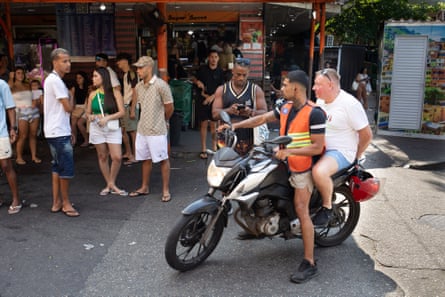
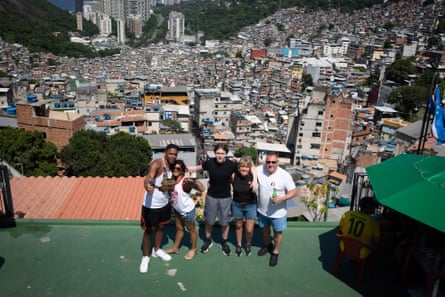
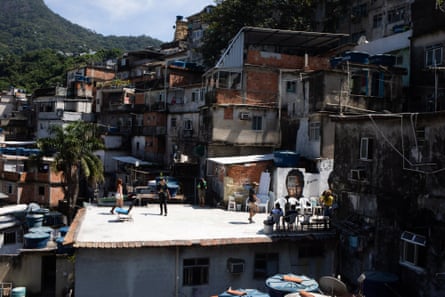
Boswell, Kelly and their teenage son Jack could have picked any of Rio’s world-famous landmarks at which to spend their Saturday: the Sugarloaf mountain, Copacabana beach or the Christ the Redeemer statue, which thousands of tourists visit each day. Instead, they were heading to a rickety, graffiti-covered rooftop deep in Rio’s largest favela, Rocinha, that has become the city’s most in-vogue tourist hotspot.
Tens of thousands of tourists have flocked to the terrace, known locally as the “Porta do Céu” (Gateway to Heaven), since last year, when favela entrepreneurs began making viral drone videos showing visitors swaggering or dancing through a metal door and across the roof to a euphoric Brazilian soundtrack, before the camera zooms out, revealing the favela’s place in the heart of Rio’s awe-inspiring landscape.
“The rooftop has existed for ages … but since 2025 these drone videos have gone viral. In January there was one that got nearly 50m views on Instagram. It blew up,” explained Vitor Hugo Oliveira da Conceição, a favela guide who accompanies outsiders to the unusual tourist spot above a family home.
The trend has been turbo-charged by influencers and celebrities visiting Rocinha, including the Brazilian artist Anitta and the Catalan pop star Rosalía.
Recently, Conceição has chaperoned visitors from as far away as China and Japan around Rocinha, a colossal sweep of housing that spills down a mountainside towards the Atlantic, as well as people from Latin America, Africa and Europe. “I’ve done tours with people from Kazakhstan and Pakistan – even Ukrainians, bro,” he said while leading an 11-strong group from Cape Verde, Argentina and the UK into the community.
Victor Hugo de Jesus Ferreira, a 19-year-old drone operator who films about 100 tourist videos each day, said: “The favela is now one of Rio’s main tourist attractions – [even more talked about] than Christ the Redeemer.”
In the past, tourist companies have been criticised for organising exploitative safari-style “poverty tours” of favelas like Rocinha, reputedly the largest such community in Latin America.
But Conceição said the favela-led visits to Rocinha’s most famous rooftop were transforming the area for the better. “This flux of tourists is changing so many people’s lives – mine included,” said the tattooed 35-year-old whose upbeat demeanour conceals a hardscrabble life in an area long stigmatised and neglected by the government.

After losing his baby daughter to pneumonia when he was 20, Conceição said he became addicted to crack and got involved in the drug gang that rules Rocinha. But he has bounced back – partly thanks to the community’s thriving tourist trade – and now supports his family with tours that seek to show a more positive side of favela life.
“I never imagined I’d be living off tourism. I didn’t finish school. I never managed to learn another language,” said Conceição, who is studying Castilian to cater for a deluge of visitors from Spain after a YouTuber from that country publicised his work.
The drone videos have proved so popular that huge queues form outside the Gateway to Heaven on Rocinha’s Street No 1, as tourists wait to strut their stuff on the improvised catwalk.
“The day I visited the rooftop, there was a two-hour queue!” said Marcelo Freixo, the president of Brazil’s tourist board, Embratur, who made his own video there last week. “It’s incredible. Once again, you have the favela reinventing itself and creating its own solutions.”
A neighbouring terrace has been turned into an alfresco waiting room where tourists can relax with an ice-cold beer or guaraná while contemplating jaw-dropping views over Rio’s beaches and forests.
“The health and safety is definitely a lot different [to the UK],” said Jack Kelly Boswell, 17, who works for his father’s building firm, as they admired Rocinha’s cascade of tightly packed redbrick homes.
“I can imagine this is what London was like in the 1600s. It’s crazy, isn’t it?” he added as they navigated a labyrinthine network of back-alleys where more than 100,000 people live.
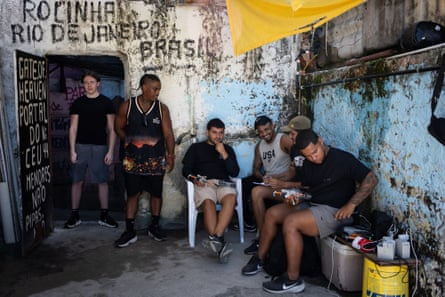
Priti Gomes, a tourist from Chelsea, said she had come to witness the strength and resilience of Rocinha residents – as well as film a rooftop video to remember her trip. “It’s one of those lifetime things, isn’t it? One of the seven wonders of the world, in a different way,” she said.
Freixo voiced excitement at how Rocinha’s rooftops had become a tourist magnet and said officials would support the boom by training young guides in eight communities, including Rocinha, Mangueira, and Rio’s first favela, Providência.
“Favelas have such creativity, such joy … There’s a human spontaneity you don’t find anywhere else,” said Freixo, who believed Rocinha’s terraces were creating jobs, income and self-esteem while honouring the favelas’ crucial role in the city’s life.
“There’s no such thing as Rio without the favelas. No postcard of Rio can ignore the favelas. The favelas are part of the city. Nearly a third of the city’s residents live [there],” said Freixo, noting how people across Brazil, and Latin America, were making copycat drone videos celebrating their own postcodes.
Freixo said the favela tourism boom mirrored a wider upsurge in tourism to Brazil, which received a record 9 million visitors last year, compared with 6.7 million in 2024. He believed part of the explanation was a global thirst for joyful, profound experiences after the Covid pandemic and at a time when much of “the world is at war”.
After the Boswell family jinked their way across the rooftop for the camera, Conceição shepherded them to another terrace where they feasted on steak and sausage under a ferocious midday sun.
“This is the essence of the favela,” beamed Conceição, tending to the barbecue to the sound of favela funk.
Wolfing down handfuls of expertly charred garlic bread, Jack Kelly Boswell said the favela had won his heart. “It’s going to be one of my best memories,” he beamed. “I’m going to come back with my friends next year.”