.png) 3 months ago
79
3 months ago
79
Since their formation in 1979, Tuareg guitar band Tinariwen have been constantly moving. Based variously in Mali, Libya and Algeria, the Grammy-winning group have used their desert blues music as a lament for a wandering refugee status that continues to this day.
Co-founder Abdallah Ag Alhousseyni says the group are currently in Algeria, after band members had to flee their homes in Mali in October 2024. “The Malian military and the Russian mercenary group Wagner have been burning villages, slaughtering animals and raping women,” he says. “No one is talking about what is happening – no politicians or journalists – so we have to let the world know through our music.”
While the Tuareg people are traditionally nomadic, living across the Saharan desert, the region’s increasingly complex politics have often placed them in violent situations. Most recently, clashes on the northern Mali border between encroaching Islamist militant groups, the Malian military, Tuareg rebel groups and Wagner mercenaries have caused mass displacements and human rights abuses in the country. It’s a harrowing conflict that now takes centre stage on Tinariwen’s 10th studio album, Hoggar.
Across the 11 tracks, the group pairs the gently tripping classic Tuareg rhythm – sometimes likened to the gait of a camel – with finger-picked guitar lines and the husky might of group vocal harmonies. On Aba Malik, a sparse and quietly swelling guitar melody accompanies clattering tende drum rhythm, and the emotive, time-worn baritone of co-founder Ibrahim Ag Alhabib, who sings about the abuses of the Wagner group, exclaiming: “Curse you Wagner / Curse your mother!” On the rollicking, bluesy Erghad Afewo, the group addresses tribal in-fighting among the Tuareg people, while the soaring guitar tones of opener Amidinim Ehaf Solan provide a buoyant accompaniment for Alhabib’s hopeful lyrics on the discovery of a green and pleasant homeland for their people.
“We don’t want independence, we just want autonomy,” Alhousseyni says, dressed down in a turtleneck while speaking over a video call from Paris where Tinariwen are on tour. “We want a place for our people where we can be safe in the Azawad” – a name given to the Tuareg territories in northern Mali. “We are all refugees in Algeria right now. We are not alone but we have nowhere else to go, even though we have done nothing wrong.”
More than just protest music, Tinariwen’s rock-influenced imagining of Tuareg desert blues has reached audiences far beyond their community over the past 48 years. Robert Plant has said of them: “This was the music I’d been looking for all my life”; and Jack White invited the group to record their 2023 album Amatssou at his Nashville studio. Swedish-Argentine singer-songwriter José González is such a fan of “their combination of hypnotic guitars and meditative songs with uplifting collective singing” that he features on Hoggar. “I first heard the 2007 album Aman Iman and was blown away by the songs,” he says. “When I was home rehearsing guitar I used to jam and try to imitate their rhythms. I fell in love.”
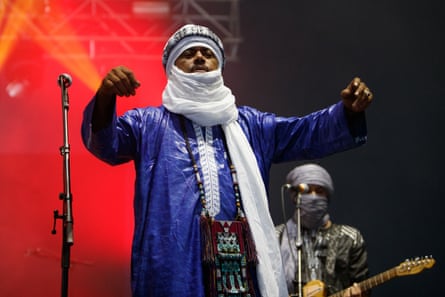
Founding members of the group first met in a refugee camp in Algeria as teenagers, then moved to Libya where they were briefly enlisted into Muammar Gaddafi’s paramilitary with a promise of Libyan citizenship that was eventually broken. On relocating to Mali in 1989, the group decided to replace their weapons with guitars and began playing as a wedding band whose bootleg cassettes soon became popular among the displaced Tuareg community.
“When we started, we didn’t have the internet so we didn’t know what was possible. All we knew was that we wanted to keep playing music,” Alhousseyni says. “We were just living in the bush, playing weddings, so the spread of Tuareg music has been a surprise to us all.”
In 1998, the group found international recognition when the French folk ensemble Lo’Jo shared a bill with them at a festival in Bamako. Taken with their politicised Tamasheq-language lyrics and syncopated rhythms, the group invited Tinariwen to tour in France and The Radio Tisdas Sessions, released in 2001, became their first release to be available outside northern Africa. Since then, Tinariwen have taken their signature flowing daraa (tunics) and tagelmust (turbans) to stages around the world, winning a Grammy for their 2011 raw-edged breakthrough record Tassili, and garnering other famous fans such as US rockers Kurt Vile and Cass McCombs.
Hoggar is an intergenerational celebration of their influence on Tuareg music. Rather than recording the album over live takes among nature in the desert, which is the traditional Tuareg method, they found a safe haven in the Algerian city of Tamanrasset, namely a studio founded by the younger Tuareg group Imarhan.
“Ever since I heard Tinariwen’s second album on a ghetto blaster as a teenager it blew me away and inspired me to make my own music,” Imarhan frontman Iyad “Sadam” Moussa Ben Abderahmane says on another video call. Imarhan recorded their first two albums in Paris, “but the travelling made us lose energy and inspiration”, Sadam says, so they built their studio in Tamanrasset. “It’s the city in Algeria with the most Tuareg people and here guitars are like footballs in Brazil – everyone has one. Except, there is no infrastructure for young people to record, they have to pay to go abroad instead. We knew we needed to make something here for ourselves.”
Naming the studio Aboogi after their 2022 album, Imarhan’s open-door ethos soon attracted the elders in Tinariwen. “Even though we don’t usually like recording between four walls, it would allow us to invite other artists in for the first time,” Alhousseyni says. “We spent three weeks with lots of people coming every day and exchanging ideas, like Sadam, and it became very emotional to have all the generations together.”
Sadam features on several tracks, duetting on Tad Adounya and playing guitar on Amidinim Ehaf Solan. Other guests include original member Liya ag Ablil, who hasn’t recorded with the group in more than 25 years; and González on Imidiwan Takyadam. “When they reached out to collaborate, I loved the demo immediately and felt like singing in Spanish on it,” González says.
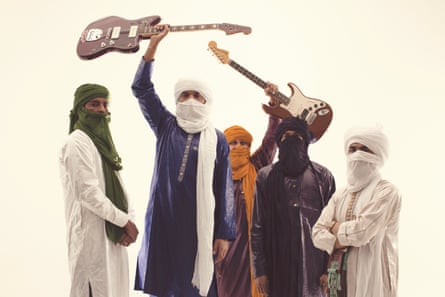
Especially significant are the backing vocals from female singers Wonou Walet Sidati and Nounou Kaola. “Eighty per cent of traditional Tuareg music is women’s voices but over the past 10 years it’s been very difficult to find female singers, because there has been nowhere for them to learn or be encouraged – once they grow up, they get married and become mothers instead,” Sadam says. “With Aboogi, we have had a lot more young women arriving, curious to try out singing or making music. Many of them have never seen a studio before but they want to sing and it’s very promising for the future.”
Several of these female singers, including Kaola, also feature on Imarhan’s recently released latest album, Essam. Taking Tinariwen’s expansive Tuareg sound one step further, the propulsive, beat-driven record not only includes electric guitar and hand percussion but also synths and electronic textures courtesy of French artist Emile Papandreou of electropop duo UTO. Sadam admits he’d “never really heard electronic music before but we wanted to try something new. We’ve since had good feedback from our own community. It could be the next step in Tuareg music.”
Currently touring with Tinariwen as the youngest member of their generation-spanning band, Sadam has his sights firmly set on the future of Tuareg culture. “We are only presenting a very small part of our heritage with both these bands and there are so many more aspects that need to be spread like Imzad music” – a single-string fiddle music traditionally played by women – “or Tamasheq poetry,” he says. “With Aboogi I want to have an archive where we can record all the Tuareg music and way of life so it isn’t forgotten.”
Tinariwen, meanwhile, see their purpose as continuing life on the road and on record, to keep raising awareness of the Tuareg plight. “We are getting older now, some of us are almost 70, so touring is becoming more difficult,” Alhousseyni says. “But we want people to hear that in our land, our people and our animals are being killed, and we need to find a way to make peace. Until that happens, we have no choice but to continue singing.”