.png) 3 months ago
67
3 months ago
67
In March 2021, six Asian women were killed in a mass shooting in Atlanta. Amy Wang, an Asian Australian writer and director, who emigrated to America in 2015, remembers that tragedy well. “It was the first time I felt genuinely unsafe here,” she says. Alongside a growing fear, childhood memories resurfaced – the internal and external racism and the exhaustion of never quite fitting in. “I moved to Australia when I was seven and didn’t speak English – it was a tough time for me,” she admits. And then there was one particular recurring thought. “There were many times when I’d wake up as a teenager and think to myself: ‘Wouldn’t life be easier if I were white?’” So, she turned that past feeling into art.
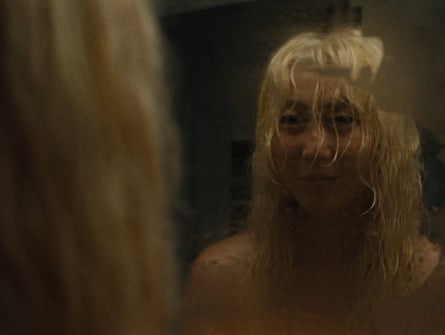
The art is Slanted, Wang’s audacious feature debut – a film whose premise is, by design, completely unhinged. An insecure Asian American high schooler undergoes a procedure at a mysterious cosmetics clinic called Ethnos (tagline: if you can’t beat them … be them) that renders people of colour visibly white, permanently. It’s taking ‘I don’t see colour’ to the ultra-extreme: equality achieved only when we all look the same, and that means whiteness. The surgery works. And then things get complicated.
Winner of the 2025 narrative feature grand jury prize at SXSW, Slanted blends dark satire, body horror and coming-of-age drama. Its unsubtlety is a feature, creating space to contemplate societal power dynamics, the immigrant experience, race and body image without ever feeling like a lecture.
“Honestly, I didn’t think the film would be controversial, because it’s so truthful to me; the core of how I felt as a teenager,” explains Wang. We are speaking via Zoom from her New York hotel room overlooking Central Park, mid-press tour.
Joan, played by Didi’s Shirley Chen, has memorised the social architecture of her high school and knows exactly where she falls within it: outside. She idolises the popular girls – their easy confidence, their proximity to the all-American ideal crystallised in the prom queen crown. When Ethnos messages her with the promise of transformation, the temptation is irresistible. Post-surgery, Joan becomes Jo, played by Scream 7’s McKenna Grace, and life appears effortless, but at what cost?
“The core concept was satirical, but I couldn’t imagine it as a dramatic satire,” Wang explains. “I wanted the movie to feel like Mean Girls at the beginning and then kind of feel like a nightmare. How do I evoke that? Well, through body horror.” She adds, with comic timing: “The concept was years before The Substance came out, I’d like to say.” While both films weaponise transformation as metaphor, Slanted operates at the edge of body horror – less viscerally savage, more interested in the quiet familial damage that follows.
The genre-mixing occasionally wobbles for that reason – it could bite harder. Yet the film’s most affecting scenes are grounded in Wang’s memories. “I had a wealth of experiences to draw from, particularly the scenes with Jo/Joan and her parents,” played by Fang Du and Vivian Wu. The comedy of cross-cultural misunderstanding shades into something more painful: parents who sacrificed everything in a new country, and their daughter is literally trying to disappear into it.
Setting the story in high school was both instinctive and strategic. The social world of adolescence gives the film’s more absurdist moments believability. “When you’re in high school, everything feels so heightened and dramatic,” Wang says. “I wanted to take the all-American girl trope, so well-known, so coveted, and flip it on its head.”
Grace, while not Asian-American, found her own way into the character. “She related to the bullying, the feeling of wanting to belong,” says Wang. “She even embraced the Mandarin. She was on Duolingo and would send me videos of herself practising.”
It’s an improvised line from Never Have I Ever’s Maitreyi Ramakrishnan, playing Joan’s friend, that lingers longest – “Do you think I’m ugly too?” – a reminder that you can occupy the same world as another person of colour and have entirely different realities. Wang recalls a response from KCRW podcast host Sam Sanders, who told her that watching Slanted made him ask whether he would have taken the surgery as a teenager. Probably not – but he would have had surgery to become straight. “To me, that’s the whole film,” says Wang. “It’s about confronting what you’re uncomfortable with and putting it on the surface – it could be your body, your face, something internal. I don’t believe anyone has existed in this world without once thinking: ‘I wish I looked different.’”
Wang has been part of Hollywood since graduating from AFI in 2017, producing Netflix’s The Brothers Sun and writing on the forthcoming Crazy Rich Asians 2, which she describes as more joyous and aspirational. Slanted is the necessary flip side: not the triumph of representation, but the cost of its absence.
She has lived in the US for over a decade. What still surprises her? She barely pauses. “That drug advertisements and billboards list all the side effects. I will never get used to that.” Somehow, it’s the most American thing she can think of.
America is home for now, and she’s proud of her Asian and Australian-ness, particularly when far away from home turf. Adopting a “who cares” attitude that only comes with age, she notes, “it really is a lifelong journey – finding the specific version of yourself that fits, that you can be proud of. I’m embracing that.” For Wang, Slanted is a reclamation of her past self. “I hope to keep making movies that confront and explore the why, and in doing so, help somebody else feel seen and feel less judged.”
-
Slanted is out now in US cinemas with UK and Australia dates to be announced