.png) 1 month ago
41
1 month ago
41
An Italian MEP has questioned whether the Italian government is trying to “hide the truth” about conditions at an offshore migrant detention centre in Albania after a delegation she was part of said they were prevented from conducting a full inspection.
Cristina Guarda, from Italy’s Greens and Left Alliance (AVS), said staff at the Italian-run facility in Gjadër had refused to give MEPs from the Greens/EFA group key information, such as how many people were being held at the centre, and that they had not been allowed to access their cells.
Guarda said that testimony gathered from those they were able to speak to depicted a daily existence defined by “limbo and alienation”.
Citing an official register of “critical events”, she said there had been six attempts by people held at the centre to kill themselves since mid-May, as well as other acts of self-harm.
“Whether they want to hide the truth about the conditions of life inside the detention centre, something is not clear,” said Guarda, who also described “sweltering” heat at the facility.
Rome’s prefect office, which has overall responsibility for Italy’s offshore migrant processing centres in Albania, did not immediately respond to a request for comment from the Guardian. Neither did Medihospes, the Italian cooperative that manages the facilities.
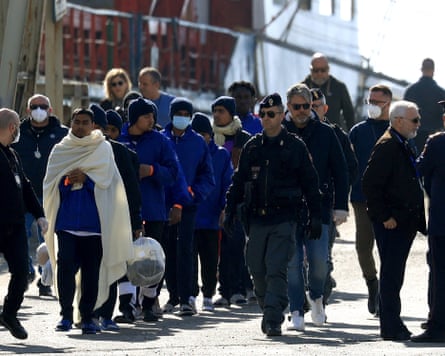
Italy opened two centres in Albania – in Gjadër and Shëngjin – in 2024 as part of a controversial pact aimed at processing the asylum applications of adult men intercepted at sea by Italian government vessels and detaining refused asylum seekers pending their deportation.
The five-year deal, which is costing Italy an estimated €130-140m (£112-120m) a year, has faced numerous legal challenges. Citing European law, Italian judges have rejected many transfers on the grounds that migrants’ countries of origin were unsafe to be repatriated to if their asylum requests were rejected.
Several people are believed to have arrived at the facilities since the European parliament adopted a plan this month enabling the creation of offshore “return hubs” – centres outside the EU where undocumented people can be held for unspecified periods while waiting to be sent back to their home country.
Although there are no official figures, the facility in Gjadër, which is primarily used to detain people before expulsion, hosts an estimated 70-80 people. Between them, the facilities in Albania are designed to accommodate roughly 1,000 people, with the original agreement allowing a cap of 3,000 at any one time.
Guarda said the use of psychotropic drugs was “a constant” and that people filled their time by sleeping because “essentially they have nothing to do”.
“One person said he was living his days in pursuit of his freedom,” she added. “This situation is alienating – it amplifies difficulties of a psychiatric nature and must be taken seriously.”
The scheme, which falls under Italian jurisdiction, has often been touted as a model to follow by other EU states seeking to manage irregular immigration.
Italy’s prime minister, Giorgia Meloni, has on several occasions expressed her determination to make the initiative work, despite her government so far failing to achieve its original goal of sending 36,000 people a year to the centres. In April, a group of senators from her Brothers of Italy party visited Gjadër and described a “modern, efficient facility in excellent condition and designed to ensure proper reception, safety and compliance with standards”.
after newsletter promotion
Tineke Strik, a Dutch MEP who was among the European parliament delegation, said in a statement that the visit was “very disappointing and disgraceful”.
She added: “The staff really created a lot of obstacles for us. We didn’t get any data, they didn’t answer any questions, and we were not allowed to really go into the cells, and see what the situation is like.
“For the people we did manage to speak to here, it’s clear they have problems asking for asylum, and many of them don’t see any way out of a failed system.”
Cecilia Strada, a politician with Italy’s centre-left Democratic party, called on the Italian government and European Commission to explain why the MEPs faced obstacles.
“They keep telling us that human rights are and will be guaranteed in centres located in third countries,” she said. “But European parliament representatives, who have the authority to enter, were ultimately unable to genuinely verify respect for those rights.”
-
In the UK and Ireland, Samaritans can be contacted on freephone 116 123. In the US, you can call or text the National Suicide Prevention Lifeline on 988, chat on 988lifeline.org, or text HOME to 741741 to connect with a crisis counselor. In Australia, the crisis support service Lifeline is 13 11 14. Other international helplines can be found at befrienders.org