.png) 1 month ago
44
1 month ago
44
Ferdinand Georg Waldmüller (1793-1865) is regarded as one of the most important figures in 19th-century Austrian art; an influential and admired teacher, and a somewhat radical figure regarding the established Viennese Academy. He worked during the Biedermeier movement which spanned the end of the Napoleonic wars until 1848 when various revolutions shook the ruling Habsburg empire and Austrian political elite. Biedermeier reflected the tastes and aspirations of a rising bourgeois society; terribly nice landscapes, genre scenes, floral and portrait pieces for the upwardly mobile drawing room. Within these genteel confines, Waldmüller intently focused on a more unflinching mode of depiction, concerned more with accuracy and integrity than the sentimentalising efforts of his peers, while also criticising the Academy’s teaching methods and eventually in 1857 even calling for the abolition of all academies.
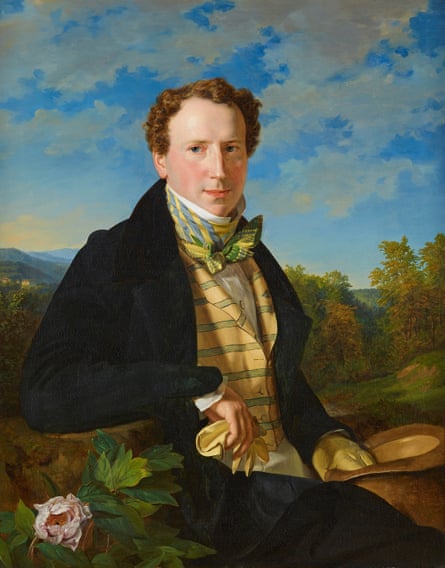
If this collection of relatively small, minutely detailed landscapes is representative of an impassioned, radical painter tearing up the rule-book, it is far from obvious from their tightly controlled, rather unimposing visual appearance. Each shows a vista of a specific location – The Ruins of the Temple of Juno Lacinia near Agrigento (1846), View of the Dachstein from the Sophien-Doppelblick near Ischl (1835) – accompanied by captions which systematically list topographical details of note, followed by some light technical analysis: for the latter, “Waldmüller has distinguished the successive elements in the landscape with distinct changes in tonality, from the soft green of the valley to the blue-grey of the most distant mountains.” In the show’s only portrait, 1828’s Self Portrait as a Young Man, which incidentally dwarfs everything else here in scale, the caption draws attention to “his delicate fingers proclaiming his sensitivity and talent”: delicacy and sensitivity are the operative descriptors for the entire show.
It is noted that Waldmüller originally taught himself by copying 17th-century Dutch artists such as Jacob van Ruisdael, abandoning this practice in favour of studying directly from nature. While Ruisdael conjures expressive landscapes of tangible mood and liveliness, Waldmüller effectively strips his landscapes of dramatic impact and overt personality in search of militant accuracy. He applies the ingredients of leaves, bark, grass and foliage to his compositions with the measured, squinty-eyed precision of a chef applying micro-garnish with a pair of tweezers.
Unusual in itself is Waldmüller’s use of the white rather than brown ground for his paintings. Applying oil paint in thin glazes on a white ground makes for brilliant shining colour; a practice also adopted in parallel by the pre-Raphaelites, whom he may have encountered during a trip to London in 1856. The pre-Raphaelites’ efforts however are technicolour riots of eye-watering intensity fully in keeping with their slightly trippy and fantastical figures of myth and legend; again in confining himself to slavishly accurate reproduction of the trees around him, the visual impact for Waldmüller is comparatively dialled down to muted as-found-in-nature colours.
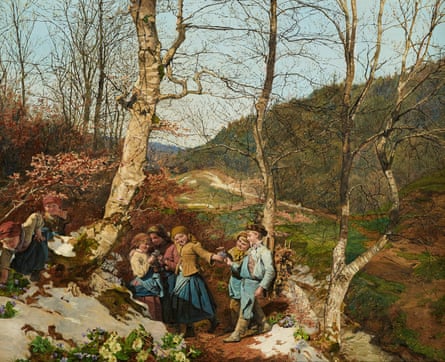
It is difficult to fully comprehend Waldmüller’s trailblazing status within the narrow parameters of landscape painting, and in isolation from contemporaneous contextual examples; what is the difference between these and the discipline of topographical or botanical paintings which serve primarily for academic record? The clue lies in a single landscape populated by a rather twee group of smiling children gathering violets in Early Spring in the Vienna Woods (1861), which gives a glimpse into the wider Biedermeier trend for sweet genre scenes with metaphorical content, here indicating the spring yet to come. With their saccharine presence, one can comparatively understand Waldmüller’s desire to do away with such unserious fancy and focus on the “unflinching honesty” of the actual world.
The choice to limit the UK’s introduction to Waldmüller to landscapes may be attributed to the National Gallery’s collaboration with the Belvedere in Vienna, which previously showed an expanded version of this group and loaned the majority of paintings. It is part of a concerted effort to plug the gaps in its holdings of German, Swiss and Austrian 19th-century Romantic paintings; after all, it has only one Caspar David Friedrich in its permanent collection. This exhibition space has been dedicated to bringing such under-represented artists to its audience. Certainly, blockbusters showing Van Gogh have the most populist pulling power, but credit is due to the National for truly seeking to provide a fuller geographic and historical view of other artists and movements. To this end, this Waldmüller showcase is the art historical equivalent of eating your greens: it may not quicken the heartbeat but is nonetheless a healthy exercise forming a fully balanced palate.