.png) 1 month ago
43
1 month ago
43
South Africa was holding its breath on Tuesday as mass anti-immigration protests were held across the country. They come after a weeks-long campaign against foreigners that has seen at least four killed and tens of thousands fleeing for safety.
In the coastal city of Durban, where violence had been expected, the streets were unusually quiet and shops were shuttered as tension hung thick in the air.
More than 2,000 protesters in Zulu attire marched through the city centre, brandishing sticks and clubs and calling out “Abahambe!” (“They must go!” in isiZulu, the most widely spoken language in the country), a phrase that has become the movement’s rallying cry.
Campaign groups behind the protests have given undocumented immigrants an arbitrary “deadline” of 30 June to leave the country, with many fearing the marches could descend into violence.
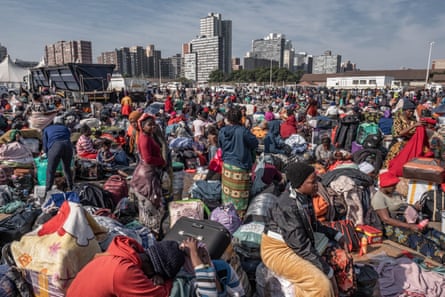
In the days leading up to the deadline, thousands of people have fled their homes in fear, sleeping rough on pavements, in open fields and in makeshift camps, in the hope of being repatriated to their home countries. Several African governments have organised buses or planes to bring their citizens home, with police saying more than 25,000 have been repatriated so far.
In the city of Pietermaritzburg, 50 miles from Durban, where a 29-year-old Malawian national was killed by a mob after a protest on 19 June, hundreds of families camped for days outside an abandoned building.
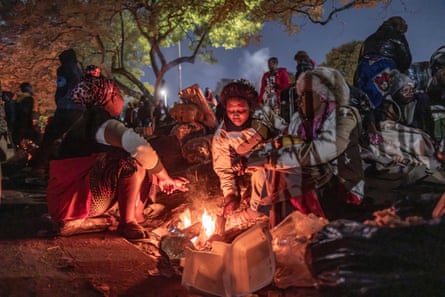
On the eve of the 30 June protests, as authorities raced to send home as many as possible, a queue snaked through the overgrown garden. Weary mothers and children sat around campfires while people lifted their tightly packed belongings into buses headed for South Africa’s northern border.
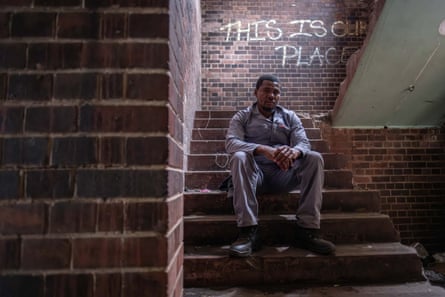
Jackson Makungwa stood in the line beside two small bags: everything he could carry from 10 years spent building a life in South Africa. The 29-year-old from Malawi had once seen South Africa as a “country of hope” and had lived there legally, but said he had been unable to renew his work permit for the past two years.
“It’s not like I want to be illegally in the country, but the system doesn’t allow me to be here legally,” he sighed.
For weeks, Makungwa resisted his mother’s growing pleas for him to leave. That changed after a friend from Malawi was attacked by seven men.
“They said the deadline is the 30th, so they will attack me if I stay,” Makungwa said.
On his phone, he showed a photo of his son, born to a South African mother. He hadn’t managed to secure travel documents for the baby in time. “I was forced to leave him behind. He turns two months old today.”
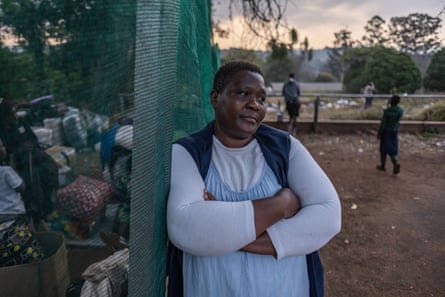
Down the road, in a makeshift camp set up by families from Zimbabwe, Lydia Mpingashato had just been informed of her dismissal from her job as a cleaner. Children ran around as women cooked on open fires. Many – including people with legal documentation – said they had been evicted by landlords who feared retaliation for renting to immigrants.
On 27 June, Mpingashato was threatened while waiting for a shared taxi in the township where she had lived for 17 years. “He said he would burn my house and kill my family,” she said. “Now I have no plan; I’m just going home to be safe.”
Her 17-year-old son had been forced to leave the only home he had ever known, as well as many South African friends, she said. “When he saw the camp, he told me: ‘Actually, they never loved us.’”
Many in South Africa blame immigrants from elsewhere on the continent for the country’s high unemployment rate and crime levels. “Xenophobia and Afrophobia … emerge where economic insecurity, high unemployment, inequality, weak governance and poor migration management intersect,” says Philile Ntuli from the South African Human Rights Commission.
The country, which is home to about 2.4 million foreigners (documented and undocumented) according to 2022 census data, has a long history of anti-immigrant violence. Xenophobic riots in 2008 killed 62 people and displaced more than 150,000. Another wave of attacks in 2015 left at least five people dead.
In response to the latest tensions, the government has sought to ease public anger by intensifying its crackdown on undocumented immigration. Police say more than 50,000 undocumented migrants have been arrested since January. On Monday night, President Cyril Ramaphosa met some of the protest leaders and warned against “vigilantism”.
after newsletter promotion
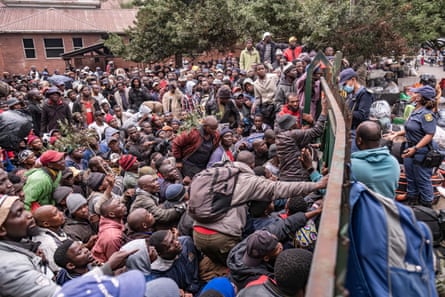
As marches began across the country, a heavy security deployment was visible as authorities prepared for possible unrest. In Durban, helicopters circled overhead while police and private security watched from armoured vehicles. Organisers urged protesters to remain peaceful and avoid looting, but some marchers made thinly veiled threats about what would happen after the “deadline”.
As the crowd moved past dilapidated apartment blocks, some protesters pointed at families watching from windows, calling out for them to leave the country and making throat-slitting gestures. “I can smell the foreigners,” said a man carrying a shield.
“We have been talking nicely. Tomorrow, we’re not going to talk. We take action,” said Nkosi Ndlovu, a 48-year-old pastor who accused immigrants of selling drugs to local young people, including his sister-in-law.
On the outskirts of the march, 40-year-old Mfundo Zulu said immigrants were taking jobs from South Africans by accepting lower wages. “Those are our kids, our youth are dead,” she said, pointing towards a nearby homeless camp. Since thousands of people had fled the country in recent weeks, she said, many jobs had suddenly become available.
“Life will be better now,” her friend added. “We don’t hate them, but they overstayed.”
For Mukandjwa Shomri of the Southern Africa Refugee Organisations Forum, South Africa’s government “is not doing enough” to hold perpetrators of xenophobic violence accountable. “When you try to open a case with the police, they will first ask for your papers,” he said. “We are being attacked in the streets, in the community and administratively.
“The hope many of us had as refugees when we came to this country – that South Africa is upholding human rights, a country affirmed internationally as a democratic state, is no longer there,” he said.
Speaking on the phone from a safe house, Leon feared what would happen after the 30 June cutoff. The asylum seeker from the Democratic Republic of the Congo, who has been in South Africa since 2014, went into hiding after his shop was attacked on 19 June. He asked to be identified only by his first name.
“Even the police are telling us openly that we are tired of you, you must leave our country,” he said, his voice trembling. Harassment had already been commonplace for years, “but now they got the opportunity to do it openly”, he said. “After 30 June, it will be even worse.”
Some days, Leon regretted seeking refuge in South Africa, a country where he thought he would find peace. “Now, we’re just living like somebody who is already dead,” he said.
“We are ready for anything.”