.png) 2 months ago
50
2 months ago
50
Opening summary: Israel says fighting will continue in southern Lebanon despite new ceasefire agreement
Hello and welcome to the Guardian’s continuing live coverage of the crisis in the Middle East.
The Israeli defence minister, Israel Katz, said the military will continue its ground operations in southern Lebanon, hours after Israel and Lebanon agreed to implement a US-backed ceasefire to end hostilities.
Katz said the Israel Defense Forces (IDF) will not withdraw from southern Lebanon, including Beaufort Castle, and the hundreds of thousands of people forced to flee their homes will not be able to return.
“The IDF will, at this stage, continue its fire and ground operations, remain in the security zone in Lebanon up to the yellow line – including in the Beaufort area – and without the return of the population, while continuing to dismantle terrorist infrastructure on the ground,” he said in a statement.
He added that the IDF retained the “freedom of action, with American backing, to strike in Beirut in response to fire on Israeli communities and territory”.
The IDF also issued a warning this morning saying fighting will continue in southern Lebanon as it urged people to “refrain from heading south of the Zahrani River”.
Lebanon’s official National News Agency reported several people were wounded in Israeli strikes in the southern Tyre and Nabatieh areas, which have seen repeated attacks in recent weeks.
It came just a day after Israel’s and Lebanon’s governments agreed to implement a conditional ceasefire following a fourth round of talks in Washington. The truce is contingent on a complete cessation of fire from the Hezbollah militia and would reportedly create a number of “pilot” security zones in Lebanon from which the Iran-aligned group’s fighters would be banned.
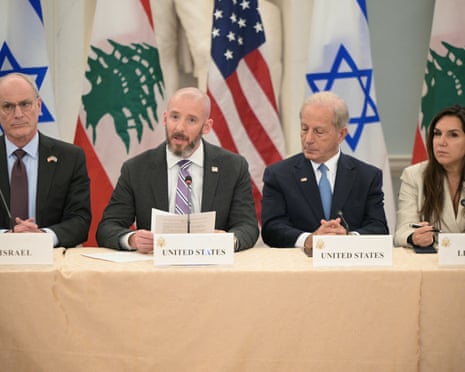
The truce involves “the evacuation of all Hezbollah operatives” from areas south of the Litani River, according to a joint US-Israel-Lebanon statement released by the US state department.
It was not immediately clear how the Lebanon security zones would be established but the agreement calls for the Lebanese army to take full control of those areas.
Hezbollah has yet to comment on the ceasefire. The group is not taking part in the talks and firmly opposes them, saying it won’t abide by agreements that may result. A Hezbollah official told Agence France-Presse on Tuesday the group would “not accept a partial ceasefire”.
In other developments:
-
Oil prices jumped nearly 2% after the attacks on Kuwait tested the fragile truce. Flights at its international airport were suspended after the Iranian drone and missile attack damaged airport facilities and diplomatic missions, killing one person and injuring more than 60, Kuwaiti authorities and state media said. Kuwait Airways and Jazeera Airways later resumed flights, authorities said.
-
Iran’s Revolutionary Guard said it did not fire at Kuwait’s airport and blamed the destruction on US interceptor missiles that failed to hit their targets, according to Iranian state media. The US military said that was not accurate and that Iranian drones targeted the airport deliberately.
-
Earlier, Iranian media said the Revolutionary Guard attacked the US Fifth Fleet headquarters in Bahrain and a US airbase, as well as a vessel. US Central Command denied its bases had been hit, also saying it had carried out new “defensive strikes” in southern Iran.
-
Iranian negotiations with the US had not been cut off but no progress had been made, Iranian foreign minister Abbas Araqchi told Lebanese broadcaster Al Mayadeen on Wednesday.
-
Donald Trump suggested earlier there could be progress for a deal as soon as this weekend. “I hear the negotiation itself is going very well actually,” he said at the White House. “If it happens, it could happen over the weekend.” He told a podcast that Iranian supreme leader Mojtaba Khamenei was involved in the negotiations.
-
Oil prices dropped on news of the Israel-Lebanon truce, with both main crude contracts down more than 1% after jumping back towards $100 this week.
Key events
Hezbollah leader rejects latest ceasefire agreement reached between Israel and Lebanon
Qassem said that Hezbollah has rejected the latest ceasefire agreement reached between Israel and the Lebanese government, demanding a complete Israeli withdrawal.
In a written statement read on Hezbollah’s Al-Manar TV on Thursday, the Iran-backed group’s leader said the agreement’s demand that Hezbollah fighters leave southern Lebanon under fire would mean “surrender, defeat and achieving the enemy’s goals.”
“What we are concerned about is an end to the aggression, ceasefire and Israel’s withdrawal,” he said.
“We did not make any commitment to any party to stop resisting as long as there is occupation,” he added.
Lebanon’s Hezbollah chief Naim Qassem said on Thursday that as long as Lebanese villages were being bombed and people were being killed, northern Israel will not be safe.
It comes as Israeli strikes killed at least four people in Lebanon, according to local authorities, and a UN peacekeeper was killed in the crossfire on Thursday.
The latest violence came after another ceasefire agreement was announced in the fighting between Israel and the Iran-backed Hezbollah militant group.
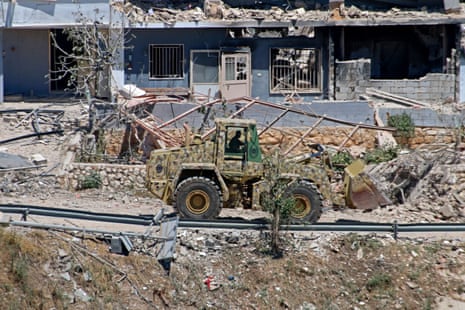
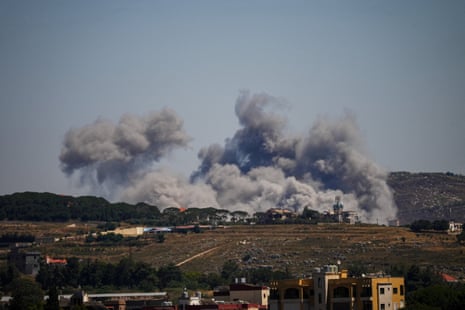
Here are some live images reaching us from Lebanon, showing the aftermath of the Israeli strikes on the country’s south:
Here is a video showing the moment Kuwait international airport was targeted in an attack yesterday.
One person was killed and more than 60 others were injured, Kuwaiti authorities and state media said, blaming the attack on Iran.
Iran denied it was responsible, blaming the destruction on US interceptor missiles that failed to hit their targets. The US said that was not accurate, and that Iranian drones targeted the airport deliberately.
Trump says House vote on his war powers 'meaningless'
Donald Trump has brushed off a House vote to rein in his powers to attack Iran without approval from Congress (see post at 12:34), saying it was “meaningless”.
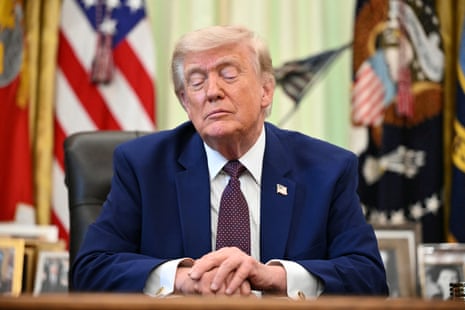
He singled out the four Republicans who joined Democrats to pass the bill in a vote of 215 to 208 yesterday.
In a post on Truth Social, the US president wrote:
Yesterday, in a meaningless vote, the House voted, 4 bad Republicans and all of the Dumocrats, to limit my War Powers, right in the middle of my final negotiations to end the War with the Islamic Republic of Iran. Who would do such an unpatriotic thing. They know where the negotiations stand. The Democrats are fueled by Trump Derangement Syndrome. They would rather have our Country fail than give me another, of many, victories. The four Republicans, that’s a whole other story - They’re GRANDSTANDERS! They should be ashamed of themselves. MAGA!!!

Robert Tait
The US House of Representatives delivered a stunning rebuke to Donald Trump over his war on Iran on Wednesday, as representatives backed a move to force him to seek approval from Congress or withdraw US forces.
The House voted 215 to 208 in favor of the war powers resolution, as four Republicans voted with Democrats. The dissident Republicans were Thomas Massie of Kentucky, Brian Fitzpatrick of Pennsylvania, Warren Davidson of Ohio and Tom Barrett of Michigan.
Wednesday’s vote came nearly two weeks after House Republicans cancelled an earlier scheduled vote, on the grounds that they lacked the votes to defeat it.
The vote sends the resolution to the Senate. A handful of Senate Republican defectors joined Democrats last month to advance a similar resolution forcing Trump to seek congressional approval after four Republican senators rebelled and voted with the Democrats.
Read more:
The commander of the Quds Force, the foreign arm of Iran’s Islamic Revolutionary Guards (IRGC), said Hezbollah is demanding Israel retreat to positions it held before the start of the war, according to a statement carried by Iranian media.
“Supporting the resistance in Lebanon is the duty of all of us, and removing Israel from the region is an attainable goal for Muslims,” Esmail Qaani was quoted as saying.
“The minimum demand of the resistance is the withdrawal of the usurping regime (Israel) to the position it held before the start of the 40-day war.”
The UN peacekeeper who was killed in southern Lebanon (see post at 10:08) has been identified as a Serbian soldier.
The Serbian defence ministry issued a statement naming the soldier as Milovan Jovanović.
The ministry said:
Staff Sergeant Milovan Jovanović, a member of the Serbian Armed Forces who was serving with the United Nations peacekeeping mission in Lebanon, died this morning as a result of injuries sustained after a projectile impacted the United Nations base where peacekeeping personnel, including a part of the Serbian contingent, are stationed. Following the incident, Sergeant Jovanović received immediate medical assistance at the base hospital and was later transported by helicopter to the University Medical Centre in Beirut, where he passed away at approximately 4.00 a.m. local time.
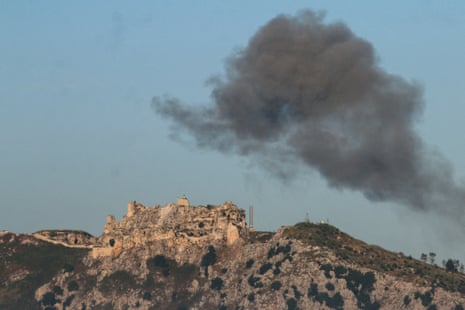
As part of the ceasefire agreement, Aoun said Lebanon proposed the “pilot” security zones include Beaufort Castle, which was captured by the Israeli military earlier this week.
The Israeli military would withdraw from these security zones and they would come under the exclusive control of the Lebanese army, Aoun said.
Aoun: Israel-Lebanon ceasefire agreement 'last opportunity'
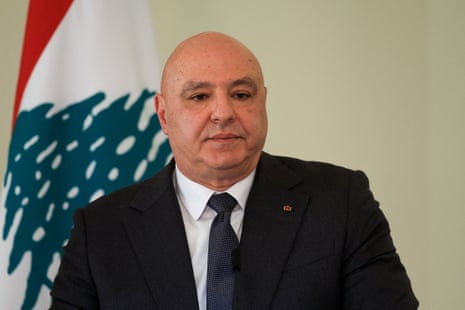
We have more comments from the Lebanese president, Joseph Aoun, who told reporters that the latest Israel-Lebanon ceasefire agreement represents a “last opportunity”.
He said negotiations held in Washington yesterday were “very difficult” and at one point the Lebanese delegation head, Simon Karam, had suspended the talks. Negotiations resumed after the US secretary of state, Marco Rubio, intervened, Aoun said.
“The agreement that has been reached is the last opportunity; otherwise, every party must bear responsibility,” Aoun said.
He added: “We are awaiting the responses of all concerned parties and guarantees of compliance, and implementation could begin within 24 hours of final approval.”
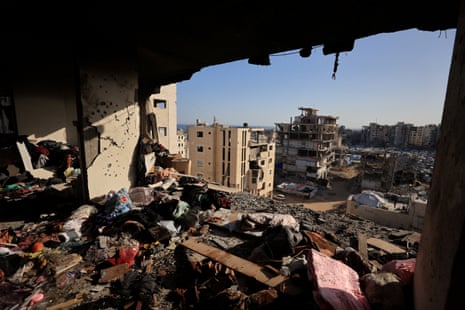
In Gaza, at least nine people have been killed in overnight Israeli strikes, including members of the same family, according to Palestinian health officials.
They were killed in at least four separate strikes in Gaza City, the al-Shifa hospital said, which received the bodies. Five members of one family were killed in a strike north-east of the city, the hospital reported, adding that 15 others were injured in the attacks.
The Israel Defense Forces (IDF) did not immediately comment on the strikes.
The Israeli military has carried out repeated airstrikes and frequently fire on Palestinians near IDF-occupied zones, killing more than 936 people since a nominal ceasefire took effect in October, according to the Gaza health ministry.
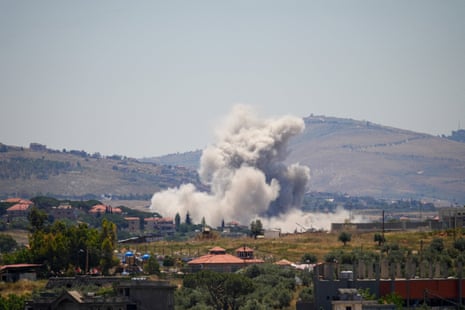
The Lebanese president, Joseph Aoun, said the US-brokered ceasefire agreed last night between Lebanon and Israel could come into force within 24 hours of all concerned parties approving it, Reuters reports.
The comments appeared to refer to Hezbollah, which has yet to comment on the ceasefire. Hezbollah previously said it is opposed to the Israel-Lebanon talks.
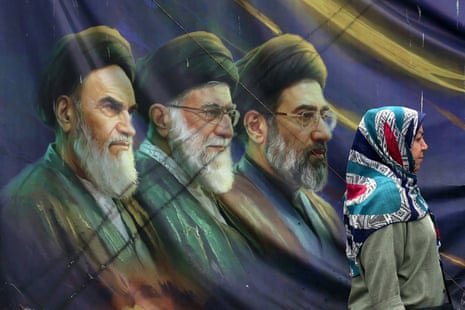
US and Israel attempting to sow division among Iranians after 'suffering defeat', says supreme leader
Iran’s supreme leader, Mojtaba Khamenei, has issued a written message calling for unity in the country as he accused the US and Israel attempting to sow division among Iranians.
In a statement carried by state media, he said the US and Israel have “suffered defeat” and faced a “decisive blow”, but he warned Iranians the enemy was “sowing the seeds of doubt, despair, fear, suspicion and disagreement” among the population.
Issued on the 37th anniversary of the death of Ayatollah Ruhollah Khomeini, the founding father of the Islamic revolution, the statement made no mention of Donald Trump, after the US president said he “would like to meet” the Iranian supreme leader “at some point”.
Khamenei has not been seen in public since the start of the war in February. US officials claim he has been incapacitated or severely injured from a bombing on the first day of the war that killed his father, Ali Khamenei.
UN peacekeeper killed in southern Lebanon, says Unifil
The UN interim force in Lebanon (Unifil) said a peacekeeper died this morning from injuries sustained when mortar shells hit his position near Marjayoun in southern Lebanon last night.
Unifil said two other peacekeepers were injured in the incident and were receiving treatment.
“Soon after the incident that happened late last night, the critically injured peacekeeper was flown to a hospital in Beirut where he succumbed to his wounds,” Unifil said in a statement.
It did not say where the shells originated from, but said an investigation has been launched “to ascertain the exact circumstances that led to this tragic incident”.
Israel-Lebanon ceasefire a 'great achievement', says Katz
Israel Katz said the US-brokered ceasefire agreement between Israel and Lebanon was a “great achievement in Lebanon, on the ground and also on the diplomatic level”.
“We promised security to the residents of the north and we delivered,” the Israeli defence minister said in a statement, according to the Times of Israel.
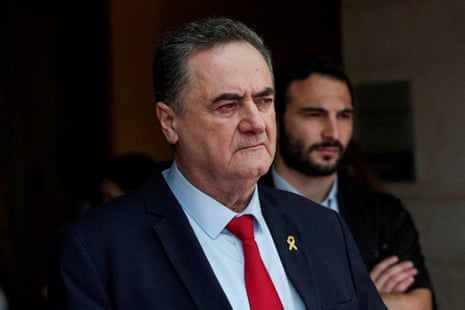
“The declaration includes an unequivocal statement on the disarmament of Hezbollah, the removal of Hezbollah terrorists from the area south of the Litani River, the continued presence of the IDF in the security area, and freedom of action for Israel.”
My colleague William Christou has more on the ceasefire here:
Opening summary: Israel says fighting will continue in southern Lebanon despite new ceasefire agreement
Hello and welcome to the Guardian’s continuing live coverage of the crisis in the Middle East.
The Israeli defence minister, Israel Katz, said the military will continue its ground operations in southern Lebanon, hours after Israel and Lebanon agreed to implement a US-backed ceasefire to end hostilities.
Katz said the Israel Defense Forces (IDF) will not withdraw from southern Lebanon, including Beaufort Castle, and the hundreds of thousands of people forced to flee their homes will not be able to return.
“The IDF will, at this stage, continue its fire and ground operations, remain in the security zone in Lebanon up to the yellow line – including in the Beaufort area – and without the return of the population, while continuing to dismantle terrorist infrastructure on the ground,” he said in a statement.
He added that the IDF retained the “freedom of action, with American backing, to strike in Beirut in response to fire on Israeli communities and territory”.
The IDF also issued a warning this morning saying fighting will continue in southern Lebanon as it urged people to “refrain from heading south of the Zahrani River”.
Lebanon’s official National News Agency reported several people were wounded in Israeli strikes in the southern Tyre and Nabatieh areas, which have seen repeated attacks in recent weeks.
It came just a day after Israel’s and Lebanon’s governments agreed to implement a conditional ceasefire following a fourth round of talks in Washington. The truce is contingent on a complete cessation of fire from the Hezbollah militia and would reportedly create a number of “pilot” security zones in Lebanon from which the Iran-aligned group’s fighters would be banned.
The truce involves “the evacuation of all Hezbollah operatives” from areas south of the Litani River, according to a joint US-Israel-Lebanon statement released by the US state department.
It was not immediately clear how the Lebanon security zones would be established but the agreement calls for the Lebanese army to take full control of those areas.
Hezbollah has yet to comment on the ceasefire. The group is not taking part in the talks and firmly opposes them, saying it won’t abide by agreements that may result. A Hezbollah official told Agence France-Presse on Tuesday the group would “not accept a partial ceasefire”.
In other developments:
-
Oil prices jumped nearly 2% after the attacks on Kuwait tested the fragile truce. Flights at its international airport were suspended after the Iranian drone and missile attack damaged airport facilities and diplomatic missions, killing one person and injuring more than 60, Kuwaiti authorities and state media said. Kuwait Airways and Jazeera Airways later resumed flights, authorities said.
-
Iran’s Revolutionary Guard said it did not fire at Kuwait’s airport and blamed the destruction on US interceptor missiles that failed to hit their targets, according to Iranian state media. The US military said that was not accurate and that Iranian drones targeted the airport deliberately.
-
Earlier, Iranian media said the Revolutionary Guard attacked the US Fifth Fleet headquarters in Bahrain and a US airbase, as well as a vessel. US Central Command denied its bases had been hit, also saying it had carried out new “defensive strikes” in southern Iran.
-
Iranian negotiations with the US had not been cut off but no progress had been made, Iranian foreign minister Abbas Araqchi told Lebanese broadcaster Al Mayadeen on Wednesday.
-
Donald Trump suggested earlier there could be progress for a deal as soon as this weekend. “I hear the negotiation itself is going very well actually,” he said at the White House. “If it happens, it could happen over the weekend.” He told a podcast that Iranian supreme leader Mojtaba Khamenei was involved in the negotiations.
-
Oil prices dropped on news of the Israel-Lebanon truce, with both main crude contracts down more than 1% after jumping back towards $100 this week.