.png) 3 months ago
64
3 months ago
64
'When Baltic states are being tested, Europe as a whole is being tested,' von der Leyen says
The European Commission’s president, Ursula von der Leyen, begins by acknowledging that the Baltic states “have been experiencing what many believed belonged to another era.”
“Air raid alerts, families sheltering, schools closing, transport interrupted. This is the reality on Europe’s eastern border in 2026.
Today it is here. Tomorrow it will be elsewhere along the eastern border.”
She warns “this is a deliberate strategy from Russia trying to destabilise our democratic societies.”
She says the EU “must be clear about what it means,” and that “these are not isolated incidents this is a deliberate strategy from Russia trying to destabilise our democratic societies.”
“Europe stands in full solidarity and unity with Estonia, Latvia and Lithuania, because when Baltic states are being tested, Europe as a whole is being tested.”
She says the EU is investing more in readiness and necessary defence projects.
Key events Show key events only Please turn on JavaScript to use this feature
The leaders also get asked about how Europe should be involved in any eventual peace talks with Russia, but broadly refuse to speculate on names of who could represent the bloc.
Estonia’s Alar Karis says he raised this issue some time ago, and faced criticism back home for his comments. He says Europe needs to be ready to talk and figure out its future relationship with Russia.
“We have to find a way how to deal with Russia after the war is over, but of course Russia has to change first of all. But we have to prepare for it because we never know when our pressure to Russia is so good that they are able to come to the table and start discussing, and we as Europeans should be ready.”
Latvia’s Edgars Rinkēvičs strikes a similar note.
“Are we going to move at some point to the diplomatic effort? I can’t rule out anything because things are changing. Is this the right time? I doubt it. Is Russia ready? I doubt it.”
But he adds that Russia likes to negotiate with individual countries to divide them and pick against each other.
“Russia really hates EU or Nato as the collective force, because then we are much stronger. They try to divide us.”
The Netherlands summons Russian ambassador over Kyiv attacks
Meanwhile, the Netherlands has also summoned the Russian ambassador to the country over Moscow’s warnings about planned attacks on Kyiv.
So that’s the EU, Norway, Germany, and now the Netherlands all calling the top Russian diplomats in their country in for a chat – what very much looks like a coordinated response.
The three presidents keep repeating – very strongly and clearly – that they reject Russian allegations that their countries allowed Ukraine to launch drones from its territories.
Latvia’s Edgars Rinkēvičs is the latest to make it very clear.
“One thing that I also want to reiterate what presidents all said, said Latvia, like Lithuania or Estonia, has not given any permission to use airspace or the territory for such attacks.”
'When Baltic states are being tested, Europe as a whole is being tested,' von der Leyen says
The European Commission’s president, Ursula von der Leyen, begins by acknowledging that the Baltic states “have been experiencing what many believed belonged to another era.”
“Air raid alerts, families sheltering, schools closing, transport interrupted. This is the reality on Europe’s eastern border in 2026.
Today it is here. Tomorrow it will be elsewhere along the eastern border.”
She warns “this is a deliberate strategy from Russia trying to destabilise our democratic societies.”
She says the EU “must be clear about what it means,” and that “these are not isolated incidents this is a deliberate strategy from Russia trying to destabilise our democratic societies.”
“Europe stands in full solidarity and unity with Estonia, Latvia and Lithuania, because when Baltic states are being tested, Europe as a whole is being tested.”
She says the EU is investing more in readiness and necessary defence projects.
'Skies above Baltic states are not sufficiently secure,' Lithuanian president says after tensions with Russia
Lithuanian president Gitanas Nausėda says the drone incursions were “a direct consequence of Russia’s aggression against Ukraine; yet another reminder of how close the war is to us.”
He also condemns “increasingly aggressive Russian rhetoric,” including “coordinated disinformation campaign and attempts to spread false accusations against the Baltic states and other Nato allies.”
He makes it very clear as to what he thinks of Moscow’s rhethoric:
“I want to state very clearly the Baltic states have not allowed and will not allow their territory or airspace to be used for attacks against other countries.
All Kremlin attempts to shift the responsibility on to others are cynical propaganda designed to divert attention from the fundamental fact that it was Russia that launched a brutal and illegal war against Ukraine.”
Nausėda warned “the skies above the Baltic states are not sufficiently secure today,” and the EU needs to step up its actions in this area.
The presidents of Estonia, Latvia and Lithuania are now speaking at a joint press conference with the European Commission president, Ursula von der Leyen in Vilnius.
The leaders met after a few days of raising tensions between the Baltics and Russia after several drone incidents and with Moscow spreading repeatedly denied allegations that the region was preparing to work with Ukraine on launching attacks on Russia.
Germany summons Russian ambassador over attacks on Ukraine, Kyiv
Germany is the latest country to summon the Russian ambassador over attacks on Ukraine and requests for foreign diplomats to leave the capital city of Kyiv, Reuters reported.
It joins the EU (13:19) and Norway (14:02), who announced similar moves earlier today.
Seven deaths in France linked to record-high temperatures as heatwave continues

Jon Henley
Europe correspondent
Seven people have died in France in an extreme early-summer heat event that is affecting a swathe of western Europe, as France and the UK set record highs for May and temperatures were forecast to rise further on Tuesday.
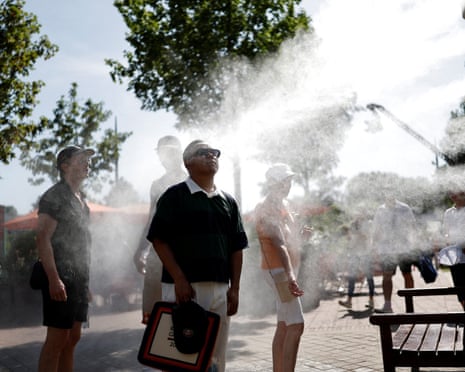
“What I can say today is that there have been seven deaths linked directly or indirectly to the heat,” a French government spokesperson, Maud Bregeon, told TF1 television, adding that five of the deaths were by drowning.
Météo France, the national weather agency, said Monday’s highest reading, 37.1C, was recorded near Hossegor, in the south-western department of Les Landes, and that temperatures across the west of the country could exceed 36C on Tuesday.
It said Monday was “the hottest day measured for the month of May since records began”, with the national average temperature, measured at 30 stations across the country, hitting 24.4C, compared with a previous high of 23.7C in 1944.
The UK’s Met Office said Monday was the country’s hottest May day on record, with temperatures hitting 34.8C at Kew Gardens, south-west London, a reading it described as “exceptional in the UK even in mid-summer, let alone May”.
In Spain, widespread highs of 36-38C in the Guadiana, Guadalquivir and Ebro valleys were expected to continue possibly until Friday, the state weather service, Aemet, said, adding that “in some of those areas, temperatures could reach 40C”.
Let’s cross to Jon Henley in Paris for the latest on the heatwave in large parts of western Europe.
Norway joins EU in summoning top Russian diplomat over Kyiv threats
Norway has also summoned the top Russian diplomat in the country, the foreign ministry in Oslo said.
In a statement, Norway’s foreign minister Espen Barth Eide confirmed the top diplomat was summoned to “protest against the threats against foreign personnel in Ukraine that Russia has made in recent days.”
“We also emphasised that we have condemned Russia’s violent attacks on Kyiv this weekend. Russia is behind very extensive drone attacks, in addition to using the Oreshnik missile against Kyiv for the first time. It is unacceptable.”