.png) 3 months ago
62
3 months ago
62
Once upon a time, a young man from Gateshead went to London to study music, established his own orchestra and gained a reputation for impeccably turned out performances of Hollywood musicals and symphonic jazz. Fast forward a few decades and John Wilson is still hand-picking musicians and still serving up performances so polished they leave critics scrabbling for superlatives.
These days Wilson’s main outfit is the Sinfonia of London, and he is as likely to be conducting the symphonic mainstream as showtunes. But fresh from collecting the conductor award at the 2026 RPS awards, and on stage at the Glasshouse for the Sinfonia of London’s official first performance as an artistic partner of the Gateshead venue, this local lad made good remains an irrepressible entertainer.
That is partly down to programming. Strauss’s Don Juan is an explosion of symphonic pizzazz even without the Wilson magic. As the Sinfonia of London’s opener, its vitality was raw, every detail gleaming – from a deliciously honeyed oboe solo to a dangerous snarl of timpani. In the Glasshouse’s forensically bright acoustic, the climaxes were deafening.
The idea that Elgar’s Enigma Variations could also be given the bells-and-whistles treatment is perhaps more controversial. There were stunning quiet moments, of course: the barest whisper of strings, woodwind solos that poured as graciously as tea into bone china, a Nimrod initially so hushed the packed hall seemed to stop breathing. But this was a performance of extremes. For every pianissimo, there was a crescendo to full-throttle intensity; for every fleeting instance of calm, a variation taken at absurd speed, with Wilson pushing at the limits of his supremely well-oiled orchestral machine. That he landed the vast final climax while spinning to face the audience seemed entirely fitting.
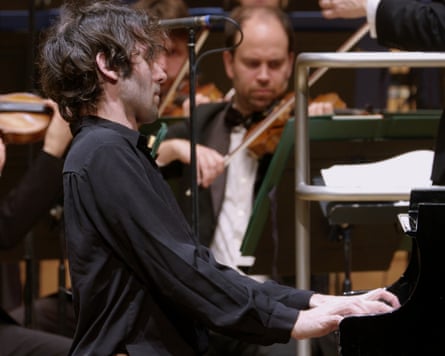
In between, Wilson largely ceded the spotlight to soloist Alexandre Kantorow in Prokofiev’s Piano Concerto No 3. By turns crisply intricate and abrasive, Kantorow seemed at times to skim the keyboard, his touch impossibly even. Wilson neither matched Kantorow’s laid-back suavity in the second movement nor his angular malevolence in the finale. Only the ending saw the conductor once again showcase his own formidable instinct for musical momentum.