.png) 1 month ago
22
1 month ago
22
These days, waking up after a big night out, no evidence can be good evidence. Perhaps the bar lights were too dim and the music so great that smartphones (and the outside world) were forgotten for a few blissful hours. Camera rolls: empty.
However, a new photo book called Sex, Clubs, Dissent: Visualising Queer Nightlife offers a striking defence of the culture-shaping role of cheeky snapshots taken inside and after the club. The anthology, edited by writer and London dancefloor regular Amelia Abraham, takes an expansive view of nightlife photography from the 1960s until today, embracing the tensions of documenting some of the most sexy, messy and politically charged moments of queer life. Contributions from artists such as Wolfgang Tillmans, Sunil Gupta and Kia LaBeija reinforce how the genre is not only a tool of community reportage and remembrance but also an art form in its own right.
“The book is fluid and feelings-led,” explains Abraham. “I wanted it to feel like a night out.” The image selection – ranging continents, decades and styles – is cacophonous. Film stills, studio portraits, and even a Grindr screenshot take readers on a nonlinear dance through scenes of queer sociality.
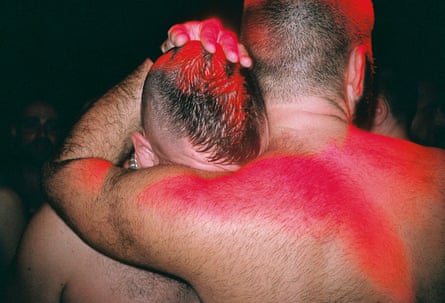
The book avoids a sanitised view of what goes on after dark, with the first “sex” section featuring stripteases, faces-in-crotches and hands-in-pants. One of the most arresting images was shot by Phyllis Christopher in San Francisco in 1991. A woman in tights pees in a back alley, in a neighbourhood that was home to many men-only leather bars.
There’s a cheekiness to certain image selections and placements. Roxy Lee, raucous documentarian of London’s Adonis party, offers up portraits of people in skimpy club attire. Her photo of a dog in a dress is an unlikely closing image for the “sex” section. A 1995 image by Tillmans at the start of the “clubs” sections shows a rat scurrying into a storm drain. Is this a metaphor for a sleazy night out?
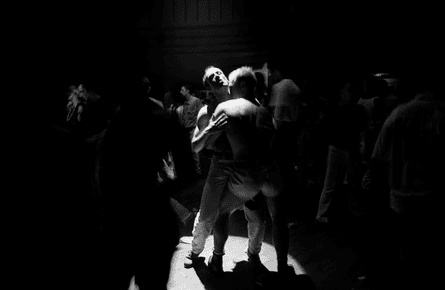
Ajamu X, celebrated photographer of London’s black gay scene, whose work appears several times in the book, argues that “lots of us [queer people] might be out around our sexual identities but marginalised around our sexual behaviours.” And a core strength of the book is its commitment to celebrating “the doing versus the being”, as Abraham puts it. For readers who know what it means to not be able to hold hands in public, there’s a universality in the ecstasy of a dancefloor embrace, whether in an awkward Polish gay club, as depicted by Agata Kalinowska, or a house party in Salta, Argentina, where trans activist Vanessa Sander smooches with her boyfriend.
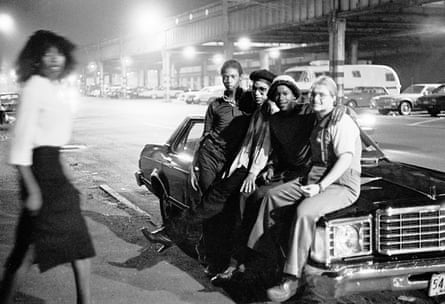
The most important kiss is on the book’s cover, seen through a peephole-esque cutout in the bright red jacket. The 1978 photo by Meryl Meisler, Two Women Embrace on Floor Next to Jupiter’s Legs, Les Mouches, NY, signals Abraham’s intention to rebalance the history of queer nightlife which has too often focused on white gay men. “I loved the idea of reappropriating the glory hole,” she says of the holes punched in the walls of toilet cubicles so man can have anonymous sex with each other. “What if we glimpse into it and see queer female pleasure too?”
A generous selection of images from Del LaGrace Volcano’s archive document the meetings of leather-clad lesbians in London. Another especially moving section brings together never before published photos from two trans community archives in Mexico City and Buenos Aires – 1980s film rolls full of makeup, snogging and stunting at Carnaval.
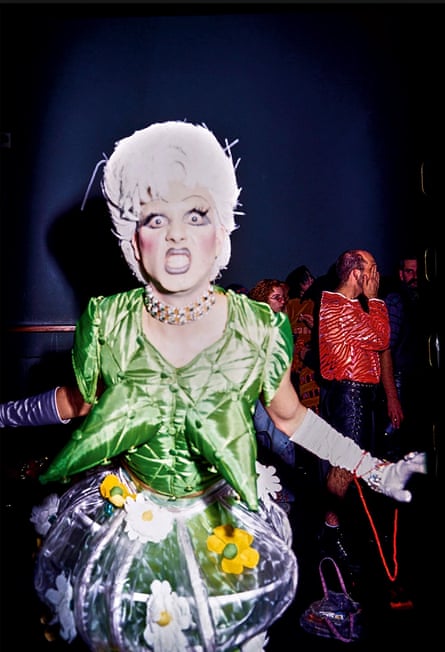
Back in 1968, when Esther Newton was doing her anthropology PhD, being queer was a pathology rather than a culture. Nonetheless, she decided to document drag queens in the Midwest in a series of photographs called Mother Camp: Female Impersonators in America. The scenes have an air of John Waters: beehive hairdos, blue lipstick and a drunk-on-stage quality that transports you to a mid-century gay dive bar. Like many of the images in Sex, Clubs, Dissent, they are both historical documents and blueprints for the colourful spectrum of ways in which one can be queer.
Yet theorist and rave fanatic McKenzie Wark argues there’s a potential underlying violence in nightlife photography, arguing: “We talk about shooting an image or capturing an image … the snap that arrests a body and self, cuts it from its motion.” Many modern clubbers are ambivalent about being caught – and tagged – in party pictures. But beyond being voyeuristic, Wark also points out how trans people experience snatched images differently. “We became other than our image once was. If you are transsexual, you know the problem here.”
Politics, and a bit of danger, define the section on Dissent. A glowing photo of dancer and 80s club kid Michael Clark, shot by DJ Jeffrey Hinton, looks like a fashion campaign but actually shows the consequences of a “gay-bashing” Clark has received. Clever juxtapositions of Jean-Marc Armani’s images of Act-Up Paris gatherings in the 1980s embody the anti-Aids activists’ controversial slogan that “SIDA is disco”. “I wanted to put the protest images side by side with the party images,” says Abraham. “The rage, then the release.”
In the foreword, Bay Area punk writer Brontez Purnell sets out an expansive view of the theme at hand: “Nightlife never just consisted of the clubs, it was the parks we went to after, the houses we ended up at to do drugs till the sun came up.” In Abraham’s vision, it’s also the sit-ins, the dinner parties and the aftercare. Purnell invites readers to consider another dying queer space: the late-night diner or cafe. Purnell recalls his first job as a waiter in one of San Francisco’s late-night joints: “It was bedlam, and oh my, how I miss it.”
In the “sex” section, there is a 1997 image of Amanda Lepore topless at Florent’s, a club-kid haunt in Manhattan’s Meatpacking District long before gentrification hit. My own first gay nights out usually ended at IHOP on 13th Street in Philadelphia, with phone numbers being passed on napkins between booths. I don’t have any photos of those nights but I sure wish I did. In many ways, the diverse photographic assemblage that is Sex, Clubs, Dissent encapsulates the intense juxtapositions of pleasure and pain, pancakes and protest, that define the queer experience. As Abraham puts it: “That’s just our life.”
-
Sex, Clubs, Dissent: Visualising Queer Nightlife is out now, published by Mack