.png) 3 months ago
104
3 months ago
104
There’s nothing quite like the warmth of the sun on your face after a long, dreary winter. But before you bask in it, you should always apply an SPF. That’s especially true if you use vitamin C and retinol serums, which can increase your vulnerability to sun damage. If you’re not wearing an SPF every day, you might as well toss the rest of your skincare out of the window.
As well as the risk of sunburn, UV rays cause longer-lasting, deeper skin damage, resulting in age spots, pigmentation and premature ageing. But if the thought of slathering sticky sunscreens on your face every day makes you want to spend your life in perpetual shade, you’ve come to the right place.
Dedicated facial SPFs are designed to feel weightless, sit well under makeup and leave no trace on the skin, so you can skip that ghostly white cast or looking like a greasy mess. I’ve spent the past three months putting the most popular face SPFs to the test; you’ll find my pick of the best below.
At a glance
-
Best face SPF overall:
Beauty of Joseon relief sun rice + probiotics
-
Best budget face SPF:
E45 Sensitive Sun face cream
-
Best face sunscreen for oily skin:
Haruharu Wonder black rice moisture airyfit daily sunscreen
-
Best face sunscreen for dry skin:
Laneige Hydro UV Defense Ex
-
Best face sunscreen spray:
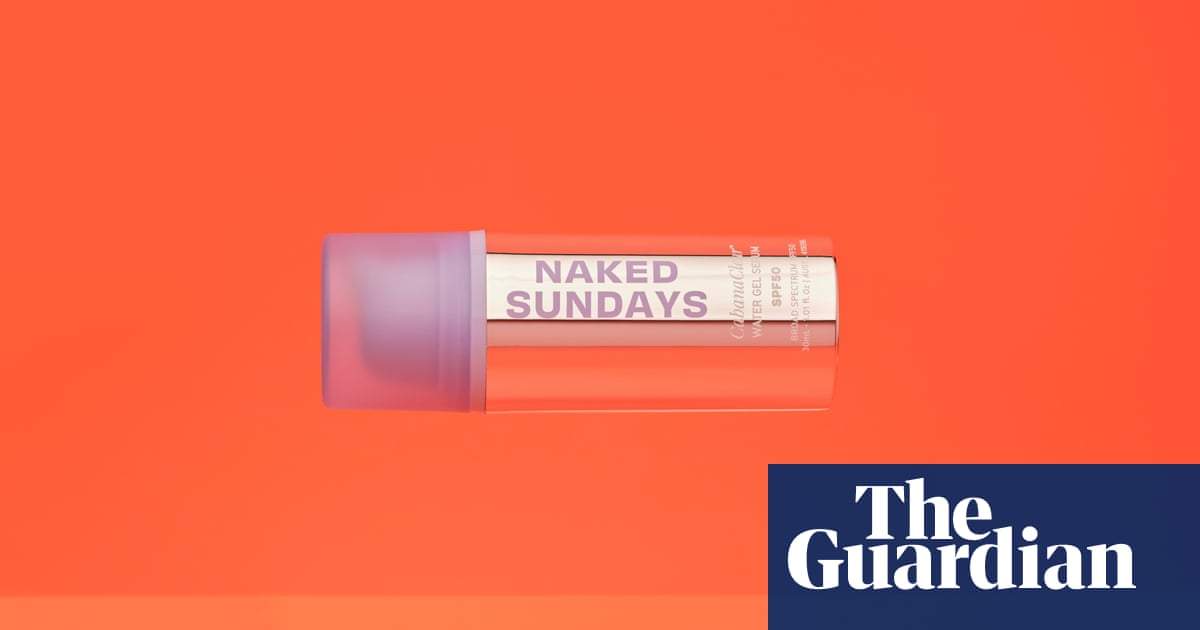
Naked Sundays hydrating glow face mist
Why you should trust me
As a beauty writer, I’m constantly testing new skincare. I’ve worn face SPF every day for the past five years, and tested 30 formulations for this roundup, so I’ve become well acquainted with the best and worst aspects of a facial sunscreen.
I’ve also completed a course in cosmetic science, which has taught me everything I need to know about how a brand might formulate an SPF, and what to check for in an ingredients list. It also taught me what works for different skin types, including sensitive skin. These recommendations are the result of months of testing and my analysis of any skincare benefits.
How I tested
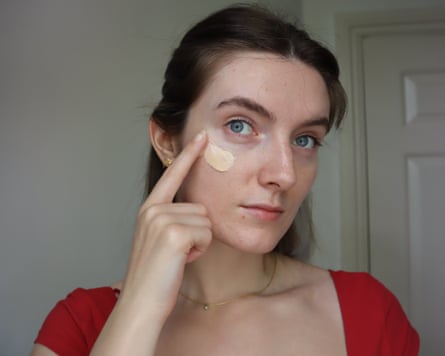
I started with each sunscreen’s formulation. Sun sticks, sprays, creams and lotions all have advantages and disadvantages, but I was looking for those that would apply smoothly, without leaving a greasy film or white cast on the skin. They also had to play nicely with makeup and skincare serums. Over each day of testing, I took note of how well each SPF lasted on my face. Any extra oil buildup, stinging in my eyes or makeup separation were huge red flags.
Many SPFs for the face also include skincare benefits. In those cases, I checked for extra protective antioxidant ingredients, hydrating humectants or other hard-working actives on top of the UV filters.
Efficacy is tricky to judge without a skin-imaging camera. However, advanced facialist Mariam Abbas reassured me that “for an SPF to be approved for retail sale, it must undergo stringent safety and efficacy testing. This process is expensive and time-consuming, so if you see an SPF on the shelf, the brand has already met significant regulatory standards.” Any facial SPFs I’ve included here are at least SPF30, with UVA protection, since this is the minimum protection recommended by experts. Sunscreen from many Asian countries uses PA as the rating system for UVA protection (SPF is a measure of UVB protection). The more pluses that come after the PA, the better the protection you’re getting.
The best face SPFs in 2026
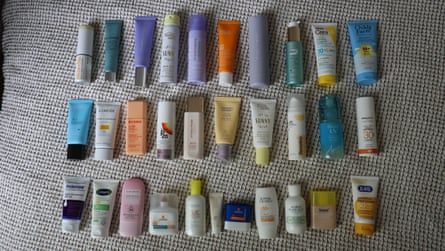
Best face SPF overall:
Beauty of Joseon relief sun rice + probiotics
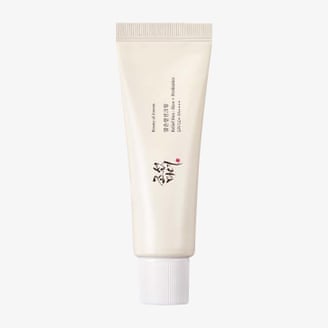
Beauty of Joseon
Relief sun rice + probiotics, 50ml
from £12.40
What we love
Luxury silky texture; quick absorption; non-greasy feel
What we don’t love
There’s nothing I don’t love about this sunscreen
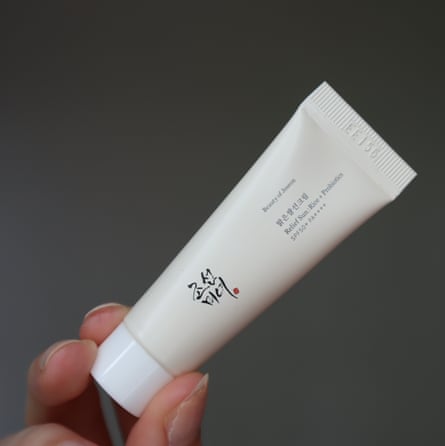
Every time I tell a fellow beauty journalist that I’m writing about facial SPFs, they almost always suggest the Beauty of Joseon Relief sun cream.
This was also the first Korean skincare product I ever tried. I struggle with acne and sensitive skin that rarely feels “balanced”, so I’m often reluctant to try products that come with a lot of hype. Thankfully, however, the sunscreen kept all its promises, with a lightweight texture that calmed my skin while keeping it hydrated.
Why we love it
The formula offers high SPF50+ to protect against UVB, and the highest level of UVA protection, PA++++. As with any sun cream, you’ll need to apply enough of it, multiple times a day, to reach that level of protection.
And its silky, luxurious texture makes that easy. If you told me it cost twice the price, I would believe you. It sinks in quickly, leaving a soft, natural finish that’s neither too oily nor too matt. Skin looks healthy and is perfectly primed for makeup.
The formula combines rice bran water with probiotics to balance the skin’s microbiome and soothe irritation, while niacinamide brightens, glycerine hydrates and propanediol gives a refreshing feel. With all that skincare packed in, those with oily skin could use this in place of a moisturiser. At the same time, on my drier skin days, it layers well with thicker moisturising creams without pilling.
It’s a shame that … it’s so hyped online that it puts people off buying it. This, however, is one of the few occasions where the hype is deserved.
Size: 50ml
SPF: 50+
Price per ml: from 25p
UVA? Yes, PA++++
Vegan? Yes
Certified cruelty-free? No
Beauty of Joseon
Relief sun rice + probiotics, 50ml
from £12.40
What we love
Luxury silky texture; quick absorption; non-greasy feel
What we don’t love
There’s nothing I don’t love about this sunscreen
Best budget face SPF:
E45 sensitive sun face cream
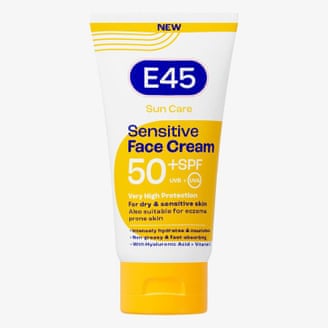
E45
Sensitive sun face cream, 50ml
from £10.39
What we love
High protection, hydrating, lightweight and non-greasy
What we don’t love
Stings slightly if it gets in the eyes
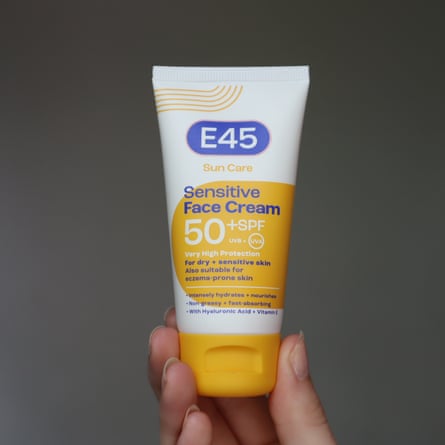
Admittedly, this cream isn’t that much cheaper than my top choice, but its creamy consistency means you shouldn’t need to apply a day moisturiser beneath. If you want high sun protection and good hydration at a good price, this comes highly recommended.
Why we love it
This SPF’s creamy, mid-weight texture spreads over the skin evenly, locking in moisture and drying down to a soft matt finish that leaves no trace and isn’t greasy in the slightest.
As well as offering SPF50+ and UVA protection, it has all the hallmarks of a good protective moisturiser. Shea butter softens, glycerine and hyaluronic acid hydrate, and squalane and antioxidant vitamin E protect the skin barrier.
It arrives in a compact bottle that’s fully recyclable and also perfect for travel. Throw in that it’s gentle on sensitive skin and water-resistant, and the E45 sensitive sun face cream is a solid sunscreen that’s a great choice for most people.
It’s a shame that … it slightly stung my eyes on one occasion where I may have applied a little too much in that area. Other sunscreens I tested made my eyes stream all day, but this lasted a minute or two at most, so don’t let that put you off.
Size: 50ml
SPF: 50+
Price per ml: from 21p
UVA? Yes
Vegan? No
Certified cruelty-free? No
E45
Sensitive sun face cream, 50ml
from £10.39
What we love
High protection, hydrating, lightweight and non-greasy
What we don’t love
Stings slightly if it gets in the eyes
Best face sunscreen for oily skin:
Haruharu Wonder Black Rice Moisture Airyfit daily sunscreen
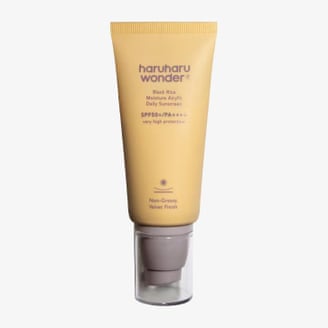
Haruharu Wonder
Black Rice Moisture Airyfit daily sunscreen, 50ml
from £11.20
What we love
Light-as-air texture; brilliant hydration without oiliness
What we don’t love
Slightly funky smell
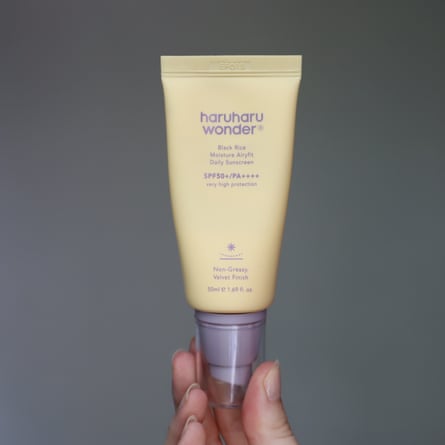
Applying the wrong SPF on oily skin can quickly leave your face looking greasy. But Haruharu Wonder’s sunscreen has a velvety texture that sinks in quickly and feels almost imperceptible on the skin. Its hydrating formula means those with oily skin can probably skip the moisturiser altogether.
Why we love it
This sunscreen has high SPF50+ and PA++++ protection from UVA yet is packed with gentle, calming and brightening ingredients to support the skin, too. Alongside glycerine and niacinamide for hydration and brightening, there’s also rice-bran oil, which includes nourishing fatty acids, protective antioxidants and softening emollients.
To pack all that into a cream that feels super lightweight is impressive, and I was even happier to find that it sat beautifully under makeup and left no white cast. It’s free of drying alcohols,fragrance and essential oils, making it suitable for sensitive skin, and the pump applicator kept things hygienic.
It’s a shame that … it’s slightly tacky when first applied, but it dries quickly. There’s also a slight play-dough-like smell on first application, but that dissipates quickly.
Size: 50ml
SPF: 50+
Price per ml: from 22p
UVA? Yes, PA++++
Vegan? Yes
Certified cruelty-free? Yes
Sensitive skin-friendly? Yes
Haruharu Wonder
Black Rice Moisture Airyfit daily sunscreen, 50ml
from £11.20
What we love
Light-as-air texture; brilliant hydration without oiliness
What we don’t love
Slightly funky smell
Best face sunscreen for dry skin:
Laneige Hydro UV Defense Ex
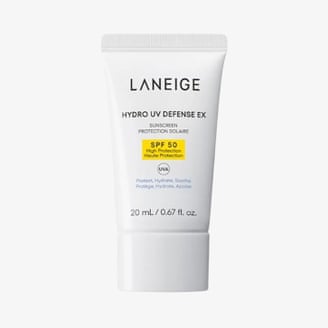
Laneige
Hydro UV Defense Ex, 50ml
from £20.80
What we love
Thick texture for intense hydration with high protection
What we don’t love
Could be too dense for some
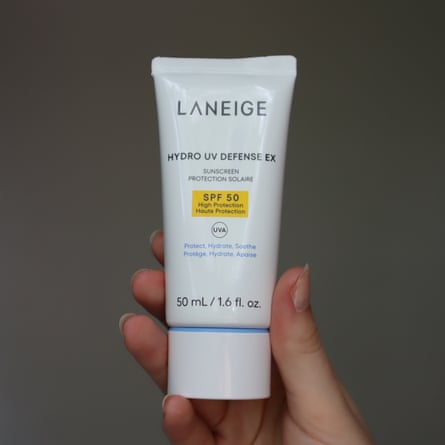
If you have dry skin, finding a sunscreen that moisturises, hydrates and protects the skin barrier is key. The Laneige Hydro Defence SPF is the richest of the formulas here, and is designed to give exactly those benefits.
Why we love it
This SPF50 cream combines UVA protection with deep hydration. The humectant glycerine draws hydro-ionised mineral water into the deeper layers of the skin, leaving it feeling replenished and refreshed.
In addition, popular Korean ingredient centella asiatica strengthens the skin barrier, improves hydration and acts as a protective antioxidant. The focus on skin barrier health aims to prevent trans-epidermal water loss, reducing the symptoms of dry skin over time.
In tests, I found the thicker texture kept my skin feeling well moisturised throughout the day, without any pilling. In fact, the boost in hydration left skin looking plump and dewy, forming the perfect base for makeup.
It’s a shame that … its thick texture won’t be for everyone; it takes some time and massaging to sink into the skin. It also has a light fragrance that might irritate sensitive skin, although I didn’t experience any issues.
Size: 50ml
SPF: 50
Price per ml: from 42p
UVA? Yes
Vegan? Yes
Certified cruelty-free? No
Laneige
Hydro UV Defense Ex, 50ml
from £20.80
What we love
Thick texture for intense hydration with high protection
What we don’t love
Could be too dense for some
Best face sunscreen spray:
Naked Sundays hydrating glow face mist
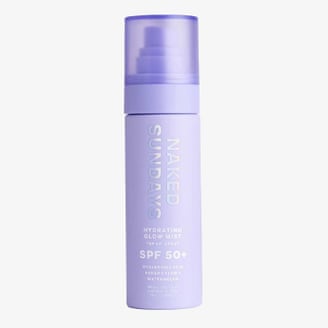
Naked Sundays
hydrating glow mist, 75ml
from £24
What we love
Easy reapplication; light feel; perfect handbag essential
What we don’t love
It’s expensive, and lightly fragranced
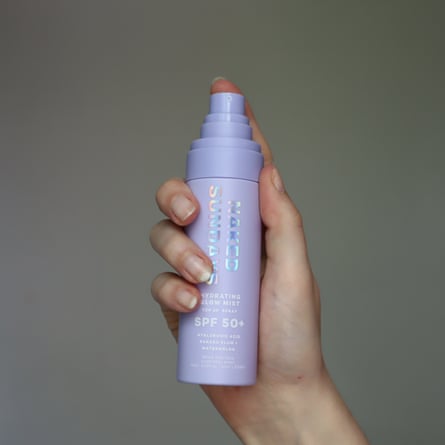
To get the best sun protection, you need to reapply sunscreen regularly – but there’s nothing more heartbreaking than having to smear SPF over the top of a flawless face of makeup. A sunscreen spray is the obvious solution, and my favourite is the Naked Sundays hydrating glow face mist. This Australian brand’s formula is perfect for SPF top-ups, while the skincare actives will keep you glowing all day.
Why we love it
Many aerosols can feel drying, reek of alcohol, or cause makeup to separate. But this Naked Sundays formula dispenses an ultra-fine mist of sunscreen, covering your face in seven sprays. And since it’s transparent, you can apply it as liberally as you like, with no splotchiness.
It has a sweet sherbet-like scent that fades quickly, masking the usual alcohol smell common in sunscreen sprays, so that it’s far more pleasant to reapply. It also layers well over makeup, offers SPF50+ broad spectrum protection, and comes in 75ml or a handbag-friendly 30ml size.
It’s a shame that … it’s lightly fragranced. Plus, the inclusion of ethanol – which is top of its list of ingredients and, therefore, the highest concentrated ingredient in the formula – can be drying on very sensitive skin types. It’s best for top-ups only, since flawless application with a mist is more difficult to achieve. The brand recommends spraying the product into your hands, then applying it to your face to ensure no spots are missed.
Size: 75ml
SPF: 50+
Price per ml: from 32p
UVA? Yes
Vegan? Yes
Certified cruelty-free? Yes
Naked Sundays
hydrating glow mist, 75ml
from £24
What we love
Easy reapplication; light feel; perfect handbag essential
What we don’t love
It’s expensive, and lightly fragranced
The best of the rest
Childs Farm sun cream
Childs Farm
sun cream, 100ml
from £9.99
What we love
Gentle; eczema safe; water-resistant; high protection
What we don’t love
Formulation is thick, and not specifically for the face
Best for: kids and sensitive skin
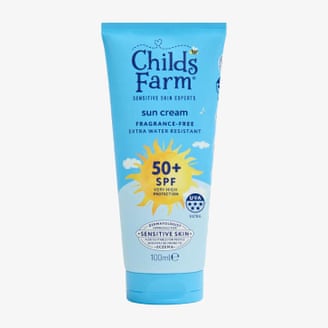
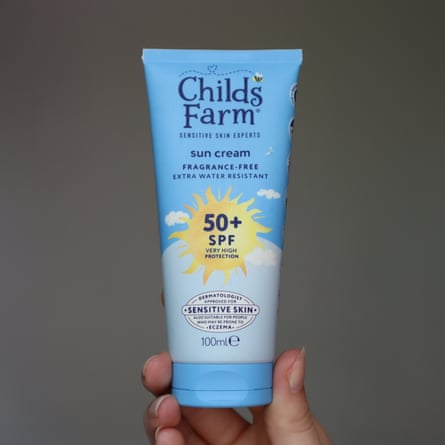
If you’re met with a grimace every time you try to smother your kids in SPF, opting for one that doesn’t stink or sting their eyes might save you a tantrum. This SPF50+ cream from Childs Farm isn’t designed specifically for their wee faces, but it offers five-star UVA protection, water resistance, and is ideal for those with very sensitive, eczema-prone skin. It’s safe for children over six months old and approved by paediatricians and dermatologists.
I liked the cream’s neutral smell and was impressed by how smoothly the thick formula spread over my skin. It took a few minutes to sink in, but did so with no hint of a white cast or any stickiness. Its moisturising formula kept my skin feeling comfortable all day.
It didn’t make the final cut because … it’s quite expensive if you want to use it as a body SPF, and some may find the thicker texture unappealing – it pilled under heavy foundations. Some have noted that it yellows white clothing, but I didn’t notice this while testing on my face.
Size: 100ml; SPF: 50+; price per ml: from 10p; UVA? Yes; vegan? Yes; certified cruelty-free? Yes
Childs Farm
sun cream, 100ml
from £9.99
What we love
Gentle; eczema safe; water-resistant; high protection
What we don’t love
Formulation is thick, and not specifically for the face
La Roche Posay UVSport pro-resistance stick
La Roche Posay
Anthelios UVSport pro-resistance stick, 10ml
from £15
What we love
Sweat-proof; protective; non-greasy feel
What we don’t love
Expensive and tiny
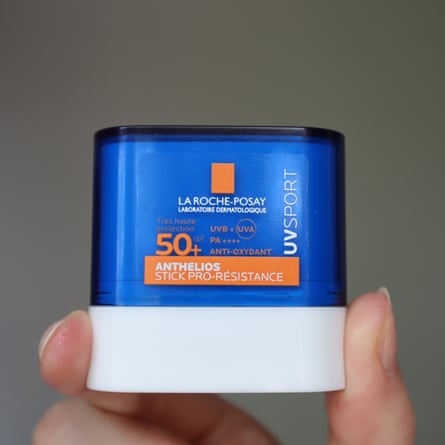
Best for: a stick face sunscreen
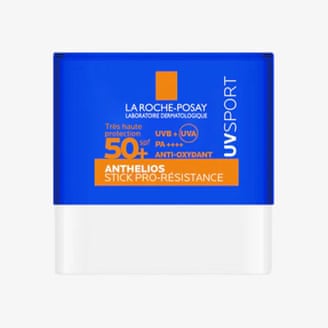
Many sunscreen sticks are incredibly greasy and can feel like you’re applying a slippery wax or stick of butter to the skin. Not so with La Roche Posay’s UVSport stick, which glides on to the skin smoothly, feels so lightweight that it’s almost imperceptible, and comes with the brand’s patented UV filter, Mexoryl 400, to fight ultra-long UVA rays.
Its formula is specifically designed for use during intense sports such as skiing, with its spinning twist-up mechanism large enough to operate on the slopes with gloved hands. Being pocket-sized, it won’t exactly weigh you down either.
It didn’t make the final cut because … it’s expensive for the small amount of product you get. It’s also more difficult to guarantee perfect coverage with a stick, and it doesn’t feel as luxurious to apply as a cream product.
Size: 10ml; SPF: 50+; price per ml: from £1.50; UVA? Yes, PA++++; vegan? No; certified cruelty-free? No
La Roche Posay
Anthelios UVSport pro-resistance stick, 10ml
from £15
What we love
Sweat-proof; protective; non-greasy feel
What we don’t love
Expensive and tiny
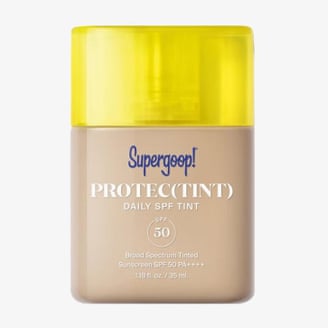
Supergoop! Protec(Tint)
Supergoop!
Protec(Tint), 35ml
from £32
What we love
Your skin, but better; excellent shade range
What we don’t love
Expensive and slightly drying by the end of the day
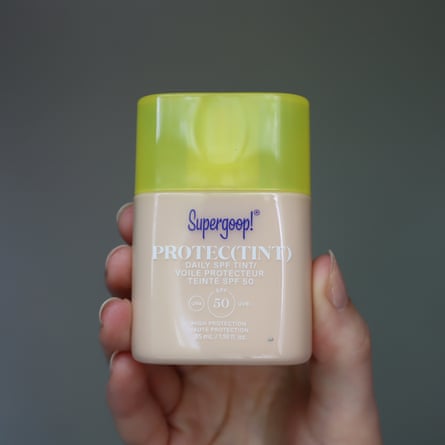
Best for: a tinted sunscreen
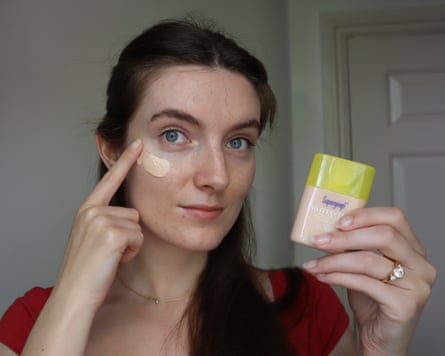
On hot days, the last thing you want to do is apply a full face of makeup. Tinted SPFs offer a brilliant middle ground, providing just enough coverage for a confidence boost but without feeling heavy. The best tinted SPF I’ve ever used is the Supergoop! Protec(Tint), which has high SPF50 protection with UVA.
Some tinted SPFs aren’t very pigmented at all, but the Protec(Tint) gives noticeable coverage while letting natural features such as freckles show through. With an impressive 14 shades to choose from, you’ll also find it easy to find a good match.
In tests, the tint didn’t separate when I applied it over thick moisturisers, and it was easy to blend other cream makeup over the SPF once it had settled. I’ll definitely be using this more often in the summer months.
It didn’t make the final cut because … my skin was left feeling a little dry by the end of a long day wearing this. You could use a hydrating face mist alongside to mitigate against this, but it might not be the best pick for those with very dry skin. It’s also very expensive considering you get only 35ml in the bottle.
Size: 35ml; SPF: 50; price per ml: from 91p; UVA? Yes; vegan? Yes; certified cruelty-free? Yes
Supergoop!
Protec(Tint), 35ml
from £32
What we love
Your skin, but better; excellent shade range
What we don’t love
Expensive and slightly drying by the end of the day
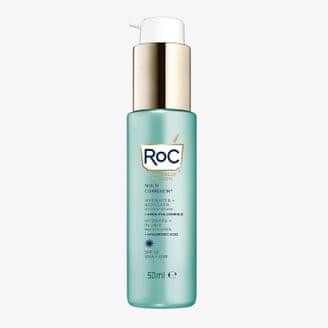
RoC Multi Correxion hydrate + plump
RoC
Multi Correxion hydrate + plump, 50ml
from £20.99
What we love
Thirst-quenching lightweight gel texture; plumps skin
What we don’t love
Expensive
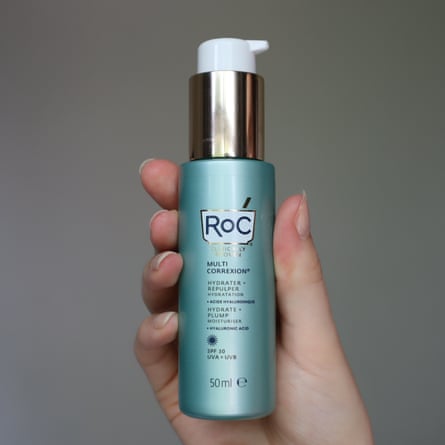
Best for: lightweight hydration and plumping
If you’re not a fan of applying heavier SPF creams, then ROC’s Multi Correxion Hydrate + Plump SPF30 is a lightweight gel alternative. The formula includes hyaluronic acid, which hydrates and plumps the skin to reduce the appearance of fine lines, alongside SPF30.
But it’s the lightweight gel texture that really had me sold. My skin felt immediately hydrated and refreshed – what I imagine you might feel like after drinking a glass of water in a desert. And, thanks to its plumping effect, makeup applied beautifully on top. I particularly loved this SPF’s pump bottle, which felt luxurious to use every morning.
It didn’t make the final cut because … it’s quite expensive and has a lower SPF than others, and it may be too lightweight for drier skin types. You need to wait a few minutes before applying makeup, too, as it can pill.
Size: 50ml; SPF: 30; price per ml: from 42p; UVA? Yes; vegan? No; certified cruelty-free? No
RoC
Multi Correxion hydrate + plump, 50ml
from £20.99
What we love
Thirst-quenching lightweight gel texture; plumps skin
What we don’t love
Expensive
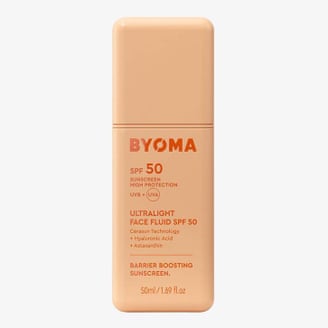
Byoma Ultralight face fluid
Byoma
Ultralight face fluid, 50ml
from £11.99
Why we love it
A lightweight, non-sticky glass-skin look
Why we don’t love it
Leaves skin feeling slightly slippery
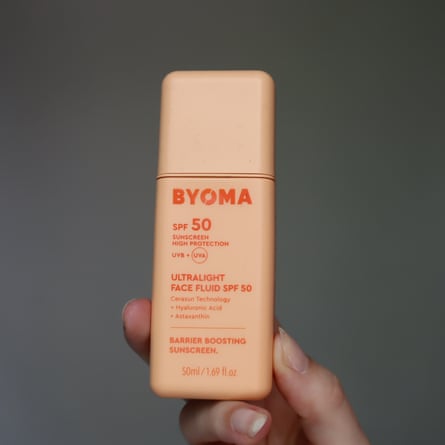
Best for: lightweight barrier repair
If you want to improve your skin barrier without the heaviness of a barrier repair cream, the Byoma Ultralight Face Fluid could be what you need. This lightweight, waterlike formula contains Byoma’s Cerasun complex, which uses ceramides to restore the skin barrier while alleviating redness caused by UV. It also includes the antioxidant astaxanthin and hyaluronic acid.
I found the thin texture quick and easy to spread evenly over my skin, and it didn’t leave a white cast. It also formed the perfect base for creating a “glass-skin” makeup look.
It didn’t make the final cut because … the SPF has a glowy finish that can leave skin feeling slightly oily. It’s best to wait 10 minutes or so before applying makeup to prevent pilling. Also, it will sting if it gets into your eyes, so apply with care.
Size: 50ml; SPF: 50; price per ml: from 24p; UVA? Yes; vegan? Yes; certified cruelty-free? Yes
Byoma
Ultralight face fluid, 50ml
from £11.99
Why we love it
A lightweight, non-sticky glass-skin look
Why we don’t love it
Leaves skin feeling slightly slippery
What you need to know
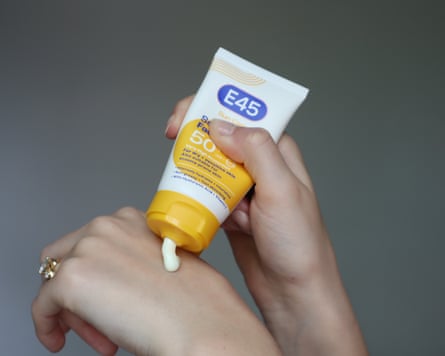
How much sunscreen should I apply to my face, and what factor should I use?
“For the face and neck, apply about half a teaspoon, roughly two finger-lengths of product,” advises consultant dermatologist Dr Derrick Phillips. This amount will provide the labelled level of protection.
Most experts recommend opting for at least SPF30, or higher, if you spend a lot of time outdoors. But the SPF rating isn’t all you should consider, as this only protects against UVB. “UVA protection is equally important,” continues Phillips. “Look for the UVA circle logo, which indicates the product meets EU standards.”
While this is the most common sign of UVA protection in the UK, other grading systems are used. You may also encounter a star rating, where five stars indicate the best protection. If buying a sunscreen from some Asian countries, such as Japan or Korea, check for the PA system, where PA+ offers the lowest protection, and PA++++ is the highest.
Reapplying SPF is key to achieving the best sun protection. “The general guideline is to reapply SPF every two to three hours,” says advanced facialist Mariam Abbas. “However, SPF breaks down more quickly with sun exposure, heat, sweat and water. If you’re at the beach, exercising outdoors, swimming or spending extended time in direct sunlight, you’ll need to be more diligent about reapplication.”
What’s the difference between UVA and UVB protection?
Fundamentally, sunscreens protect you from UVA and UVB rays. They have different impacts on the skin.
“UVA are the longest rays that penetrate the skin all the way to the dermis,” says Abbas. “UVB are shorter, so they penetrate the epidermis and cause tanning, sunburn and skin cancer.” UVA’s effects are more gradual and covert. “They break down collagen and cause skin ageing, and can pass through clouds and glass.” This is why experts recommend wearing facial SPF every day, even if you’re staying indoors.
Chemical vs mineral SPFs
Thanks to their physical mineral filters, zinc oxide and titanium dioxide, mineral SPFs work as soon as they’re applied. However, since the mineral filters provide sun protection by reflecting UV light, they tend to leave a white cast on the skin. According to Phillips, “older formulations used larger [mineral] particles that reflected and scattered more UV light”. Newer formulations use smaller mineral particles, but are still reflective and more likely than chemical sunscreens to leave a white cast on darker skin tones.
Instead of using reflective mineral filters, chemical SPFs use chemicals that absorb harmful UV rays. They tend to be lighter in texture and can blend into the skin without leaving a trace. But they don’t work instantly; to allow a protective film to form, always wait 15-20 minutes before sun exposure.
As a rule, mineral sunscreens are better tolerated by those with very sensitive skin. At the same time, I have sensitive skin and have never had a problem with any of the non-mineral sunscreens above. If you have sensitive, darker skin, it may be worth trying a sunscreen that’s been formulated specifically for sensitivity before resigning yourself to an ashy complexion.
Should sunscreen go on top of or underneath makeup?
“Apply sunscreen after your usual moisturiser and before makeup,” says Phillips. “When reapplying, it’s fine to apply on top of makeup, although using a generous amount is still important.”
Some SPFs don’t layer well with makeup. The most common complaint is pilling, which is when products roll up on your skin as you apply them.
“SPF tends to pill when it can’t form an even film on the skin,” continues Phillips. This usually happens when your previous layer of skincare hasn’t fully absorbed. Before you rush out to buy a new SPF, he says, “keep your morning routine simple and allow each layer to settle before applying the next”.
For more, read our guide on how to build a skincare routine
Can I just use a body sunscreen on my face?
“There’s no hard-and-fast rule against using a body SPF on the face. It will still provide protection from UV rays,” says Abbas. I can also understand the temptation, since a 50ml facial SPF often costs the same as a 200ml body sunscreen. Sadly, it’s not so simple.
“Facial SPFs are typically developed with greater precision, considering factors such as ingredients that won’t sting the eyes or sensitise the skin.” Furthermore, Abbas says, “Body SPFs tend to be richer and heavier, which can be comedogenic when used on the face. This may lead to blocked pores and breakouts, and can also cause makeup to pill.”
Does sunscreen expire?
Yes. Phillips says, “the filters can degrade over time and become less effective”. So, it’s always worth checking the expiry dates on your sunscreen, regardless of whether it’s for face or body.
They tend to last six to 12 months after opening, but remain stable for up to three years if unopened. To check the expiry time, look for a small period-after-opening symbol on the bottle, which looks like an open tub. This should contain the length of time a product is safe for – “12M” would mean 12 months. Occasionally, sunscreens will also be marked with a normal expiry date, as you’d find on food.
For more:
The best eye creams for banishing bags, puffiness and fine lines
The best anti-ageing creams, serums and treatments
The best vitamin C serums – tested
Sarah Matthews is a consumer journalist who’s spent the past four years testing more beauty products than she can count. Whether that’s hi-tech skincare gadgets, hair stylers or swanky new cosmetics, she’s never far away from discovering something new to love or loathe. Regardless of what hits her desk, face SPF is a non-negotiable in her morning skincare routine