.png) 2 months ago
24
2 months ago
24
After six decades as an actor, Patricia Hodge says she still gets nervous before a play opens. “I think nerves are always the fear of the unknown,” she says. “Particularly with comedy, where there is no knowing how the audience will react: you’ve got to surf that.”
We meet on a sunny winter morning at the Orange Tree theatre in Richmond, south-west London, where Hodge is about to appear in The Rivals, to celebrate the 250th anniversary of the Richard B Sheridan play, in which she plays the ironic – sorry, iconic – Mrs Malaprop. “You’re sort of in a tunnel, your entire being is focused on this,” she says. She was here in rehearsals until 11pm the night before. Today, she is sitting at a table with a large coffee. Does she enjoy this bit, the putting together of a play? “I think it’s love-hate actually. The process is really why I do theatre.” She says she finds it energising, “but it’s also very trying, and you just don’t want to be left with your own limitations”.
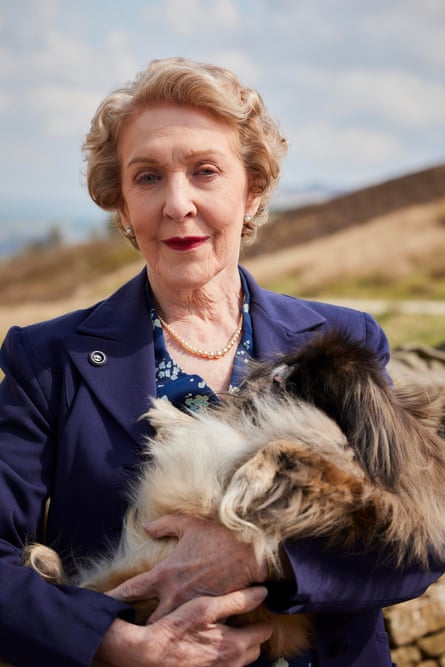
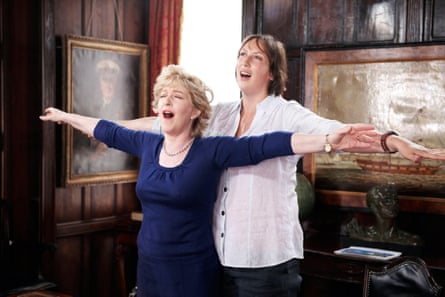
Hodge’s first work was in the theatre, although it was TV that brought her to a far wider audience: she is most likely to be recognised on the street as Penny, the overbearing mother in the joyous sitcom Miranda, though her career seems to have spanned everything from Shakespeare to Pinter, Orton to Frayn. She has even been in a Bruce Willis movie (Sunset, 1988). Hodge wanted to do The Rivals, she says with a smile, because she lives up the road in west London. “So this is a very local theatre for me. But, much more importantly, [the smaller theatres] is where the work that we all joined for is being done.” Like the Almeida, she says, for David Hare’s 1997 revival of Heartbreak House, and, most recently, the Donmar, in Watch on the Rhine in 2023.
Back to The Rivals, the vain and deluded Mrs Malaprop must be fun to play. It is, says Hodge. “I’ve always seen her as one of those people who has absolutely no real self-awareness. They don’t quite realise a disconnect between the way they present themselves and the way they’re seen. I think that’s interesting, and I suppose we’re all like that a bit.”
Many of her roles, at least in recent years, share an upper-class eccentricity – there’s Miranda’s mother (“such fun”), and currently, Mrs Pumphrey in Channel 5’s star-packed All Creatures Great and Small, who, in the latest series, called out the emergency vet to talk about the sex life of Tricki Woo, her pekingese. “I suppose that’s the level you get to when you get to a certain age.” She points to the “gallery of grotesques” that Maggie Smith once wryly noted. “That’s what they give you to do, but no, I’ve always liked eccentric people. I found them rather interesting.” Later, she mentions one of her greatest friends is Miriam Margolyes, with whom she made the 1975 TV adaptation of Muriel Spark’s The Girls of Slender Means. Hodge does a brilliant impression of Margolyes visiting her son’s school once, and shocking the children. “I’m drawn to people who make me laugh. I love a slightly outrageous thing in people, but not exclusively – I’ve got friends of every different stripe.”
Eccentricity is a liberation, perhaps, for women who reach an age when they stop caring about being judged. “Yes, what’s that Jenny Joseph poem?” she says, referring to Warning, which begins: “When I am an old woman, I shall wear purple.” I look pointedly at the purplish velvet suit that Hodge – fine-boned beautiful, 79, and far from seeming “old” – is wearing today, and she laughs. “She was speaking as somebody who had a more ordinary life,” Hodge points out. “Our life is about dressing up, isn’t it, escaping the real world.”
It’s a thread she can trace back to childhood, growing up in Grimsby, in the town’s poshest (though this is all relative) hotel. She has been thinking about it a lot recently, she says. “I’m quite sure that it’s contributed to what I ended up doing.” The family lived in a flat at the top of the hotel, overlooking the docks. “There was nothing otherworldly about it. But I’d go downstairs and there was this whole other thing.” There was something stage-like about the parts of the hotel that were on show, and the people who passed through them. “Then you go through the doors into the kitchen, and you’ve got something entirely different going on.” The hotel had a ballroom, where Hodge would invent shows, “so it allowed for all kinds of fantasy escape”.
A revolving parade of hotel guests would trail their glamorous lives with them, along with their luggage. There would be TV presenters, radio personalities and – more excitingly – rock stars, including the 60s band Manfred Mann. A film crew stayed and put Hodge’s younger sister in the film, much to the future actor’s annoyance (she wasn’t allowed the time off school). When Violet Carson, Coronation Street’s Ena Sharples, stayed, Hodge asked for her autograph. “She spoke beautifully, because that [original] cast of Coronation Street were actors doing the most wonderful work in rep.” It was a glimpse of another life. “I thought, that’s the world I want to be in.”
There was no professional theatre company near Grimsby, she says. “So nobody became a professional actor, because it wasn’t in the language. But there was a lot of amateur [theatre], and amateur things are what kept it all afloat.” What made her think she could be a professional actor, then? “I don’t know that I necessarily did think I could do it. I knew that I just wanted to.” The nearest thing to the performing arts was dance, so Hodge did that instead (her mother also insisted on piano and elocution lessons). Never chosen for the school play, Hodge and a few friends wrote their own revue to perform; the following year, they were invited to audition. She loved, she says, “just getting up and becoming somebody else on a stage. I think there’s always a mixture of shyness, well, introversion and extroversion, and you need to step over that threshold.”
Hodge trained to be a teacher first, and taught for a year, but she couldn’t shake the feeling she should be acting. She applied to the London Academy of Music and Dramatic Art (Lamda) and got in. After that, she went into repertory theatre, a world that has all but disappeared now. “It’s an apprenticeship. You can learn so much. Art can’t be learned as much as it has to be practised, and that was the training ground. I think we’ve lost a huge amount, quite apart from the fact that it is so wonderful for a community [to have a theatre]. You know, every major city in Germany has state-supported theatre. That’s why they’re so good.” For the UK, she says, “it’s tragic”. At the time, Hodge had to earn her Equity card with so many weeks in rep, a system she also thinks worked. “It stopped people from too big a sprint before they were ready.”
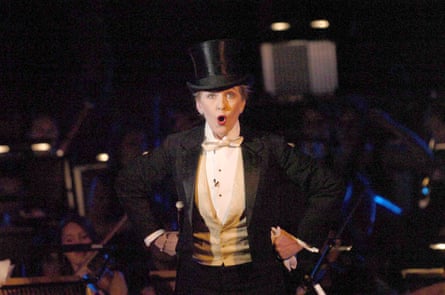
Hodge was ready by the time she landed in the West End – a small role in the Ben Travers farce Rookery Nook, and as understudy for the lead – and her next job was in the musical Pippin, directed by the legendary choreographer Bob Fosse. It was thrilling, she says, although Fosse – whose film Lenny, with Dustin Hoffman, was still in production – wasn’t around enough: “We didn’t get him until about the last 10 days.” Last year, Hodge appeared in the two-night West End performance of the Pippin 50th anniversary concert, which was “one of the best experiences of my life. If you stay in the ring long enough …” she says, laughing.
At the time of the 1973 production, did she think she had made it? “I wasn’t very good in it, because I didn’t get much direction,” she says, breezily. “I didn’t really know what I was doing.” Still, it must have been thrilling to have been a young, beautiful actor working in the West End in the 70s. “Oh, wonderful,” she says. “All the different casts, the shows. It was the big time of the rock musical.” She had parts in The Two Gentlemen of Verona and Hair. “There was such a community. It was absolutely fantastic.”
Parties? Drugs? “There were drugs,” she says, leaning forward slightly. “But I was really an innocent with all that.” Her only time, she says with a laugh, was an incident at drama school involving some curious cakes that were being passed around. “I didn’t know what I was doing. I was so ill.” It put her off for life. “So I was never part of that.” She was similarly naive when it came to sexual harassment, which must have been a hazard of the job for any young actor. “It didn’t really cross my path,” she says. “I think there was one producer that grabbed me one day, and you just thought: Oh, for God’s sake. You just sort of thought it was part of male behaviour.”
From the beginning of her career, Hodge never wanted to be constrained to one area, although when she first tried to move into TV, people considered her only a theatre actor. She has always done a wide range, including radio and cabaret (she put on shows for several years with the colourful critic Sheridan Morley). “All these things are different disciplines, and I think they keep you at the sharp end, and they make life interesting.” She was wary of only focusing on film and TV. “I think screen can eat you up and spit you out.”
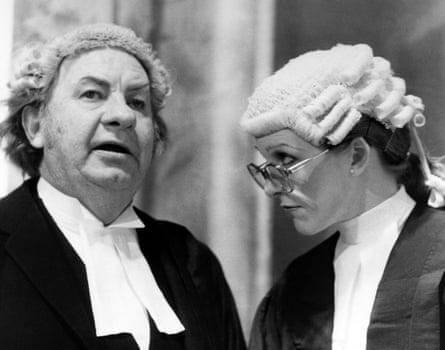
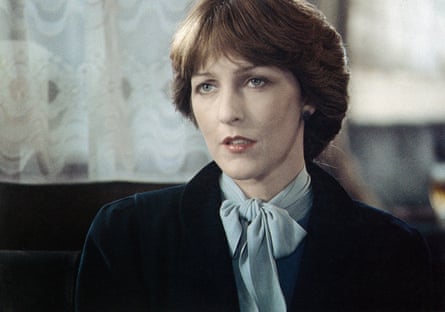
She had a terrific early run – her 1978 TV breakthrough as the formidable barrister Phyllida Trant in Rumpole of the Bailey, as the lead in the mystery series Jemima Shore Investigates (from 1983), and in the 1986 adaptation of Fay Weldon’s The Life and Loves of a She-Devil. She played the lead in Betrayal, the 1983 film version of Harold Pinter’s play (a few years later, she would play it on radio, with Pinter himself). But, although she worked steadily, Hodge was part of that generation of actors who struggled to find roles good enough for them as they got older. For Hodge, “I think where it gets really bad is once you get to your 50s, because that’s when you notice that the men continue on, but the women that are cast with them are in their 30s. And that’s when you start to be sidelined. It probably hit me more from about 55 upwards.”
As someone who loves to work, and who had amassed so much experience by then, that must have been difficult. “Well, yes and no,” she says. “The thing that was different for me was I was a very late mother. When they were very young, I was working quite a lot, but by the time it started to slow down, the children needed my attention. I think having another life is really important. If this business is all you have, it’s going to kick you. Family life was always so important.” Hodge had her sons in her 40s, after years of infertility. “Every day of my life, I’m thankful for it and for what it’s brought to me.” For her, she says: “It’s the real meaning of life.”
Hodge was with her husband, Peter Owen, a music publisher, for more than 40 years, and has spoken movingly before about caring for him when he was diagnosed with dementia (he died in 2016). After a long and happy marriage, how do you rebuild a life? “I think what I’ve learned is that it’s because I had something else, I didn’t have to find something else, and that was work. I sort of lost myself in that, not totally – family life goes on – but it keeps me engaged and busy.” Selling the family home was difficult, but necessary. “The life in it wasn’t there any more, and much as I loved it, I was never going to get back that life.”
She remembers her mother, a week after her father died, saying – she repeats it with a perfect comic pause – “well, at least now I can have a curry”. “I thought, actually, that’s a wonderful line, because you look at the breadth of that – you’ve shared your life and you compromise yourself. So you have a kind of autocracy that comes in, you can do what you want, when you feel like it. But of course, there’s an aloneness. I won’t say loneliness, because I have a lot of wonderful friends, not just people in the business, people I’ve held on to for many years.”
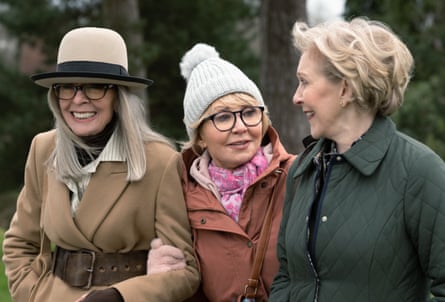
She has mentioned friendships a few times – not least when I mention last year’s Arthur’s Whisky, the film about three friends which also starred Lulu and the magnificent Diane Keaton (“She was extraordinary, a wonderful woman. She was totally true to herself, she didn’t try to make herself other than what she was”). Does Hodge collect friendships? “Actually, my mother said that once – ‘Patricia collects people’ – and I don’t think I’ve thought of it, but yes, I just enjoy people a lot. I think you have to [in order to] step inside characters – you can play a monster, but that is a person underneath. So yes, I probably do.”
It’s one reason she loves theatre (and also why she brought such energy to the Miranda ensemble). “I love company work, and [this play] is the essence of it. Something is only ever as good as the sum of its parts, and you have to fit into the mechanism.” It requires toughness and discipline, though I don’t suppose Hodge minds this. “I think we just challenge ourselves, just keep, every day, doing something that makes you uncomfortable.” Then a smile and a perfect comic pause. “And I say that because I’d like to crawl under a duvet at times.”