.png) 3 months ago
76
3 months ago
76
For a decade or more, a familiar theme of Cups of Nations has been how the pyramid of African football has been growing little taller but much broader. African sides came no closer to really challenging at a World Cup, but the range of teams capable of beating the continent’s elite, of getting to the knockout stage of the Cup of Nations, was becoming more diverse. Perhaps, though, a new phase is beginning.
It’s dangerous always to read too much into the performance of one side at one tournament, but in Qatar in 2022 Morocco at last broke through the quarter-final barrier and became the first African side to reach a World Cup semi-final. And now, in the Cup of Nations Morocco are hosting, the traditional powers are reasserting themselves. There is yet to be a real surprise in the tournament and, halfway through the round of 16, the prospect is of the highest-powered list of quarter-finalists in history.
On recent form, it’s perhaps debatable whether South Africa, who have qualified for the World Cup, beating Cameroon, who have not, would have classed as a shock but the five-times champions were 2-1 winners on Sunday evening.
This has been a very strange tournament for the 1990 World Cup quarter-finalists. They arrived in apparent chaos, with two rival coaches each naming squads and submitting them to the Confederation of African football. But Samuel Eto’o, the president of the Cameroonian football federation, has, at least temporarily, won his power struggle with the sports ministry and the young side selected by his preferred coach, David Pagou, has impressed with a dynamic and very direct style.
Their opener, calmly finished by Junior Tchamadeu, may have followed a fortunate ricochet but the second was a classic header by Christian Kofane from Aboubakar Nagida’s cross. Not that South Africa played at all badly and but for a couple of fine saves from Devis Epassy, their second-half rally might have forced extra time.
Their opponents in the quarter-finals will be the hosts Morocco, who won just their fourth Cup of Nations knockout game. They may be strong favourites for this tournament, but they are clearly feeling the pressure of not having won it for 50 years. Their victory came by a single goal as Brahim Díaz’s shot flew past Tanzania’s eccentric goalkeeper Hussein Masalanga at his near post.
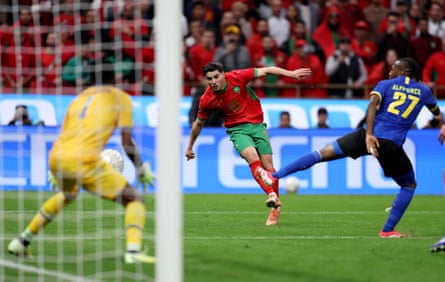
Notably, it was set up by a forward surge from Achraf Hakimi whose increasing influence in the game in the second half was critical in getting Morocco over the line. The question, though, is whether they can manage at some point to use the sense of public yearning as inspiration rather than being weighed down by it.
Saturday’s last-16 games threw up a west African derby in the quarter-final. In the end, Senegal were too good for Sudan, but they went behind early on, and, although they created more than enough chances to win the game comfortably, the openness of their midfield, especially on the left, will be a concern – and that despite Iliman Ndiaye being left on the bench for the notionally more defensive Habib Diarra.
The balance is still not quite right and that could be a problem against better teams. Two excellent finishes from Pape Gueye had Senegal ahead by half-time, before the hugely exciting 17-year-old Paris Saint-Germain forward Ibrahim Mbaye came off the bench to add the third.
Mali’s victory over Tunisia was, by turns, almost unwatchable, absurd and ultimately hilarious. It was perhaps the closest to a shock the tournament has provided so far, although it can never really come as a surprise when Tunisia become entangled in the net of their own neuroses. It was also, given they played with 10 men for well over 90 minutes, a triumph for their Belgian coach Tom Saintfiet.
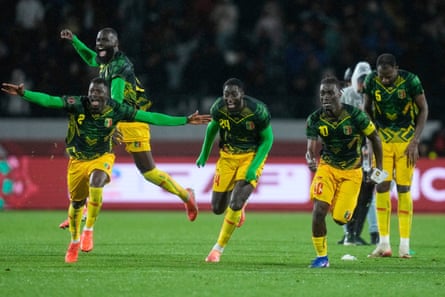
No manager currently working has more international experience than Saintfiet, who is in his twelfth job with a national side (thirteenth if you include Qatar’s Under-17s). He has made a career of making smaller sides hard to beat, and has implemented a similar approach with Mali, probably the biggest job he has had.
Four draws have been enough to get Mali to the quarter-final, but that is very much in keeping with their status as the Tony Hart of international football: they just never stop drawing. They’ve drawn 14 of their past 23 games they’ve played at the Cup of Nations. If there is a weakness to be exploited in Senegal’s midfield, Saintfiet is as likely to be able to exploit it as anybody.
If Nigeria beat Mozambique and Egypt beat Benin on Monday, every side to have won three or more Cups of Nations apart from Ghana, who failed to qualify, will be in the last eight, and they will be joined by the winner of a meeting of Algeria and DR Congo, the two sides to have won it twice.
If there has been a criticism of the tournament so far, it is that has perhaps been a little predictable, that it has lacked a real breakout star. But the flip side of a lack of shocks is a great concentration of quality at this stage.