.png) 2 months ago
63
2 months ago
63
Austria has said it will continue with plans to host next year’s Eurovision, in spite of its budget being hit by four countries boycotting the song contest over Israel’s participation and the war in Gaza.
At a meeting in Geneva, the national broadcasters that make up the European Broadcasting Union gave the all clear for Israel to take part in next year’s event in Vienna, the contest’s 70th anniversary edition.
In response, broadcasters from Spain, Ireland, Slovenia and the Netherlands announced they would boycott the world’s largest live music event, by declining to broadcast the semi-finals and finals, and not fielding their own entrants.
Even though Spain is among the “big five” nations in terms of financial contributions to Eurovision, Austrian broadcaster ORF said the 2026 event would go ahead in May as planned.
“The show will not suffer in any way,” said ORF’s director general Roland Weissmann, adding that those pulling out still had until mid-December to change their minds.
“Overall, it would of course be a financial burden if several countries didn’t participate, but we had already taken this into account … and this mainly affects the EBU, which has already factored this into its budget,” Weissmann said.
“I don’t see this being a problem in Vienna and even if there is a bit less, we’ll be able to compensate for it.”
Austria, alongside Germany, was among the countries to come out most firmly in favour of Israeli participation in the run-up to Thursday’s general assembly.
Germany’s foreign minister, Johann Wadephul, said he welcomed the decision, saying the Israel “traditionally” belonged in the song contest.
The Christian Democrat politician urged the boycotting nations to rethink their stance, saying: “Culture should always have something that connects people […] this forum should not be used as a place for dealing with political differences.”
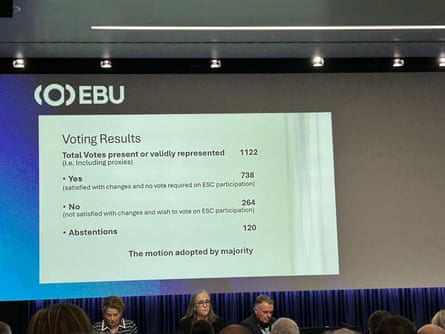
No vote on Israel’s participation was held on Thursday at the EBU general assembly. Broadcasters voted only to introduce new rules designed to stop governments and third parties from disproportionately promoting songs to influence voters.
“A large majority of members agreed that there was no need for a further vote on participation and that the Eurovision song contest 2026 should proceed as planned, with the additional safeguards in place,” the EBU said in a statement. This “large majority” amounted to 65% of delegates voting in favour of the changes to the song contest and no further discussion on participation of Israel, while 23% voted against and 10% abstained.
Some countries had raised concerns over undue promotion methods after Israel topped the public vote at the contest in May, finishing second overall when the jury votes were taken into consideration. In Ireland, broadcaster RTE has called for an audit of the public vote.
It said on Thursday it would be “unconscionable” to participate in the 2026 contest if Israel took part “given the appalling loss of lives and the humanitarian crisis” in Gaza.
Slovenian broadcaster, RTV SLO, said it would be boycotting the contest “on behalf of the 20,000 children who died in Gaza”.
Of the boycotting countries, the Netherlands participated in the song contest’s inaugural edition in 1956. Ireland, meanwhile, shares with Sweden the joint record for most Eurovision wins, with seven victories.
Ireland’s prime minister, Micheál Martin, on Friday said he “fully understands” his country’s withdrawal from the song contest, describing it as an “act of solidarity”.
So far, no further countries have joined in the boycott. Sweden’s national broadcaster STV confirmed on Friday it would take part in the 2026 contest despite speculation it might have pulled out over Israel’s confirmed participation.
“The new rules mean, among other things, that governments refrain from campaigns, fewer votes per participant and that professional jury panels are once again introduced in the semi-finals”, STV said in a statement. “Technical security is also being strengthened to avoid vote fraud.”
“This – combined with the result of the vote – is in line with the conditions that SVT has set for participating in Eurovision: a broad European support and a competition that is as apolitical as possible.”
The Nordic countries including Finland, Norway, Denmark and Iceland, expressed support for the EBU’s public voting reforms on Thursday.
Icelandic broadcaster RUV, which had previously reserved the right not to participate, said it would consider its position at a board meeting on Wednesday.