.png) 2 months ago
71
2 months ago
71
In Frank Gehry’s world, no building was left untilted, unexposed or untouched by unconventional material. The Canadian-American architect, who died in his Los Angeles home at 96, designed a career around defying what was predictable and pulling in materials that were uncommon and, as such, relatively inexpensive.
Gehry collaborated with artists to turn giant binoculars into an entryway of a commercial campus, and paid homage to a writer’s past as a lifeguard by creating a livable lifeguard tower. And while dreaming this up, he transformed American architecture along the way.
Below, take a look at how his work wrapped around and shaped the neighborhoods and urban centers of California.
Walt Disney Concert Hall
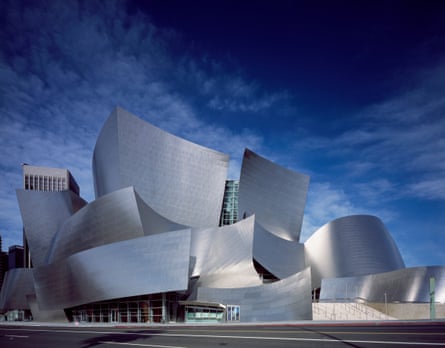
With its stainless steel waves rolling on a corner of Downtown Los Angeles, the Walt Disney Concert Hall has become an integral part of this urban center. Lillian Disney gifted the hall to the city and to pay tribute to her late husband’s commitment to the arts. Gehry built the music hall from the inside out, designing it around how music was to be heard within its walls with a team of acousticians.
While the hall’s exterior has free-forming waves and Gehry’s touch of unconventional geometry, the interior is surprisingly symmetrical – an intentional contrast. “The reason I made Disney Hall symmetrical was because I knew that I was a very suspect architect for a building like that by the general public,” Gehry told the Getty. “Everybody is going to think I’m going to do a Thing. So I decided to give them a comfort zone.”
Gehry house
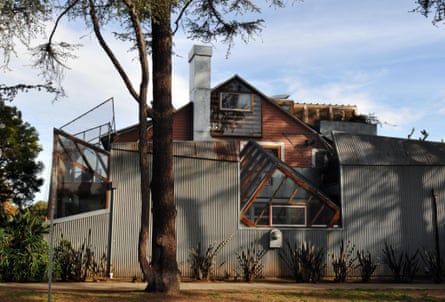
Gehry pruned this Dutch colonial bungalow in Santa Monica down to its original wooden bones and, in 1978, built around it intricate layers of glass, exposed plywood, corrugated metal, and chain-link fencing. The home is considered one of his earliest works of deconstructivist architecture, with large tilting windows that allow the outside world to peer into the home’s internal, seemingly unfinished structure. Gehry continued to add to this residence until 1992.
Binoculars Building
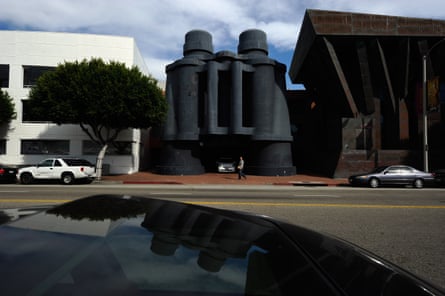
First commissioned as a commercial office building in Venice for advertising agency Chiat/Day, this bold design has become one of Gehry’s most recognizable works in Los Angeles, thanks to its towering entryway that looks exactly like what it is: a giant pair of binoculars. This 44-foot feature was actually designed and created by his collaborators, artists Claes Oldenburg and Coosje van Bruggen. Gehry designed the 79,000 sq ft campus to have a tree-like metal canopy facade on the south of the binoculars, with a bright-white ship-like exterior to the north. Google has occupied the building since 2011, though it is currently on sale for the first time in 30 years for an undisclosed price.
Norton residence
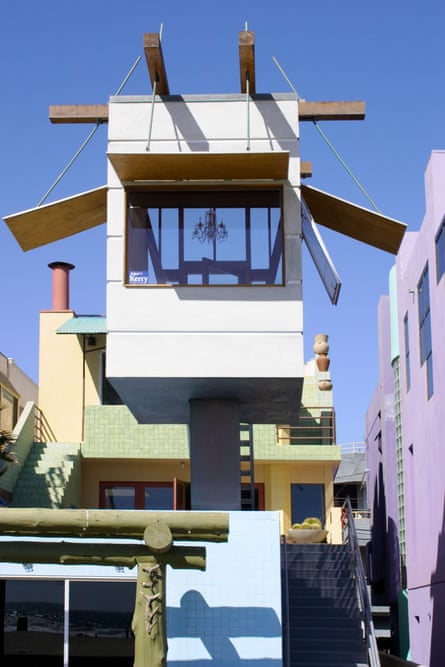
When artists hire artists to design a home, places like the Norton residence pop into existence on Venice Beach’s famed Ocean Front Walk. Inspired by photos of his Santa Monica home, Lynn and William Norton, an artist and writer respectively, hired Gehry to bring this eclectic deconstructivist beachfront home to life in the 1980s. Gehry’s design plays with contrasting sizes of stucco and concrete boxes, heights and shapes, making chaos seem like a cohesive, colorful whole. At the forefront of the property is Gehry’s version of a lifeguard tower in the shape of a one-room studio standing on a single pillar, an apparent nod to William Norton’s former life as a lifeguard.
Loyola Marymount University Law School
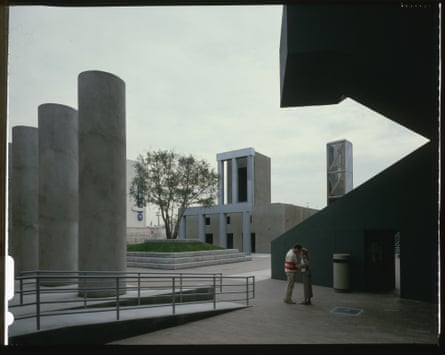
Gehry was chosen to redesign the law school for Loyola Marymount University in 1979 because, unlike other architects who presented plans for a big building, Gehry proposed a collection of smaller buildings designed around a plaza. Robert Benson, a member of the committee who selected Gehry’s design, said the committee “squabbled” with the architect over his strange but signature choice of materials and angles, including sheet metal-wrapped Roman columns, chainlink fences or the peculiar angling of a building. Gehry won most of the squabbles, as Benson recalls it, and the result is a village-like complex of contemporary buildings, bold shapes, bright yellows and at least one oversized chainlink structure.