.png) 3 months ago
83
3 months ago
83
UK bank shares jump after 'avoiding budget tax raid'
Shares in UK banks have jumped at the start of trading, following reports that they will be spared from a tax raid in the budget.
NatWest (+3.3%), Barclays (+2.9%) and Lloyds Banking Group (+2.95%) are all among the top risers on the FTSE 100 share index in early trading this morning.
The banks have been lobbying against higher taxes, arguing that this would lead to less lending and harm the economy.
The effort appears to have been successful, the Financial Times reports this morning, citing people familiar with the planning for the Budget tomorrow.
Back in August, the IPPR thinktank has argued that Rachel Reeves should levy a new bank tax to claw back money which the commercial banks receive from the Bank of England on money created during its quantitative easing stimulus programmes.
Intriguingly, the FT reports that the Treasury has asked banks to praise the budget, and highlight that new policies will boost lending to first-time buyers and small businesses.
Key events Show key events only Please turn on JavaScript to use this feature
UK retailers' confidence falls at fastest rate in 17 years before budget

Sentiment amongst retailers has fallen at the sharpest rate in 17 years as budget fears mount, a new survey has found.
The CBI’s latest quarterly Distributive Trades Survey, just released, has shown that sentiment among retailers worsened in November to the greatest extent in 17 years – a sign that budget speculation and uncertainty has hurt the economy.
More firms expect their business situation to deteriorate over the coming quarter – this measure has weakened to -35% from -10% in August (meaning that the balance between optimistic and pessimistic companias has deteriorated).
The Distributive Trades Survey, which polled 66 retailers and 95 wholesalers across the UK, also found that retail sales volumes fell at a fast pace in the year to November.
November’s retail sales were judged to be “poor” to a somewhat greater extent than in October.
In a worrying sign for Christmas spending, retailers expect demand to remain subdued heading into December, with sales set to fall again, albeit at a somewhat slower pace.
Alpesh Paleja, deputy chief economist at the CBI, says:
“Retailers continue to grapple with a long spell of weak demand, as households remain cautious around day-to-day spending. With all eyes on the forthcoming Budget, uncertainty in the run-up has meant that businesses are holding back on plans for investment and hiring.
“The Chancellor must avoid pulling the business tax lever once again, at risk of further curtailing firms’ efforts to build a more resilient, dynamic economy. Businesses want bold decisions to wrestle back the government’s fiscal headroom and get the economy on a solid path to prosperity. This includes finding a landing zone for the Employment Rights Bill that doesn’t harm job prospects or shortchange economic growth.”
Dan Coatsworth, head of markets at AJ Bell, cautions that UK banks aren’t definitely off the hook for tax rises tomorrow:
“Reports that UK banks might get a reprieve in this week’s Budget from previously floated new tax measures helped give the likes of Lloyds, Barclays and NatWest a lift and underpinned the FTSE 100’s rise on Tuesday.
“It suggests that some intense lobbying by the industry has paid off, although U-turns have been a theme in UK politics for some time so banking boardrooms may not breathe a full sigh of relief until Rachel Reeves has sat down tomorrow afternoon.”
Analyst: pound could be in for a bumpy ride
The pound is creeping higher today; it’s up a third of a cent at $1.3134 against the US dollar.
Kathleen Brooks, research director at XTB, reports that the foreign exchange (FX) market is “nervy” ahead of the UK budget:
With taxes and spending on benefits and welfare payments expected to rise, the pound could come under pressure as the FX market questions whether this government can deliver growth. More FX traders are buying downside protection for the pound in the run up to this budget, and the 1-month GBP/USD risk reversal is trending lower. Thus, it could be a bumpy ride for the pound in the coming weeks.
The pound is one of the weakest currencies in the G10 FX space since the start of Q4, and is lower by 2.8% vs. the USD and by nearly 1% vs. the EUR. These losses have slowed since the start of this month; however, this is not a sign that the market has warmed to sterling. Instead, the market could be waiting for another driver to send the pound lower, and an unconvincing budget both regarding growth and long-term fiscal consolidation, could tip GBP over the edge, sending it below $1.30 vs the US dollar.
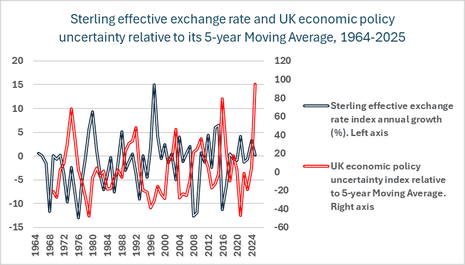
The “painful truth” is that sterling captures the confidence of international investors in the UK economy, writes Professor Costas Milas of the University of Liverpool’s Management School.
Professor Milas tells us:
Investors, of course, hate economic policy uncertainty. From a historical point of view (going back to 1965!) there is an inverse relationship between year-on-year growth (strength) of the sterling effective exchange rate and Economic Policy Uncertainty (EPU) in the UK, the latter proxied by economic policy uncertainty relative to its five-year moving average (the correlation coefficient is -0.43).
I also note (sadly) that economic policy uncertainty in 2025 is higher than that of 2016 in relative historical terms...

Lisa O’Carroll
Over in Brussels, EU chiefs have pushed back at veiled threats by Howard Lutnick that Donald Trump’s punitive steel tariffs could only by lowered if the EU rolls back on regulation of US tech giants.
Trade commissioner Maroš Šefčovič told reporters the EU legislation was not aimed at the US but admitted commerce secretary Howard Lutnick and US trade representative needed more education on the matter.
Šefčovič told reporters:
“We explained how our legislation is working, it is not discriminatory and it is not aimed at American companies. We simply need to do more explanation in this regard. We’ll engage in that process.”
He was speaking after the US commerce secretary Howard Lutnick demanded a “more balanced” approach before they would “handle the steel and aluminium issues”.
Earlier Lutnick had met EU trade ministers after a rare invitation was extended for a lunch at a formal council gathering.
His remarks were considered undiplomatic but one EU official shrugged: “They wouldn’t be American if they didn’t complain”.
Another pointed out that the EU retains the “sovereign right” to legislate in its own territory without foreign interference. The official also pointed out that “steel and digital are completely unrelated” and the discussions on steel had been formally agreed by both sides in a joint statement in August.
Lutnick also launched an undiplomatic attack on the EU, speaking directly to Fox News on the red carpet internal entrance to the summit of EU ministers.
Incredulous at the EU’s green agenda, he claimed:
“They rule out diesel gas and you gotta have batteries here by 2035. But Europe doesn’t make batteries! Only certain countries make batteries and Europe is not one of them. They gotta think better about themselves ... come on! Think correctly.”
His social media post, viewed by more than 200,000, elicited a string of comments, pointing Europe has almost 40 battery production sites up and running or about to launch.
Yesterday US trade representative Jamieson Greer also met tech commissioner Henna Virkkunen where they discussed “how to deepen the transatlantic cooperation on semiconductor supply”, a matter brought into sharp focus by the recent battle with China over Nexperia chip exports.
In a separate meeting with defence commissioner Andrius Kubilius, the EU stressed the “big economic opportunities” for both sides in defence and space exploration.
AO World criticises welfare spending rise
The boss of electricals retailer AO World has called on the Chancellor to focus on cutting welfare spending rather than hitting businesses with more taxes, and claimed that reported plans to scrap the two-child benefit cap are “madness”.
AO World chief executive John Roberts argues it would be a mistake wrong to increase welfare spending while the nation’s public finances need repairing.
He urged Rachel Reeves to look at measures within the government’s own spending to plug the public finances black hole and not hit businesses with more taxes.
Roberts – who was paid £1.392m last year - told the PA news agency:
“Business is a force for good in the economy.
“It gets demonised in this government and all it’s seen as is a source of more and more tax that they can then blow on the welfare budget.”
Roberts told PA the Cabinet “couldn’t run a bath let alone a business”.
And despite Rachel Reeves’s criticism of the misogyny and mansplaining she has faced, Roberts argued the Labour party needed to “man up” and “make some difficult decisions” in Wednesday’s Budget.
Pound volatility soars as traders hedge against budget turbulence
As flagged in the introduction, sterling volatility has indeed soared as traders brace for tomorrow’s budget.
The cost of protection against swings in sterling has surged to a seven-month high this morning, as traders try to protect themselves against wild swings in the currency’s value.
Overnight volatility versus the euro jumped to the highest since mid-April on an intraday basis, and is at the strongest closing level since June 2023 as traders load up against near-term price gyrations. Options now trade at the widest premium to realized swings in three years, signaling hedges are way overpriced relative to what the market has recently delivered.
UK risk is being routed mostly through the euro, sidestepping the US macro influence on pound-dollar. Still, positioning has leaned pound-bearish this month versus both the common currency and the greenback, according to data from the Depository Trust & Clearing Corporation.
More here:
Campaigners call for bank windfal tax
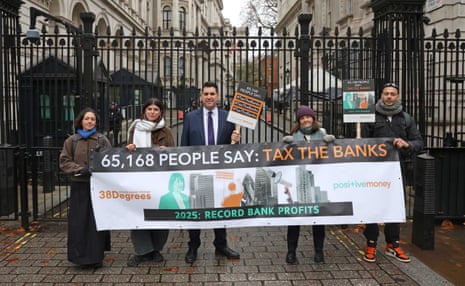
Rachel Reeves was yesterday urged to impose a windfall tax on bank profits.
Labour MPs Richard Burgon and Simon Opher joined campaign groups Positive Money and 38 Degrees as they delivered a petition to Downing Street, signed by over 68,000 people.
The petition points out that the UK’s four biggest banks - HSBC, Barclays, NatWest and Lloyds - made record pre-tax profits of £45.9bn in 2024, and have already earned another £35.1bn in the first three quarters of this year.
The campaigners say banks are enjoying windfall profits from higher interest rates – directly through higher mortgage rates and indirectly through the billions of pounds of interest that the Bank of England is paying banks on the risk-free reserve accounts they hold with it.
Hannah Dewhirst, head of campaigns at Positive Money, says:
“As households across the country prepare for a “difficult” Budget with little relief from the cost of living crisis, banks are reportedly going to escape contributing their fair share.
Banks have made record profits at the public’s expense - allowing them to keep those unearned billions sends a terrible signal to ordinary people about where the government’s priorities lie.
The Chancellor must resist the lobbying efforts of banks and claw back billions to repair our crumbling schools and hospitals with a windfall tax on their profits.”
UK bank shares jump after 'avoiding budget tax raid'
Shares in UK banks have jumped at the start of trading, following reports that they will be spared from a tax raid in the budget.
NatWest (+3.3%), Barclays (+2.9%) and Lloyds Banking Group (+2.95%) are all among the top risers on the FTSE 100 share index in early trading this morning.
The banks have been lobbying against higher taxes, arguing that this would lead to less lending and harm the economy.
The effort appears to have been successful, the Financial Times reports this morning, citing people familiar with the planning for the Budget tomorrow.
Back in August, the IPPR thinktank has argued that Rachel Reeves should levy a new bank tax to claw back money which the commercial banks receive from the Bank of England on money created during its quantitative easing stimulus programmes.
Intriguingly, the FT reports that the Treasury has asked banks to praise the budget, and highlight that new policies will boost lending to first-time buyers and small businesses.
Kingfisher raises profit forecasts
Shares in DIY chain Kingfisher have jumped by over 5% at the start of trading, after it raised its earnings forecasts.
Kingfisher, which operates B&Q and Screwfix in the UK and Ireland, and DIY chains abroad including in France, Spain, Poland and Romania, has upgraded its full year adjusted profit before tax guidance to £540m-£570m, up from £480m-£540m previously.
It raised its outlook despite “softening market conditions in the UK and Poland” in the last quarter, and cited progress in strategic initiatives and discipline on costs and profit margins.
Thierry Garnier, chief executive officer at Kingfisher, said:
“We delivered another quarter of high quality, volume-led growth, driven by our Group strategic initiatives in e-commerce and trade and by our performance in core and ‘big-ticket’ categories. B&Q, Screwfix and Iberia continue to strongly outperform their markets. Our performance to date and progress in our strategic initiatives give us the confidence to upgrade our full year profit guidance.
As we look ahead, we are committed to driving shareholder returns through the consistent execution of our strategic priorities and by being disciplined on margin and costs.”
Budget airline easyJet has beaten profit expectations, after raising its selling prices.
EasyJet reported an 18% jump in pre-tax earnings in the last financial year, to £703m, ahead of forecasts of around £669m.
Revenues at its holidays division increased by 27%, ahead of the 20% increase in customers due to an increase in average selling price of 5%.
This means easyJet holidays hit its target of a pre-tax profit of £250m last year, earlier than expected; it now has a new, upgraded target of achieving £450m PBT by 2030.
EasyJet has also raised its average selling price by “high single digits” in the first half of this financial year, and has sold 80% of capacity so far.
Kenton Jarvis, easyJet’s CEO, says the company is on track to hits its medium-term goal of delivering over £1bn in profit before tax:
“Since setting our medium-term targets in 2023 we have made significant progress, delivering a 46% improvement in profit before tax, adding 9% this year through the continued, successful execution of our strategy. easyJet holidays is today launching an even more ambitious goal having achieved its target early.
“Our focus on investing in operations and enhancing customer experience, providing the warmest welcome in travel, has delivered improved punctuality, enhanced customer satisfaction and cost efficiencies this year.
"How do you spell stagnation? G-E-R-M-A-N-Y."
We have confirmation this morning that Germany’s economy failed to grow in the last quarter.
German GDP was unchanged in the July-September period, statistics body Destatis has reported, which matche the initial estimate last month.
Ruth Brand, president of the Federal Statistical Office, says:
“Economic activity was hampered in the third quarter by weak exports, while investments increased slightly.”
The lack of growth is a blow to chancellor Friedrich Merz’s efforts to stimulate the economy with a major spending programme.
Carsten Brzeski, global head of macro at ING, fears that Germamy is in a state of “apparently never-ending paralysis”, with tariffs, the stronger exchange rate, and political tensions and uncertainty all hurting its economy.
Brzeski told clients:
How do you spell stagnation? G-E-R-M-A-N-Y. In the past three years, the German economy has recorded only two quarters of positive growth. On average, the economy has shrunk by 0.1% quarter-on-quarter in every single quarter since the fourth quarter of 2022.
The just-released second estimate of German GDP in the third quarter of 2025 has confirmed this sad record of yet another stagnating quarter. On the year, the economy grew by a meagre 0.3%.
Introduction: Sterling volatility expected around the budget
Good morning, and welcome to our rolling coverage of business, the financial markets and the world economy.
The pound is in the spotlight as investors brace for tomorrow’s budget, fearful of a negative market reaction to Rachel Reeves’s plans.
The pound has weakened over the last few months, down from $1.36 in mid-September to $1.31 today, having hit a seven-month around $1.30 at the start of this month.
Traders are anxious as to whether the chancellor will manage to rebuild, or even increase, her headroom to hit the government’s fiscal targets in coming years.
Matthew Ryan, head of market strategy at financial services firm Ebury, predicts the pound will be volatile this week:
“It’s unclear if there will be enough room to raise taxes sufficiently to reach the required £25-30 billion shortfall, with the government reportedly ruling out hiking income tax rates and seemingly unable to cut fiscal expenditure.
“We instead see a sort of patchwork of assorted and targeted tax increases, but the devil will be in the details, and if Reeves is unable to convince markets that she has a credible long-term plan for fiscal sustainability, then the pound could struggle on Wednesday. At any rate, brace for volatility in sterling this week.”
According to the Financial Times this morning, traders have been “piling into bets” that the budget will push the pound lower against the dollar,
They report that trading volumes in put options, used to speculate on or hedge against a fall in the pound, have outstripped those of bullish call options by more than four to one over the past week, according to derivatives firm CME Group.
News yesterday that the UK’s growth forecasts will be downgraded has further dampened the mood:
The flurry of reports of potential budget measures over recent weeks – with an income tax rise first on, then off, the agenda – hasn’t reassured the markets.
Thomas Pugh, chief economist at audit, tax and consulting firm RSM UK, says this “chaos” is costly:
“The flip-flopping, U-turning and general chaos of the last couple of months means we are much less certain of what to expect in this week’s budget than usual.
“This raises three issues. First, chaos has a cost. The recent economic data make it clear that worries about the Budget is dragging on growth. Second, uncertainty raises the chances of an adverse reaction in gilt markets on the day if the budget disappoints. Third, the chances of additional rate cuts next year are falling quickly because it looks like the budget will be less deflationary and more backloaded.
A tax-heavy budget is likely to weigh on growth, increasing the possibility that the Bank of England cuts interest rates in December and again in 2026.
Ipek Ozkardeskaya, senior analyst at Swissquote, says tomorrow’s budget is “make-or-break’ for sterling, because…
..either the Bank of England steps in to prevent a gilt flare-up if investors dislike what they hear, or to cushion the economy if tax hikes bite hard.
The agenda
-
11am GMT: CBI distributive trades report on UK retail
-
1.30pm GMT: US retail sales report
-
2pm GMT: Case-Shiller US house price index
-
3pm GMT: Pending US home sales report
-
3pm GMT: US consumer confidence report