.png) 2 months ago
57
2 months ago
57
This year, despite not particularly liking the show nor wanting to, I have thought a lot about the opening scene to Adults. The FX half-hour comedy about a group of recent college graduates in New York begins, naturally, on the subway; what seems like an over-studied portrait of early adulthood intimacy – tangled limbs, in-group references, aggressively relaxed banter – quickly devolves into a standoff between a creepy subway masturbator and the group’s instigator, Issa (Amita Rao), trying to out-masturbate him to make a wildly off point about feminism. “Is this the world you want?!?” she shouts at him, hand vigorously in pants.
The moment is intentionally off-putting, perhaps too much so – I’m as ripe as anyone for surprise, but found the try-hardness of this shock memorably irksome. Yet it’s also unintentionally revealing: this, it implicitly screams, is a show to get young people’s attention. A similar anxiety courses through the opening of I Love LA, HBO’s west-coast rejoinder to Adults that is similarly pitched as a zeitgeist-y take on the thrilling chaos of young adulthood. We meet Maia, played by creator and co-writer Rachel Sennott, mid-sex with her boyfriend, heedlessly determined to come before going to work, even if it means ignoring an earthquake.
Both scenes contain many of the hallmarks of TV about the wilderness that is one’s 20s – intense relationships, staggering narcissism, blinkered optimism, intoxicating messiness – though watching them, and many of the scenes that followed, I was reminded less of the turbulence of that age than of the television industry at large. TV is desperate to connect with young people, who increasingly opt for YouTube or social media for their screen time. Perhaps that’s why the industry seems especially bullish on I Love LA, in a way that’s incongruous with a show that still feels like a work in progress. Before it even aired, Variety declared the series a “generational text” and put Sennott, a former internet comedy “It Girl” turned nascent screen star, on its cover; HBO has already announced a second-season renewal, calling it “among the fastest-growing” of its original comedies, averaging 2 million viewers – substantial for prestige cable, though by no means generationally defining.
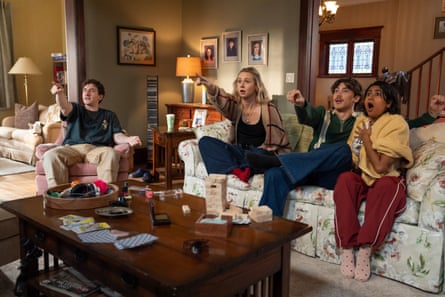
All of this belies a strange phenomenon in Hollywood: youth still dominates the culture, but not on television. Gen Z, generally defined as those born between 1997 and 2010, are the second largest generational demographic in the US behind millennials, and critical to the future of television. And yet the market for any series, let alone a great one, about being young and single and hanging with your friends is virtually wide open. Past generations had broad network sitcoms like Living Single, New Girl, Happy Endings, How I Met Your Mother and The Big Bang Theory; prestige creator-star HBO entries like Lena Dunham’s Girls and Issa Rae’s Insecure; and cult hits like Comedy Central’s Broad City, TBS’s Search Party and Freeform’s The Bold Type. Gen Z has duds like Generation, a one-and-done HBO teen show attempt in 2021, or the latest round of small network attempts to speak to those in their 20s – I Love LA, Adults and Overcompensating, internet comedian Benito Skinner’s college-set series for Prime Video, all of which have been renewed for second seasons on modest buzz.
What once used to be a staple entree of the television buffet – TV that reflects young people’s realities, anxieties, fantasies and hijinks – is now a small subsection, neither drawing the eye nor tasting right. The closest one could get to a definitional gen Z hit is Euphoria, the overwrought HBO soap about high schoolers that reads as a millennial fever dream of all the ways the internet can ruin adolescence, though it did christen a distinctive sexualized aesthetic, popularize some imitably outlandish fashion and launch several movie-star careers. It has also been off the air for five years, with its long-awaited third season, including a time jump to post-college life, delayed until spring 2026.
In the meantime, the Friends for gen Z seems to be, well, Friends itself. According to viewership data from Nielsen, when gen Z does pick a show to watch, they tend to go back in time – 65% of the shows watched by 16 to 34 year olds are so-called library series, including NBC’s archetypical twentysomething hangout sitcom (10.63bn minutes watched in 2024), fellow coming-of-age series Gilmore Girls (11.6bn) and medical soap Grey’s Anatomy (17.37bn). Nearly half of gen Z prefers YouTube or social video platforms like TikTok over traditional TV or paid streaming, a harbinger of what Vox’s Rebecca Jennings termed the MrBeastification of entertainment. A very online segment of the cohort have taken to rewatching Girls, close-reading the series as a rich archival text of cringe millennial striving.
But for reflections of their own experience, much of the same cohort turn to social media – to see their peers post about their dating experiences or gag-worthy stories online, to watch influencers riff on fun and flirty nights out with friends or, in the case of the long-running TikTok series by comedians Kyle Chase and Veronika Slowikowska, to tune into the latest lore-filled chapter of roommate situationship that may or may not be real. (SNL, also looking to attract young viewers, smartly tapped Slowikowska for its current season.)
Hollywood is attempting to meet an audience increasingly acclimated to bite-size content where they are, paying firms to chop their series into micro-chapters for social media; Hollywood trade The Ankler reported that a producer on Adults paid the firm $15,000 to blast out 2,500 videos from the series on social media as experimental marketing. (The scheme reportedly netted 40m views across TikTok, Instagram Reels and YouTube Shorts.) Studios such as Fox Entertainment and Miramax are investing millions in vertical video companies, part of a “microdrama” gold rush that attempts to capture fractured youth attention spans with compact narratives told in two-minute “episodes” that slot easily on to social media.
But once you reach an audience, you still need to connect with them, and TV, no matter how TikTok-able the episode, is in a tough bind: there is no way that television, even with accelerated production and release schedules relative to film, could ever hope to keep up with the warp-speed trends and nimbleness of social media, or model the speed, hyper-referentiality, and distinctly un-prestige aesthetic of internet comedy. It is notoriously difficult for film and television to capture the seamless presence of the internet in our lives or our sprawling online selves, let alone the creator economy, in a way that doesn’t feel distracting, deadening, or cheap. As Jeff Astrof, a 59-year-old alum of the Friends writers’ room, put it to The Ankler, if the iconic NBC series “took place now, Chandler would go on his phone the entire episode”.
But they must try, in order to have a semblance of accuracy to the generation they’re portraying. I Love LA and Adults both attempt to build internet life into the fabric of its characters’ social groups – the former focuses on Maia’s career managing her influencer best friend Talullah, the latter features side plots such as air-tagging a roommate’s crush. The results are expectedly mixed. In I Love LA, the satire of influencers is too toothless, Talullah’s actual work as an influencer too vague; Adults fares better, but still handles the tribulations of online dating and location sharing with what feel like oven mitts.
I should say that, like many aimless twentysomethings, both of these series show promise; the second halves of both freshmen seasons are significantly better than their firsts. But watching them mostly left me nostalgic for the gut-twisting insights of Girls, or the resonant friendship fights in Insecure, or the well-worn coziness of Friends – shows that feel connected to some hazy, common experience of growing up and figuring it out. Perhaps traditional television, transitioning from dominant cultural art form to niche medium, will too.