.png) 3 months ago
75
3 months ago
75
In the echoing exhibition halls of Abu Dhabi’s International Hunting and Equestrian Exhibition, hundreds of falcons sit on perches under bright lights. Decorated hoods fit snugly over their heads, blocking their vision to keep them calm.
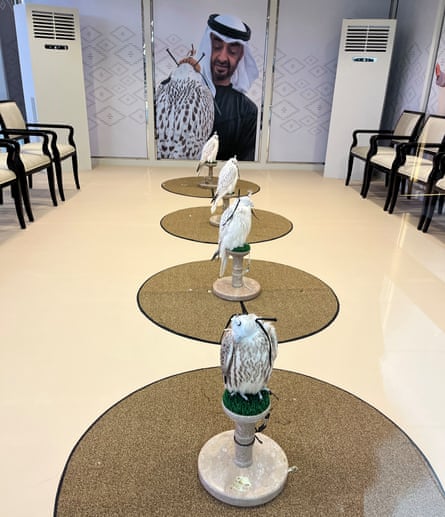
In a small glass room marked Elite Falcons Hall, four young birds belonging to an undisclosed Emirati sheikh are displayed like expensive jewels. Entry to the room, with its polished glass, controlled lighting and plush seating, is restricted to authorised visitors only.
These falcons are granted Emirati passports, jet around the world and have entire hospitals that specialise in their healthcare. Some cost more than luxury cars – an American falcon at the exhibition will sell for AED 350,000 (£71,000). The most prestigious birds travel in Range Rovers and Bentleys fitted out with a perch between the front seats.
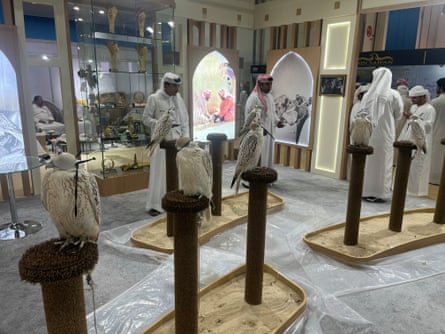
For thousands of years, people have hunted using falcons over the vast Arabian desert. In the UAE, however, this Bedouin tradition has evolved into a spectacle of wealth and prestige to meet the tastes of the modern Gulf elite. As falconry has become a multimillion-dollar international industry that stretches around the world, an investigation by the Guardian and Arab Reporters for Investigative Journalism (ARIJ) shows that it is fed by a shadow industry of the smuggling and illegal capture of wild birds.
Vanishing chicks
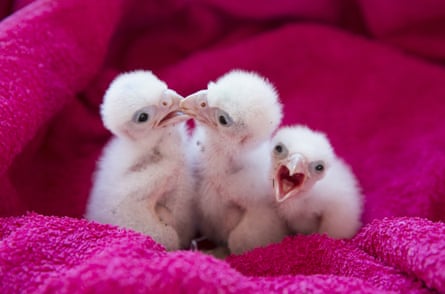
Far from the hot plains and glass skyscrapers of Abu Dhabi, in rural counties across the UK conservationists and police are reporting a troubling pattern. Peregrine falcon chicks are vanishing from remote cliff ledges and treetop nests unreachable without specialist climbing gear. Later, some of these chicks are ending up in deserts in the Middle East, having been issued with fabricated documents, according to police witness statements from people who bought them thinking they were legitimate.
The cold climate of northern Europe is considered the ideal for creating tough, fast birds, and British-bred birds from established lines carry additional prestige. Legally only captive-bred peregrine falcons can be traded. Birds cannot be taken from the wild, as they are strictly protected under the Wildlife and Countryside Act.
Exclusive data shared with the Guardian and ARIJ by Royal Society for the Protection of Birds (RSPB) investigations shows that from 2014 to 2023 there were 126 reports of nests being raided, 21 of which have been confirmed using camera footage, DNA work or eyewitness accounts. All are believed to be linked to the peregrine falcon trade.
“There are hundreds of birds going missing each year,” says Kevin Kelly, head of the National Wildlife Crime Unit (NWCU).
Demand for wild birds appears to be coming from two directions, experts and police say. The first is direct from falconers in the Middle East who want wild birds for racing. The second is from some breeding facilities that need them as parents to feed a booming appetite for hybrid falcons and legally exportable, captive-bred birds.
At the Abu Dhabi exhibition, traders will happily discuss their desire for wild-caught birds – although they are not formally advertised, as the practice is illegal.
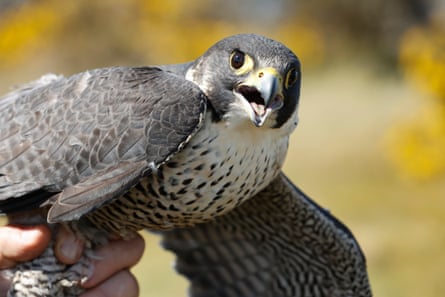
“British falcons are in very high demand in the UAE because of their record in winning races, their purity of bloodline and their speed,” says one employee of a high-profile Emirati falconry body. He says most Emirati falconers prefer wild-caught falcons since “farm-bred falcons might come from mixed bloodlines, while wild-caught birds are pure and perform better”. This preference for wild-caught British falcons was echoed by four other farm owners and sellers, as well as two falconers interviewed at the exhibition.
The demand for British birds has driven soaring exports. Last year, 4,000 peregrine or peregrine hybrids were exported from the UK to the Middle East, and this year the number rose to 5,000, according to the police. In 2023 (the last year data is available), 88% of all peregrine falcons exported out of the UK were sent to the UAE, according to data extracted from the Convention on International Trade in Endangered Species (Cites) database. It is not known how many of those exported birds are wild caught, but police have identified at least some that are.
Wild birds held captive
To feed the booming export demand, there has also been a huge growth in UK breeders. There are now about 160 breeding facilities in the UK, up from about 27 in the 1980s, according to NWCU. All of the facilities have links to the Middle East (either owned by a resident from the region or selling directly to a buyer there).
The most valuable falcon for export is the gyr peregrine – known for its speed and strength – which has a peregrine falcon as the mother and gyr falcon as the father. The female offspring are infertile, which is why there is high demand for female peregrine falcons in breeding facilities. In 2024, 1,200 peregrine falcons were registered in captive breeding facilities, up from 750 in 2000, freedom of information (FoI) data shows.
DNA techniques – which rely on volunteers sending in hundreds of samples from wild birds – prove that some of these birds are wild caught. “The DNA work shows there are a number of wild birds within captive breeding centres up and down the country,” says PC Gavin Ross, who has led the crackdown on falcon thieves.
Police don’t have the capacity to inspect all of the country’s facilities, but say more than half of the facilities they do investigate are non-compliant, with offences ranging from non-registration of birds and false declarations of parentage to selling birds that have been taken from the wild. There were 27 physical inspections of facilities breeding peregrine falcons in 2023 and 2024, according to FoI data – a significant increase from previous years. During those checks, 15 wild birds were discovered and confirmed using DNA testing.
A ‘minor’ issue
These findings have been disputed by some experts in the industry, who argue that the trafficking is minor or nonexistent. “In reality, the level of illegal take described by the NWCU is a handful of birds per year,” says Dr Nick Fox, director of International Wildlife Consultants (UK) Ltd, who has supplied the royal families of UAE and Bahrain with falcons.
“Breeding falcons in the UK has increased hugely over the past 25 years as expertise has developed,” says Fox, who has an OBE for falcon conservation. “Basically we have succeeded in killing the market for wild birds.”
The suggestion that Emirati falconers are actively seeking wild-caught British birds is false, says Julian Mühle, CEO of the International Association for Falconry and Conservation of Birds of Prey (IAF). “Comments gathered informally at an exhibition do not reflect the established preferences in the region,” he says.
Mühle says the discovery of wild falcons in breeding facilities “should not be interpreted as evidence of widespread criminality”. Instances of chicks being taken from wild nests “while serious, are extremely rare and, crucially, not linked to the legitimate falconry community”.
Khaled Bin Soufan, a prominent falcon trader in the UAE, says there is “zero” smuggling of wild birds from the UK: “It is not allowed.”
The Abu Dhabi’s International Hunting and Equestrian Exhibition did not respond to a request for comment.
Threatened by greed
Wild peregrine falcons spend their lives soaring above cliffs and cathedrals up and down the UK, slicing through the cool air at breakneck speed. A few will swap that for a life of flying over golden deserts and sprawling glass cities. Yet many kept in captivity rarely – if ever – fly, according to Ross. Some who spend their lives in breeding facilities are “treated like battery chickens”, he says, fed supplements to produce up to 14 eggs a season.
Peregrine falcons were on the verge of extinction in the UK in the 1950s until the banning of insecticide DDT and stronger legal protection. Their return has been a conservation success story, with 1,750 breeding pairs in the wild. Now they are threatened by greed, says Ross. “If a blind eye was turned to [the illegal taking of birds], the peregrine would again be under threat of extinction.”
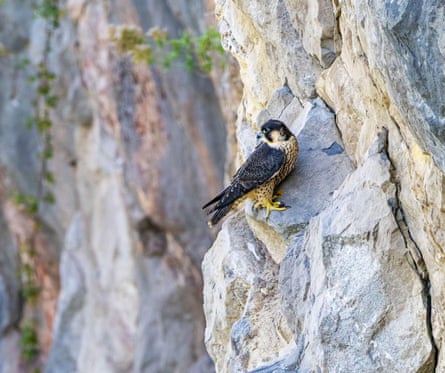
The population is now classed as stable, but some areas are more targeted than others. “Locally we’re seeing a decline in peregrine falcons,” says George Smith, who monitors 60 nests over an area of south-east Scotland. “When they disappear, the food chain gets wrecked.”
Smith has been monitoring the birds for nearly 40 years. This year he believes that four nests containing at least 10 chicks in his area were raided for falconry, and that nationally about 100 are taken. He tries not to get too attached to the birds he monitors. “It’s pretty bad just now,” he says. “Nest raiding was bad in the early 70s, and now it has returned.”
Find more age of extinction coverage here, and follow the biodiversity reporters Phoebe Weston and Patrick Greenfield in the Guardian app for more nature coverage