.png) 2 months ago
69
2 months ago
69
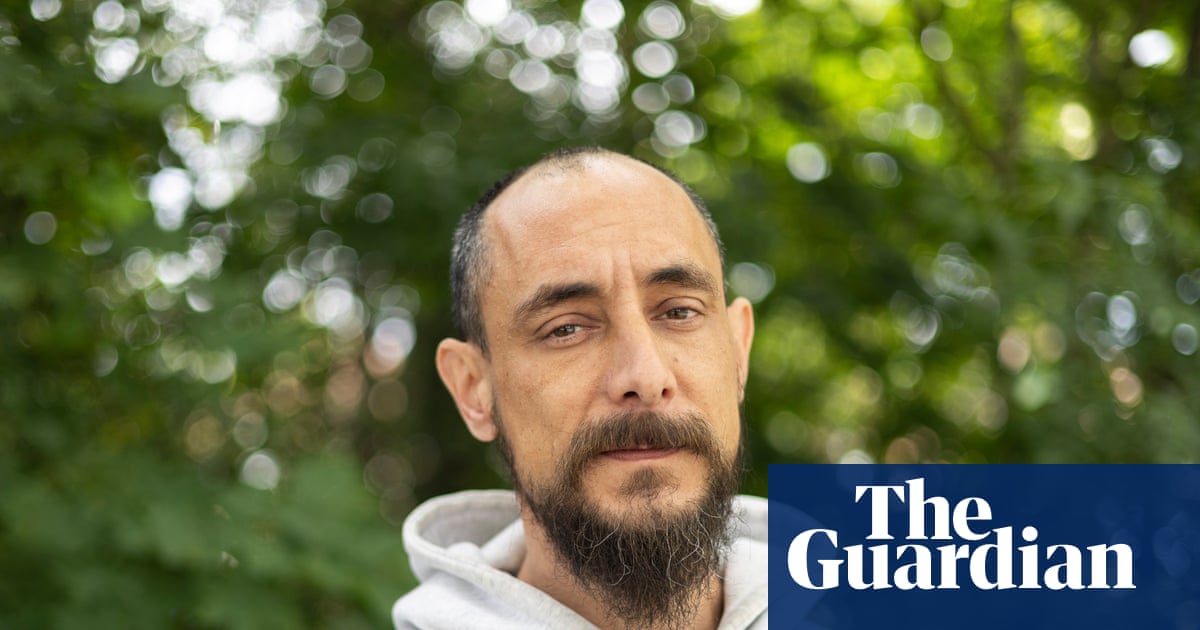
When Corentin Roudaut moved to Paris 10 years ago, he was too scared to cycle. The IT developer had biked everywhere as a student in Rennes but felt overwhelmed by the bustling French capital. Cars were everywhere. Cyclists had almost no protection.
But once authorities carved out space for a segregated bike lane on Boulevard Voltaire near his home in the 11th arrondissement, Roudaut returned to the two-wheel commute and did not look back. He now volunteers with Paris en Selle, a cycling campaign group, and has watched with wonder as the city has shaken off its car-centric reputation.
“It was a process that started slow and really accelerated in the last 10 years,” Roudaut said. “At least in some parts of the city, we have a [cycle] network that is starting to be safe and pretty much complete.”
Paris has embarked on a grand transformation since Anne Hidalgo became mayor in 2014, planting 155,000 trees, adding several hundred kilometres of bike lanes, pedestrianising 300 school streets and banning cars from the banks of the Seine. Parking spots have been turned into green spaces and terraces for cafes and bars. Fewer parents have to fear their child being run over when they walk to school.
Now, as Hidalgo leaves office on Sunday after 12 years as mayor, her fight to make the city more livable has been held up as an example for progressive European cities as national governments roll back green policies.
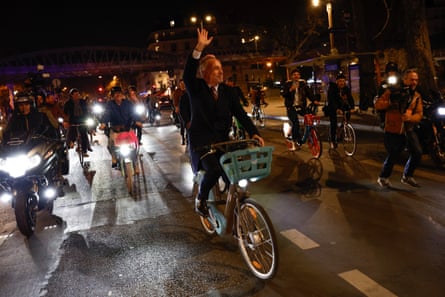
“When people ask me if I have any advice, I say don’t be afraid of being ambitious,” said Roudaut, who last year welcomed a delegation of Green politicians from Germany trying to understand why Paris was doing what Berlin could not. Even though Hidalgo achieved only part of her plan, he added, “everybody’s saying: ‘Look at what Paris has done, it’s so amazing.’”
Parisians do not all feel the same. Efforts to make streets safer have taken space away from cars, sparking direct opposition from motorists, while referendums on charging SUV drivers more to park and pedestrianising more school streets were won with troublingly low turnouts. Before last month’s municipal elections, Rachida Dati, the mayoral candidate for the rightwing Les Républicains, criticised the chaos in public space as “anxiety-inducing”, though she stopped short of proposing to undo central policies.
In a wide-ranging interview with the Guardian last week, Hidalgo said pedestrianising the city’s riverbanks had been “a tough battle” but now that it had happened people did not want to go back. “Today there are generations of children who have not known cars there. People say ‘wow!’ when you tell them,” she said.
Experts say the transition was made easier by the city’s unusually tight administrative boundaries, which give commuter suburbs less say over its transport than in other capitals, as well as groundwork laid by previous mayors. But still courage was needed to push through policies that inconvenienced motorists while introducing shared social and environmental benefits.
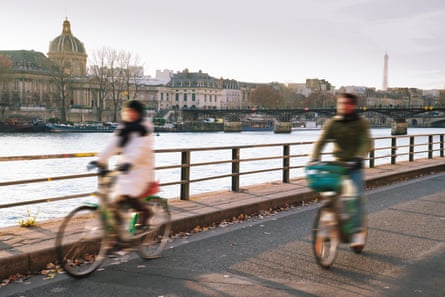
More could still be done but the changes so far are “fabulous”, said Audrey de Nazelle, an environmental epidemiologist at Imperial College London who grew up in Paris and returns frequently. She remembers when cycling was so rare “you could go and have coffee together” if you ran into someone else on a bike.
“What’s missing in the rest of the world is courage,” she said. “Mayors could say: ‘This is my opportunity [to leave a] legacy,’ but most will not dare.”
Paris is one of 19 global cities that achieved remarkable reductions in two toxic air pollutants between 2010 and 2024, a report last month found, although the list also includes a handful of neighbouring capitals with less progressive urban politics. Fine-particle pollution fell faster in Brussels and Warsaw over the same period, while nitrogen dioxide fell faster in London.
Berlin, which last year opened a new stretch of motorway inside the city and voted to scrap 30km/h speed limits on 23 main streets, still has a higher share of cyclists than Paris.
Rather than being exceptional, Paris has caught up with many other cities from a lower starting point, said Giulio Mattioli, a transport researcher at the Technical University of Dortmund, who used to live in Paris. “The conditions were there already, you just needed to make some bike lanes and people would use them,” he said.
Cities across Europe saw a boom in cycling and bike-friendly infrastructure during the Covid-19 pandemic but have suffered setbacks amid a political shift to the right and the emergence of conspiracy theories that have unexpectedly taken aim at ideas such as having amenities within walking distance.
While Paris proper has undergone a radical shift to becoming a “15-minute city”, the extensive suburbs are still dominated by cars and are cut off by a busy ring road. Analysis for the thinktank Terra Nova by Jean-Louis Missika, a former deputy mayor who served under Hidalgo and her predecessor, said transforming the Boulevard Périphérique that surrounds the city was essential to making Paris a post-car metropolis.
“As long as this 35km motorway continues to encircle Paris, the Greater Paris metropolis will remain a figment of the imagination, an administrative construct devoid of urban reality,” he wrote. “Because a metropolis cannot be built by erecting walls between its inhabitants.”