.png) 2 months ago
64
2 months ago
64
For someone who has waited so long – umming and erring, should I or shouldn’t I – about whether to speak out, it became abundantly clear on Thursday what I had to do. There was Nigel Farage holding a press conference on live television and responding to racism allegations from his teenage years by lambasting the BBC and ITV for giving airtime in the 1970s to the comedian Bernard Manning and the fictional character of Alf Garnett. As a Christian, I could not help but see it as the most amazingly disingenuous example of the phrase “let he without sin cast the first stone”. It was also the final straw.
My late parents were born in Nigeria and came to the UK in the 1950s. For the Windrush generation, I am told it was a ship ride of many days. My parents came to serve, as is so typical of immigrants from the Commonwealth at the time. My mum had to undergo “further” training as a nurse despite having already practised as a nurse in Nigeria, while my dad qualified as an osteopath. They both in effect came over here to participate in creating a healthy nation, whether via the NHS or in a private capacity.
I will spare everyone their experiences of racial abuse in the 1950s and 1960s, both “direct or indirect”, both “with intent or without intent”, both “malicious or non-malicious”. Not only does this categorisation, deployed by Farage in recent days to explain away his behaviour, distract from the real issue, it is an unnecessary attempt to imply some levels of racist abuse are tolerable. But I was simply not there to experience the vulgarity of that period. It is not my story. I was, though, at Dulwich college, a public school in south-east London, at the same time as Farage, the teenager. That is a story I can – and now want – to tell.
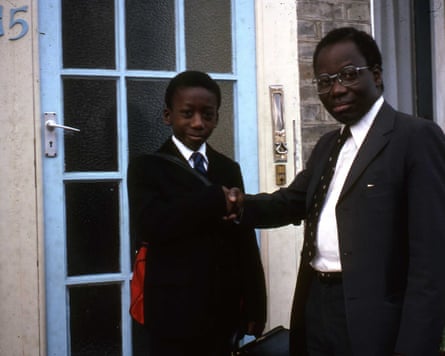
I went to the school for a year between 1980 and 1981, starting at a mere nine years of age. I was in the most junior class (JC) at the time, in a college that was so large, consisting of lower, middle and upper schools with an age range from nine to 18. My hard-working parents celebrated with pictures as proud parents would do when their child is so privileged to attend such a well-reputed educational institution.
It took him a while, I recall, but one day Farage, and at least one other, spotted me in the lower-school playground. He was about 17. He towered over me. “Where are you from?” he asked. Within seconds of offering my rather confused and sputtering answers, he had a clear response. “That’s the way back to Africa” with an accompanying hand gesture pointing towards a place far away.
Once my existence as a target was established, he would wait at the lower-school gate, where I was dropped off for school, so as to repeat the vulgarity. I will leave it to the reader to decide whether this was “malicious or non-malicious”, “meant with intent or not with intent”, “direct or non-direct”. I know how I experienced it. It certainly felt malicious to me.
I’ll never forget the look of hatred he had for me, seemingly simply for existing. Without knowing my name but just looking at me with what appeared to be no appreciation of my humanity and simply because of how I looked.
Farage has suggested that it is inconceivable that anyone could recall such events of more than four decades ago. I would simply ask: can a victim of such abuse ever forget? I know I haven’t forgotten. I recognise his walk every time I see it on TV as that same walk that used to approach me.
after newsletter promotion
Looking back, it was perhaps a stroke of luck that I left after a year; the high school fees being a contributory factor along with family relocation. The thought terrifies me of what could have happened if I was there the following year when the bully would have had even more authority. The prospect of him having infinitely more of that in a few years’ time is truly a chilling thought.
My mum died this year and I try to live by her peaceful, tolerant, “just get on with it” attitude to life. It is one common to the vast majority of immigrants to a new country. But quite why such events from more than four decades ago have stuck with me will be well understood by those who have experienced something similar. Sometime ago, I started putting down some thoughts in a memoir, dedicated to my mum. I did not think I was quite ready for it to have a wider readership. But the sight of a perpetuator denying or dismissing hurt will always be a trigger for even the quietest, most peaceful private person to finally feel the need to speak out.