.png) 3 months ago
66
3 months ago
66
As a long-distance runner, I had always wanted to use running as a means of travel, a way to traverse a landscape. I’d heard of people running across Africa, or the length of New Zealand, and the idea of embarking on an epic journey propelled only by my own two legs was compelling. I had just turned 50, and some might have said I was having a mid-life crisis, but I preferred to envisage it as a sort of pilgrimage – a journey in search of meaning and connection. And the obvious place to traverse, for me, was the land of my ancestors: Ireland.
Most summers as a child, my Irish parents would take us “home” to Ireland, to visit relatives, sitting on sofas in small cottages, a plate of soda bread on the table, a pot of tea under a knitted cosy. Having been there many times, I thought I knew Ireland, but, really, I knew only a tiny fragment.
And so I concocted a mad plan to run around the entire island of Ireland. I’d start in Dublin, the birthplace of my mother, and run down through the Wicklow mountains, all the way to Cork in the far south, before making my way up the Wild Atlantic Way, up past Galway, the birthplace of my father, home of the Finns, up to Donegal in the north, on through Northern Ireland, and then south to finish back in Dublin. A mere 1,400 miles. And along the way, I’d get to know Ireland more intimately.
It took me just under 10 weeks, averaging over 20 miles of running a day, while my wife and 15-year-old son travelled around in a motorhome, meeting me each evening with food and our home on wheels.
Many days I ran alone, often through a rolling landscape of farms, cows staring at me over hedges, the roads dotted with new-build houses picked straight, I was told, from a book called Bungalow Bliss.
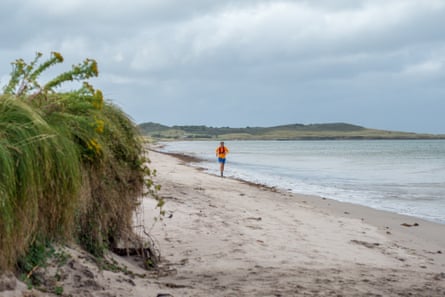
Often, though, people would come out to run with me. Those were the easiest days, when the miles would slip by unnoticed, like water under a boat, the chat being the wind in our sails. Ireland is known for its warm welcome, it’s a national cliche, but we found ourselves regularly invited into people’s houses for food, or offered a bed for the night.
One evening the fuse in our motorhome blew, which meant we had no water pump. And I hadn’t yet showered. I found a hardware shop that was long closed for the day, and I did something I wouldn’t dream of doing at home in England: I knocked on the door. It just seemed that in Ireland you can do that sort of thing. Sure enough, a man opened it, not at all put out, and found me the right fuse in his shop drawer. He didn’t even charge me.
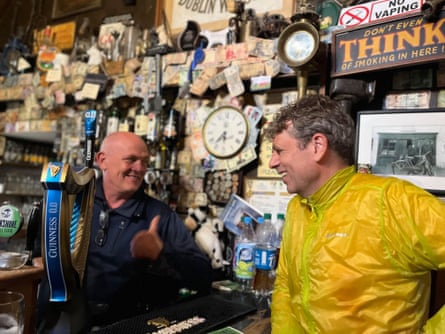
Virtually every town or village we stopped in had a pub seemingly lost in time, wood-panelled walls covered in random objects and pictures, a happy buzz emanating from people sitting in their cosy nooks. We learned to look for the handwritten sign in the pub window: “Trad session tonight.” It was never a performance, as such, but just whoever turned up that evening, sitting in one corner, playing their fiddles, guitars and accordions, chatting among themselves between songs.
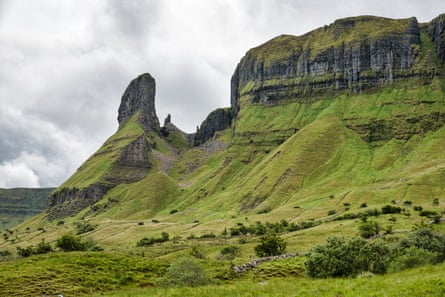
Ireland has a lot of space. I hesitate to call it wild space, as it is one of the least biodiverse countries in the world, with barely any remaining natural forest. But I would often find myself running all day up and over mountains, or along stretches of coastline, without meeting a single other person. One memorable day, I ascended Knocknadobar in Kerry, one of Ireland’s many “holy mountains” (of which Croagh Patrick in Mayo is the most famous). These are known pilgrimage routes, and along the trail were 14 crosses with depictions of Jesus signifying the 14 Stations of the Cross. Despite not being religious, as I made my way up the mountain in the rain, the story of Jesus struggling on, being whipped each time he dropped his cross, picking it up and carrying on, began to resonate with my own struggle, and I felt it pushing me on.
What burden was I carrying, I began to wonder. I’d been in a low mood all that day, grumbling about the weather, the long roads, the endless running. But I decided to put all that down, and instead be grateful for where I was; that I was able to be out here; that my body was healthy and strong enough to do this. And in that moment – I kid you not – the clouds parted, and below the swooping drop of the mountain the sea appeared. I felt my spirits lift as I raced to the top and down the other side. To complete the sense of the entire day being an allegory in itself, at the bottom I found myself in a tropical garden, complete with palm trees and waterfalls, the day now warm and humid, basking in sunshine.
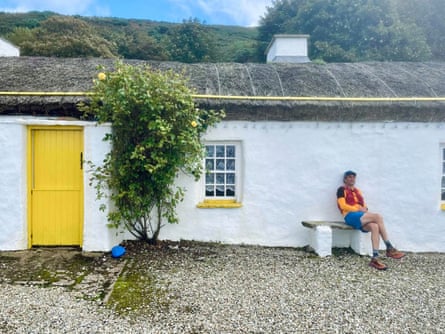
Had I emerged from the mountain into paradise? Not quite. It turned out it was the RHS award-winning Kells Bay House and Gardens.
One of Ireland’s hidden gems is the Beara peninsula, straddling Cork and Kerry, and one of the most spectacular sections of the Beara Way trail is the path from Adrigole to Glengarriff. Here, the mountains are pointy and lush, like something from a Japanese painting. The trail also passes through a rare section of native Irish forest in the Glengarriff nature reserve, and ends at the beautiful Blue Pool, a tidal harbour complete with a purpose-built bathing area.
Alas, I arrived as the tide was out, so there was no chance of a cooling dip, but I did find many other swimming spots on my run around Ireland. Of course, there were some stunning beaches, such as the white sands of Derrynane Beach in Kerry that, on a less windy day, could pass as a tropical beach in the South Pacific. I also found myself dipping in numerous lakes and waterfalls, such as the serene Poulanassy waterfall in Kilkenny.
Northern Ireland also has some wonderful coastline, and I was lucky to have two days of glorious sunshine as I ran along the north Antrim coast. The Giant’s Causeway is truly one of the most extraordinary landscapes, but there are other, less explored sections of coast, such as the area around Ballintoy Point, a fantastical array of rocky outcrops and hidden sandy coves. I don’t know if it was the power of the evening light on a late summer evening after 20-odd miles of running, but as I passed through it, I wanted to lie down on the grass and never leave.
Running as much as I did, I never dwelt long in any one place, and while I saw so much, my experiences were, by their nature, mostly fleeting. It felt as though I was getting an impressionistic image of Ireland. And the impression I got was of a country at ease, in no big rush to be anywhere else, letting the world in for a cup of tea and a chat, and a bit of music.
As for my own journey, and my sense of pilgrimage, I had set off not knowing if I could even run that far. There were times of struggle, and moments of transcendence, but most of all I came away feeling that I had been taken in and looked after by Ireland. The last day, headed into Dublin, I was joined by about 30 runners from across the country and we sang Molly Malone at the tops of our voices as we ran alongside the River Liffey, finishing at Ha’Penny Bridge, much to the bemusement of passing tourists. And then afterwards, we all went to the pub, where I enjoyed a Guinness.
Adharanand Finn has written three books on running: Running with the Kenyans; The Way of the Runner; and The Rise of the Ultra Runners (published by Guardian Faber)