.png) 2 months ago
67
2 months ago
67
Macron reportedly warned European leaders against potential US betrayal on Ukraine — media report
French president Emmanuel Macron has reportedly warned European leaders that “there is a chance that the US will betray Ukraine on territory without clarity on security guarantees,” German magazine Der Spiegel reported, quoting a leaked note from a recent call between the European leaders.
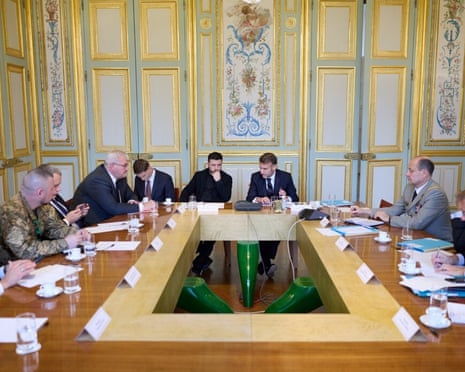
Spiegel said it had obtained an English note summarising the call, featuring what it claims are direct quotes from some of the participants.
The magazine claimed that Macron talked about the tense moment in the talks to be “a big danger” for Zelenskyy, with German chancellor Friedrich Merz adding that the Ukrainian leader – also on the call – needed to be “very careful.”
“They are playing games with both you and us,” Merz was reported as saying, which the magazine concluded was a reference to Steve Witkoff’s mission to Moscow.
The magazine said that other leaders also expressed their concerns, with Finland’s Alexander Stubb reportedly saying “we must not leave Ukraine and Volodymyr alone with these guys.”
Even Nato secretary general, Mark Rutte – who in public is very complimentary of Trump – reportedly said that he agreed with Alexander “that we need to protect Volodymyr.”
There is an obvious health warning here: there is no easy way of verifying this note’s authenticity, and the Guardian has not been able to immediately confirm the report.
But Der Spiegel said that it spoke with “several” participants of the call, who confirmed it took place, and two of them reportedly said the quotes were “accurately reproduced.”
A spokesperson for Zelenskyy declined to comment, as did the Merz’s office, while the Élysée Palace contested the quotes attributed to Macron.
The full German story is here, and Spiegel also separately published an English version here, saying it contained original quotes from the note in English.
Key events Show key events only Please turn on JavaScript to use this feature
Jakub Krupa
The big question – like with the other high-profile leak on Witkoff last week – will be: who produced the note and (assuming it’s genuine) how did it end up in the hands of journalists?
Macron reportedly warned European leaders against potential US betrayal on Ukraine — media report
French president Emmanuel Macron has reportedly warned European leaders that “there is a chance that the US will betray Ukraine on territory without clarity on security guarantees,” German magazine Der Spiegel reported, quoting a leaked note from a recent call between the European leaders.
Spiegel said it had obtained an English note summarising the call, featuring what it claims are direct quotes from some of the participants.
The magazine claimed that Macron talked about the tense moment in the talks to be “a big danger” for Zelenskyy, with German chancellor Friedrich Merz adding that the Ukrainian leader – also on the call – needed to be “very careful.”
“They are playing games with both you and us,” Merz was reported as saying, which the magazine concluded was a reference to Steve Witkoff’s mission to Moscow.
The magazine said that other leaders also expressed their concerns, with Finland’s Alexander Stubb reportedly saying “we must not leave Ukraine and Volodymyr alone with these guys.”
Even Nato secretary general, Mark Rutte – who in public is very complimentary of Trump – reportedly said that he agreed with Alexander “that we need to protect Volodymyr.”
There is an obvious health warning here: there is no easy way of verifying this note’s authenticity, and the Guardian has not been able to immediately confirm the report.
But Der Spiegel said that it spoke with “several” participants of the call, who confirmed it took place, and two of them reportedly said the quotes were “accurately reproduced.”
A spokesperson for Zelenskyy declined to comment, as did the Merz’s office, while the Élysée Palace contested the quotes attributed to Macron.
The full German story is here, and Spiegel also separately published an English version here, saying it contained original quotes from the note in English.
Merz cancels Norway trip to travel to Belgium for talks
But on a more serious note, we are hearing that German chancellor Friedrich Merz has postponed his planned visit to Norway scheduled for Friday and will travel to Brussels instead.
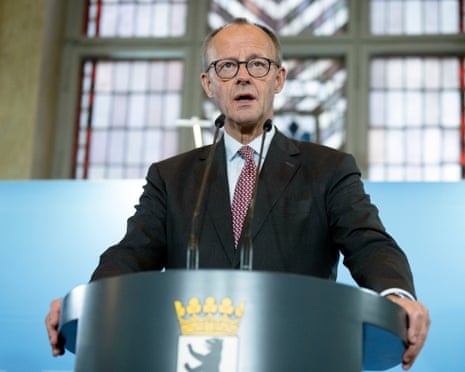
Merz will travel to Belgium for a private dinner with Belgian prime minister Bart De Wever and European Commission President Ursula von der Leyen, his spokesperson said in comments reported by Reuters.
The meeting obviously comes amid a heated debate about the use of frozen Russian assets to fund Ukraine, with Belgium continuing to express its opposition to the proposal for the so-called reparations loan (9:44), so we can safely assume this will be a prominent topic of their conversation.
German sitcom character Stromberg revived for Merz era

Philip Oltermann
European culture editor
He’s the middle-manager who talks as if he’s the CEO, a beacon of workplace inclusivity in his own head but a bigoted chauvinist as soon as he opens his mouth. And listening to him creates a mix of familiarity and embarrassment-by-proxy that turns out to be surprisingly pleasurable.
Ricky Gervais’s cringe-making general manager of a soul-destroyingly dull Slough-based paper merchant stopped being a regular presence on British TV over two decades ago, but the many comedic characters that he spawned across the globe have outlived him.
In Germany, where a feature film based on a German sitcom inspired by The Office opens in cinemas on Thursday, some are even starting to suspect that their own David Brent is now leading the country.
The mockumentary sitcom Stromberg launched on German TV in 2004, three years after the start of the British series; its makers denied it was based on the British show until the BBC threatened legal action. It ran for eight years, and the self-aggrandising wisdom of its titular character, Bernd “Let papa sort it” Stromberg, has proven inescapable on social media.
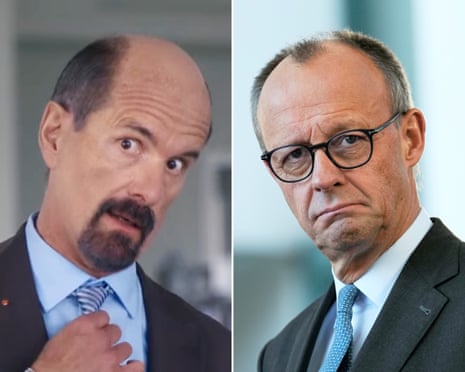
German federal elections at the start of this year gave Stromberg meme culture a new lease of life, and not just because the slender physique and partial baldness of the chancellor, Friedrich Merz, resembles that of the office authoritarian played by the comedian Christoph Maria Herbst.
“They are both boomers to the core and seem to lack any sensitivity to social cues,” said Lukas Lohmer, a German comedy writer for television. “The only difference is that Stromberg realises when he makes a faux pas and often corrects himself.”
In recent weeks, Merz elicited fremdschämen (“vicarious embarrassment”), especially among younger Germans, when proclaiming during a trip to Angola how much he missed German bread, or when he asserted upon returning from Belém, Brazil, that “everyone was delighted to be back in Germany and to have left that place”.
And since we’re on Germany, let’s go to our European culture editor Philip Oltermann, who writes about growing comparisons between chancellor Merz and… the main character of the German TV series inspired by The Office, Bernd “Let papa sort it” Stromberg.
Bundestag passes resolution on memorial to Polish WW2 victims amid Polish-German tensions on history
Jakub Krupa
Earlier this week, the issue of historical rememberence caused some tensions between Poland’s Donald Tusk and Germany’s Friedrich Merz as they met in Berlin for the annual Polish-German summit.
During a press conference after the meeting, their differences over the issue of reparation or compensation for the Nazi German crimes during the second world war were laid bare (as covered in detail on Europe Live), with increasingly impatient Tusk urging Berlin to “hurry up” with a decision to support some 50,000 living Polish victims of the war.
Yesterday, the German parliament, Bundestag, passed a resolution calling for the works on the memorial site dedicated to the Polish victims of the war to be accelerated.
The proposal was adopted with overwhelming majority as both government parties and most opposition forces voted in favour, except for the far-right Alternative für Deutschland which either abstained or even voted against in some individual cases.
This could become significant at some point further down the line as the AfD leads – and widens its lead – in the German polls, with a 3pp lead over the ruling CDU/CSU party of Friedrich Merz, according to the latest Ipsos poll.
Macron's China visit 'balancing act' between competing interests — snap analysis

Lisa O’Carroll
Emmanuel Macron’s visit to Beijing is a three day balancing act between national and European interests and between engagement with Chinese business and safeguarding its economy.
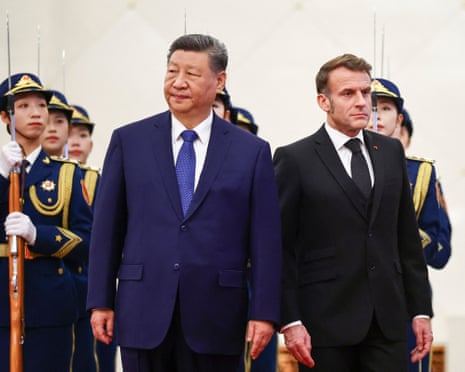
China has never condemned Russia for its 2022 invasion of Ukraine and it is unlikely this will happen now. But French diplomats have said that Macron would be urging Beijing to “convince and influence Russia to move toward a ceasefire as soon as possible”.
“Now, more than ever, dialogue between China and France is vital,” Macron told his host during their Thursday meeting at Beijing’s Great Hall of the People. “I propose a positive threefold agenda for our relations, one of geopolitical stability, of economic rebalancing, and of environmental sustainability.”
On the economic side, France like Germany and the EU as a whole, is in deficit with China, selling less (€30bn) to the country than the €66bn imports. Nuclear reactors and machinery, where both countries are global leaders, is France’s second biggest export category.
But a hoped for deal on Airbus orders is unlikely to materialise during this visit amid escalating tensions with Europe as a whole, which has a centralised policy on trade with negotiations conducted through Brussels. A probe into cognac exports remains resolved.
Macron has recently called for the EU to reduce its dependence on China warning the bloc does not want to be a “vassal” to US and Chinese tech companies.
Yesterday Brussels launched a €3bn fund to reduce dependency on China warning it would force EU industries to do so through legislation, if they did not do so voluntarily.
Jakub Krupa
Let’s go to Lisa O’Carroll for a bit more context on Macron’s visit to China (10:03).
Half of Europeans see Trump as enemy of Europe, survey finds

Jon Henley
Nearly half of Europeans see Donald Trump as “an enemy of Europe”, rather more rate the risk of war with Russia as high and more than two-thirds believe their country would not be able to defend itself in the event of such a war, a survey has found.
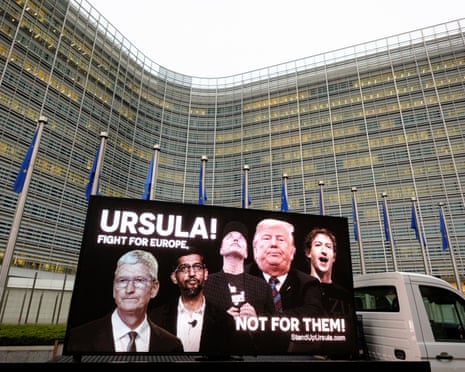
The nine-country poll for the Paris-based European affairs debate platform Le Grand Continent also found that nearly three-quarters of respondents wanted their country to stay in the EU, with almost as many saying leaving the union had harmed the UK.
Jean-Yves Dormagen, a political science professor and founder of the polling agency Cluster17, said: “Europe is not only facing growing risks, it is also undergoing a transformation of its historical, geopolitical and political environment. The overall picture [of the survey] portrays a Europe that is anxious, that is deeply aware of its vulnerabilities and that is struggling to project itself positively into the future.”
The polling found that an average of 48% of people across the nine countries see Trump as an outright foe – ranging from highs of 62% in Belgium and 57% in France to lows of 37% in Croatia and 19% in Poland.
“Across the continent, Trumpism is clearly considered a hostile force,” Dormagen said, adding that this perception was hardening, with fewer people than in December 2024 describing Trump as “neither friend nor foe” and more as definitely hostile.
However, Europeans still view the relationship with the US as strategically important: when asked what position the EU should adopt towards the US government, the most popular option (48%) was compromise.
The survey in France, Italy, Spain, Germany, Poland, Portugal, Croatia, Belgium and the Netherlands also found a relative majority (51%) felt the risk of open war with Russia in the coming years was high, and 18% considered it very high.
Norway signs defence deal with UK to 'hunt Russian submarines' and protect undersea infrastructure
I will also keep an eye on the visit of the Norwegian prime minister, Jonas Gahr Støre, to London, to sign a major defence deal between Norway and the UK “to hunt Russian submarines” and protect critical undersea infrastructure.
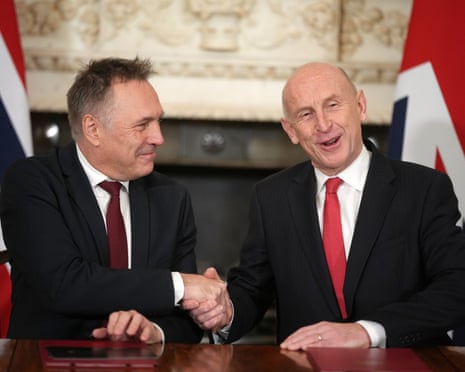
Norway’s defence minister Tore O. Sandvik met with the UK’s defence secretary John Healey earlier today to sign the deal, and Støre has just been welcomed by UK’s Keir Starmer outside the iconic black doors to 10 Downing Street.
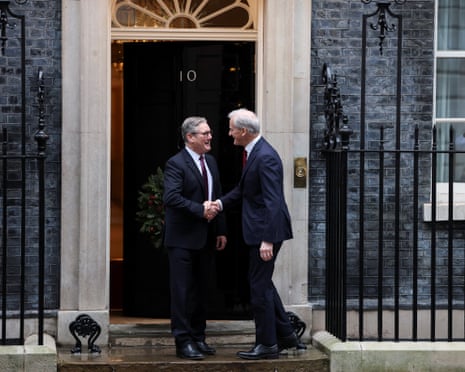
Here’s the UK press release with all details, and here’s the Norwegian side of the story, which also helpfully explains the fascinating history behind the deal’s name, Lunna House, comemmorating a clandestine operation to transfer men and materials between Shetland and Nazi-occupied Norway during the second world war.
France's Macron sees China's Xi to discuss Ukraine, geopolitics, economy
Meanwhile, as we were sleeping, France’s Emmanuel Macron has met with China’s Xi Jinping, urging him to “work together” on ending the war in Ukraine and broader geopolitical and economic issues.
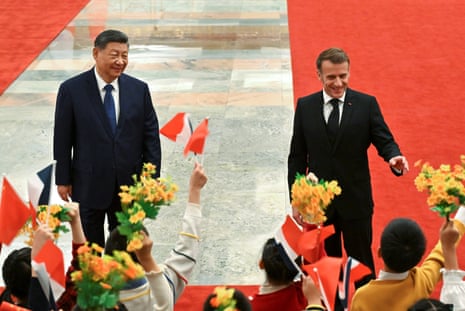
“Now, more than ever, dialogue between China and France is vital,” Macron told his host during their Thursday meeting at Beijing’s Great Hall of the People, Reuters reported.
“I propose a positive threefold agenda for our relations, one of geopolitical stability, of economic rebalancing, and of environmental sustainability,” he said.
Reuters noted that the French president seeks to bolster his foreign policy credentials and secure commercial deals for French industry in a bid to revitalise his political legacy in the final years of his term after a tumultuous summer, and ahead of the 2027 presidential election.
China, for its part, wants to ease trade frictions with the 27-strong EU over its heavily subsidised electric vehicle industry, while presenting itself as a reliable trading partner and an alternative market to the US as global economies face recession risks resulting from President Donald Trump’s tariffs.
Morning opening: So, what's next?
Jakub Krupa
Russian president Vladimir Putin has described this week’s Ukraine peace talks as “necessary,” “useful,” and “difficult work,” stressing that some of the proposals were unacceptable to Moscow.
He also continued his attacks on Europeans, saying they should get involved to help a deal, rather than hinder it. (Erm.)
But US president Donald Trump insisted that Putin would like to agree a deal, describing the talks as “reasonably good.”
What comes next, however, is not clear.
Meanwhile, the European Union is consumed by a debate on the use of frozen Russian assets, with Belgium only doubling down on its opposition to the European Commission’s proposals, which its prime minister Bart de Wever insisted was totally reasonable.
Let’s just say that not everyone agrees, as much as some of them are sympathethic with some of Belgium’s concerns.
In a comment piece for Frankfurter Allgemeine Zeitung, German chancellor Friedrich Merz warned fellow leaders that the decisions they are going to make now will “decide the future of Europe,” as he talked about the growing threat from “imperialist Russia.”
The EU leaders are still hoping to make a decision at the summit later this month, which gives them 14 days to come up with some sort of acceptable consensus.
I will bring you all the key updates throughout the day.
It’s Thursday, 4 December 2025, it’s Jakub Krupa here, and this is Europe Live.
Good morning.