.png) 2 months ago
62
2 months ago
62
Last week the world’s best marathon runner, Sabastian Sawe, looked me straight in the eye and told me “doping is a cancer”. Then he insisted he was clean. You hear such oaths and affirmations all the time. But, uniquely, Sawe recently backed up those words by asking the Athletics Integrity Unit to test him as much as possible.
You see, Sawe believed he could break the world record in Berlin in September. And he also understood that Kenya’s abysmal doping record meant that success would be met with more raised eyebrows than a plastic surgeon’s clinic in Hollywood. So the call went into the AIU. Test me. Repeatedly. Throw everything at it. My sponsors, Adidas, will pick up the bill.
“The main reason was to show that I am clean, and I am doing it the right way,” Sawe, who won the London Marathon in April, told me. “As Kenyans we have been challenged because of doping cases. So before the Berlin Marathon I was tested 25 times, blood and urine, around two or three times a week. And one day I was even tested twice – first thing in the morning and late at night.”
In the end, hot weather put paid to Sawe’s dreams of a world record. But his approach to the AIU tells you something about Kenya and doping. It is now so routine that when Sheila Chelangat, who ran in the Tokyo Olympics, was banned for six years for taking EPO last week, it barely made a ripple.
How bad is the problem? Well, since the AIU was set up in 2017 it has sanctioned 427 elite athletes for doping offences. And, staggeringly, 145 of them – more than a third – have been Kenyans. The next on the list? Russia with 75. Then Ethiopia and India with 20 each. Little wonder, then, that the calls for Kenya to be banned have grown in intensity. You see it on athletics threads, and hear it in the frustrations of coaches doing things the right way. If Russia, why not Kenya?
The anger is understandable. But Russia and Kenya are not the same. Partly because there is no evidence of state-sponsored doping coming from Nairobi. But also because the experts believe that Kenya is finally getting its act together. “There’s no doubt there’s a really serious doping problem in Kenya,” the AIU’s chief executive, Brett Clothier, says. “That’s just beyond question now.” But, he stresses, things are much better than six or seven years ago, when it was almost open season.
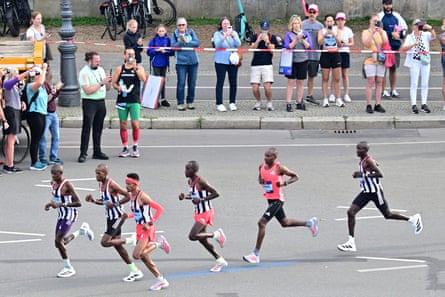
“The one thing I will say about the testing system in Kenya, it’s the best in the world. Within an hour of getting intelligence, the AIU team can have a test executed anywhere in the country. We can’t say that about anywhere else.”
Clothier also stresses that elite road runners, a large number of whom are Kenyans, are tested far more than track athletes. As he points out, for most disciplines the AIU focuses on the world’s top 10 when it comes to out-of-competition testing. In other words, those likely to win medals. That’s because testing and gathering intelligence is so expensive, the AIU has to leave it to national anti-doping bodies to test those lower down the rankings.
However when it comes to road running, there is a lot more money sloshing around as the major races, athletes, and sponsors such as Nike, Adidas and Asics have put in $3m a year since 2019 to fund extra testing for hundreds of athletes.
It also helps that the Kenyan government now gives the AIU $5m (£3.75m) a year as well. As Clothier points out, Kenyan GDP per capita is about $2,000. So the equivalent would be the UK government putting in £75m a year to tackle doping.
“We are going to continue to have a high number of cases in Kenya because we’re doing way more testing,” Clothier admits. “But I’m certain that there’s less doping now than five years ago, because there’s much more control of the situation – as well as consequences for people who are doping.”
He contrasts the situation with the AIU’s early days. “Back in 2018, the overwhelming majority of their podium finishers of elite marathons were not being tested out of competition at all in the lead-up to races,” he says. “It was a complete recipe for disaster.”
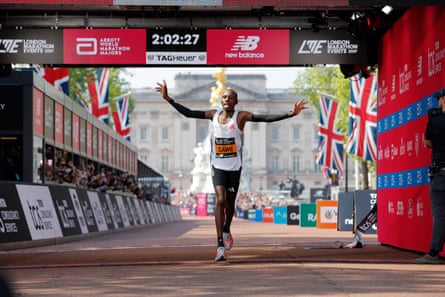
The AIU is widely seen as the best anti-doping unit in sport. But despite its best efforts, athletes do escape detection. Ruth Chepngetich, who shattered the women’s marathon world record last year, was tested 14 times in 2024 without yielding a positive test. It was only in March 2025 that she was finally caught.
And while days when athletes would mainline EPO with impunity are gone, they can still microdose substances that can be out of their body within hours. It means that unless there is hard intelligence, or testing late at night and then early in the morning, they can still escape detection.
So why is there reason for hope when it comes to Sawe’s approach to the AIU? As Clothier explains, he was not only tested 25 times in a few weeks, but his samples were also scrutinised with top-end analysis, including isotope ratio mass spectrometry testing, which is much better at detecting tiny levels of banned drugs.
“It was really very comprehensive,” Clothier says. “We don’t didn’t do just standard blood and urine tests, but for every test we did a high amount of special analysis. Normally we can’t do this because of budget constraints.
“None of this was initiated by us. It came from his sponsor, his agent and Sawe himself – I’m told he was the driver behind all this. I think it’s a really potentially powerful and important moment for the sport.”
The caveat is that this was for a limited time period. However the AIU says it is discussing with Sawe’s management about how to continue this enhanced program but in a more sustainable way.
Meanwhile Sawe’s agent, Eric Lilot, says he will soon require his athletes who train at the 2 Running Club in Kapsabet to sign a contract that will require them to give up any money still owed to them if it is shown they intentionally tried to dope – which will be passed on to anti-doping authorities. And what if an athlete doesn’t sign the document? “Then we will kick them out of the group,” Lilot says.
None of this means we can be absolutely sure that Sawe is clean, of course. However he deserves great credit for realising that in a time of heightened scepticism, extraordinary performances require extraordinary proof.